
5 Types Of Stainless Steel
Okay, so picture this: I'm rummaging through my grandma's kitchen, you know, the one that smells faintly of lemon polish and baked cookies, and I stumble upon this old saucepan. It's seen better days, a little scuffed, maybe a bit dented, but you know what? It's still a perfectly good saucepan. No rust, no weird discoloration, just… solid. And it got me thinking, why is some metal just built to last, while other stuff… well, let’s just say it’s seen better days very quickly.
It turns out, a lot of that kitchen magic, and indeed a lot of the stuff we rely on every single day, owes its longevity to a humble hero: stainless steel. You’ve seen it everywhere, haven't you? From your cutlery to your car parts, your fancy water bottles to, yes, Grandma’s trusty saucepan. But here’s the kicker: not all stainless steel is created equal. It’s like a secret society of metals, each with its own personality and purpose. And frankly, I find it all pretty fascinating.
So, grab a cuppa, settle in, and let's dive into the surprisingly diverse world of stainless steel. We’re not going to get bogged down in super-technical jargon, promise! We’re just going to get a good feel for what makes these guys tick. Think of this as your friendly, no-pressure guide to understanding why that spoon you’re holding isn't just… a spoon.
The Secret Ingredient: Chromium!
Before we start naming names (or rather, numbers and letters), it's worth knowing the real MVP of stainless steel. It’s not actually steel in the traditional sense, which is an alloy of iron and carbon. Stainless steel is that, plus a crucial addition: chromium. We're talking at least 10.5% chromium by volume. And what does this magical element do?
Well, when chromium meets oxygen, it forms this super-thin, invisible layer called the passive layer. This layer is like a superhero shield, protecting the underlying steel from rust and corrosion. It's pretty clever, really. Even if the surface gets scratched, the chromium in the surrounding metal can reform the shield. It's like the metal has its own built-in repair system!
Without chromium, that lovely iron would be just like… well, regular iron. Prone to flaking, rusting, and generally making a mess of things. So, next time you see something shiny and rust-free, give a little nod to Mr. Chromium. He deserves it.
Let's Meet the Family: The 5 Main Players
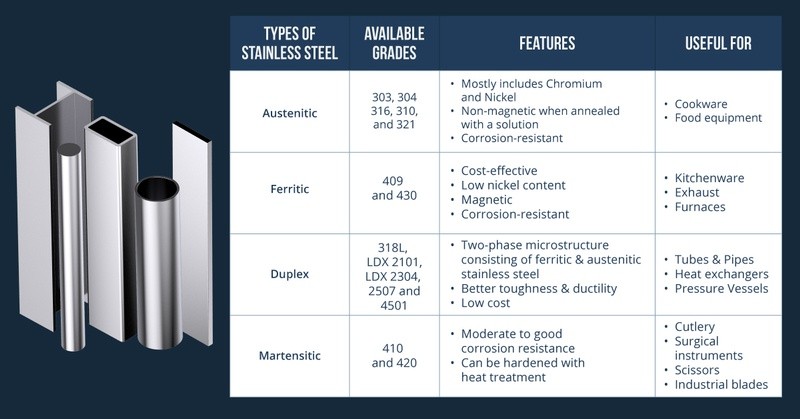
Now that we know the secret sauce, let's explore the different types of stainless steel. They’re generally categorized into five main families, based on their microstructure. Don't worry, we’re not doing a deep dive into crystal lattices here, just the practical stuff. These families have different properties, making them suitable for different jobs. It’s like choosing the right tool for the right task, but with metal!
1. Austenitic Stainless Steels: The All-Rounders
These are the most common types of stainless steel you’ll encounter. Think of them as the friendly neighborhood superheroes. They’re versatile, corrosion-resistant, and easy to work with. The ‘austenitic’ part refers to their crystal structure, which is pretty stable and gives them their awesome properties.

The most famous members of this club are 304 and 316. You’ve almost certainly used them without even realizing it. 304 is your everyday hero. It’s in your kitchen sink, your cutlery, your appliances, and probably that water bottle you’re currently sipping from. It’s got good corrosion resistance, is non-magnetic, and can handle a wide range of temperatures.
Then there’s 316, the slightly more sophisticated sibling. It’s essentially 304 with a little bit of molybdenum added. And why do we care about molybdenum? Because it gives 316 even better corrosion resistance, especially against chlorides (like salt). This is why you’ll find 316 used in more demanding environments, like marine applications (think boat parts!), medical implants (super important!), and chemical processing equipment. If it’s going to be exposed to salty air or harsh chemicals, chances are it’s 316.
The neat thing about austenitic steels is that they’re non-magnetic. This is a handy little trick. If you stick a magnet to something and it doesn’t stick, there's a good chance it's an austenitic stainless steel. Very handy for those DIY projects where you’re trying to identify that mystery metal piece!
2. Ferritic Stainless Steels: The Cost-Effective Protectors
Moving on, we have the ferritic family. These guys are also iron-based alloys, but they have a different crystal structure (hence ‘ferritic’). The key difference from austenitic is that they generally contain less nickel and are therefore more cost-effective. They’re still pretty darn good at resisting corrosion, though maybe not quite as spectacular as their austenitic cousins in all situations.
You’ll often find ferritic stainless steels in applications where cost is a significant factor, but you still need decent corrosion resistance. Think of things like automotive exhaust systems (they get pretty hot and need to resist rust), kitchen appliances (especially the outer casings), and decorative trim. They're also magnetic, which is another distinguishing feature.
While they’re not as strong as some other types without heat treatment, they offer a good balance of properties for many everyday uses. They’re like the reliable workhorses of the stainless steel world. Not flashy, but they get the job done, and they don’t break the bank.
3. Martensitic Stainless Steels: The Tough Guys
Now, things get a bit more interesting with the martensitic family. These steels are all about strength and hardness. They can be heat-treated to achieve very high levels of hardness, which makes them ideal for applications where wear resistance and the ability to hold a sharp edge are crucial.
The classic example? Knives. Yes, the knives in your kitchen drawer that are supposed to stay sharp are likely made from martensitic stainless steel. Think of those high-end chef's knives. They’re tough, can be honed to a razor’s edge, and still resist rust reasonably well. Other uses include surgical instruments, turbine blades, and high-strength bolts.
The trade-off for this impressive hardness is that martensitic steels generally have lower corrosion resistance compared to austenitic steels. They also tend to be more brittle. So, you wouldn't want to use them for a boiling pot that's going to be constantly banged around. They’re for precision and durability in specific, often demanding, scenarios.
4. Duplex Stainless Steels: The Hybrid Powerhouses
Alright, buckle up, because duplex stainless steels are where things get a bit… complex. As the name suggests, they have a mixed microstructure, meaning they contain both austenitic and ferritic phases. This blend gives them some of the best properties of both worlds!
Duplex steels are known for their high strength (often twice that of standard austenitic steels) and excellent corrosion resistance, particularly against stress corrosion cracking. This is a fancy term for a type of corrosion that happens when metal is under stress in a corrosive environment. Duplex steels are much less susceptible to this.

Because of their strength and corrosion resistance, you’ll find duplex steels in some pretty heavy-duty applications. Think offshore oil and gas platforms, chemical tankers, pulp and paper processing equipment, and desalination plants. They’re built to withstand serious pressure and harsh conditions. They are also magnetic, which is a clue to their mixed structure.
The downside? They are typically more expensive than standard austenitic or ferritic steels, and can be a bit trickier to fabricate due to their higher strength. But for those extreme environments where failure is not an option, they are often the go-to choice. They’re the overachievers of the stainless steel world!
5. Precipitation Hardening (PH) Stainless Steels: The Specialized Strength Boosters
Last but not least, we have the precipitation hardening, or PH, stainless steels. These guys are a bit more specialized. They get their name from a special heat treatment process called age hardening or precipitation hardening. This process allows them to achieve very high strength levels while still maintaining good corrosion resistance.
Think of it like this: you have a base stainless steel that has decent properties, and then you subject it to a specific heat treatment that causes tiny, hard particles to precipitate out within the metal’s structure. This makes the steel incredibly strong. Different PH grades (like 17-4 PH, which is a very popular one) achieve this strength through different compositions and heat treatments.
Where do you find these specialized powerhouses? In aerospace components (they need to be light and strong!), high-performance shafts, and other critical engineering applications where a combination of high strength and good corrosion resistance is absolutely essential. They are often magnetic and can be quite expensive due to the complex manufacturing and heat treatment involved.

They’re like the finely tuned athletes of the metal world – built for peak performance in very specific disciplines. Not for everyday use, but absolutely vital for certain high-stakes jobs.
So, Why Should You Care?
You might be thinking, "Okay, that’s all well and good, but why does this matter to me?" Well, the next time you're buying something made of metal, a little bit of this knowledge can go a long way. You'll start noticing the subtle differences. That cheap set of cutlery might be made of a more basic, less corrosion-resistant steel, meaning it might pit or discolor over time.
That expensive outdoor grill? It's probably made of a higher grade of austenitic (like 316) or even a duplex steel for ultimate durability against the elements. Your car's exhaust system? Likely a ferritic type, balancing cost and corrosion resistance for that tough job. And that trusty chef's knife? Pure martensitic magic!
Understanding these types helps you appreciate the engineering that goes into the objects we use every day. It’s not just random metal; it’s carefully selected and engineered to perform a specific function. It’s about choosing the right tool for the job, whether that job is cooking a gourmet meal or building a skyscraper.
And hey, the next time you’re admiring Grandma’s rust-free saucepan, you can give a knowing nod. She probably knew what she was talking about when she chose that thing, even if she didn't know the official grade. It was just… good stuff. And often, that ‘good stuff’ is a well-chosen type of stainless steel, doing its quiet, shiny, and wonderfully corrosion-resistant job.
So, there you have it. A little peek into the fascinating world of stainless steel. It’s a material that’s often overlooked but incredibly important. And now, you're a little bit more in the know. Pretty cool, right?