
Alkali Metals Vs Alkaline Earth Metals
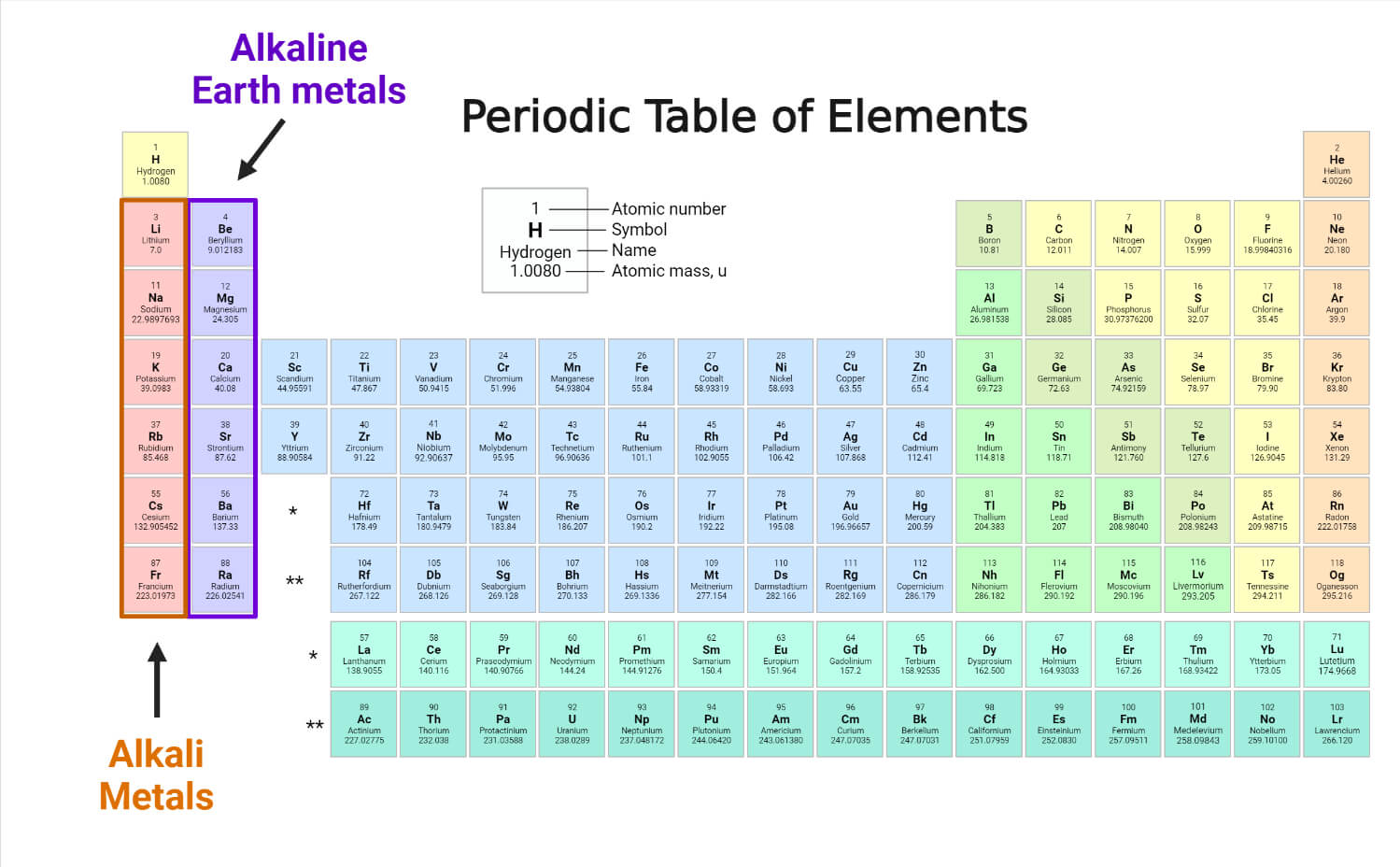
Ever find yourself staring at the periodic table, maybe during a particularly inspired moment of studying, or perhaps while waiting for your latte to brew, and wondering… what’s the deal with these columns? They seem so orderly, so… science-y. And among the most approachable-looking of these groupings are the Alkali Metals and the Alkaline Earth Metals. They sound kind of similar, right? Like they’re just trying to make things less acidic, a friendly pair in the grand chemical fam. But peel back the surface, and you’ll find they’re more like cousins than twins, each with their own distinct vibe and a surprising role in our everyday lives.
Let's dive in, shall we? Think of it as a chill exploration, no pop quizzes here. We're not talking about dissecting frogs or memorizing complex equations. We're just curious about these elements that, while not exactly in our kitchen drawers, are silently influencing everything from our morning cereal to the glow of our smartphones. Ready to get a little elemental?
The Alkali Metals: The Life of the Party (Just Don't Get Too Close!)
First up, the Alkali Metals. These guys are in Group 1 of the periodic table. We’re talking Lithium (Li), Sodium (Na), Potassium (K), Rubidium (Rb), Cesium (Cs), and Francium (Fr). And let me tell you, these metals have a reputation. They are famously… well, let’s just say they're energetic. Like that one friend who’s always up for anything, maybe a little too up for anything.
The key characteristic of Alkali Metals is their single, lone electron in their outermost shell. This makes them incredibly eager to share – or, more accurately, to give away – that electron to achieve a stable electron configuration. This eagerness translates into being incredibly reactive. Seriously. Like, "don't even think about leaving me out in the rain" reactive.
Take Sodium (Na), for example. You know it as the salt (sodium chloride, NaCl) that seasons your fries. Essential for life, right? But pure, elemental sodium? Not something you want to mess with. It reacts so violently with water that it can cause explosions. Imagine dropping a tiny piece of metal into your water glass and boom! So, while your table salt is perfectly friendly, the pure element is a bit of a wild child.
Lithium (Li), another star player, is the go-to for rechargeable batteries. Your phone, your laptop, your electric car – they’re all likely powered by this light, silvery metal. It’s like the unsung hero of our digital age, quietly fueling our connected lives. Who knew something so reactive could be so crucial for our Netflix binges?
Potassium (K) is another one we can’t live without. It’s vital for nerve function and muscle contractions. So, the next time you’re enjoying a banana (a great source of potassium!), give a little nod to our friend Potassium for keeping your body in sync.

Fun Facts and Everyday Encounters with Alkalis:
Did you know that Cesium (Cs) is so reactive that it’s used to calibrate atomic clocks? These incredibly precise clocks are essential for things like GPS navigation. So, your ability to find your way to that new brunch spot? Thank Cesium!
Rubidium (Rb) has applications in fireworks, giving them a beautiful violet hue. Imagine a dazzling display, and there’s a hint of Rubidium adding to the magic. It's like the metal backstage, making the show happen.
Practical tip: When you see warning labels about certain chemicals, remember that the extreme reactivity of Alkali Metals is often what makes them hazardous in their pure form. It’s all about context! Your salt shaker is fine, but a lab experiment with elemental sodium requires serious caution.
The vibe of Alkali Metals? They’re the ✨high-energy, can't-be-contained✨ types. They want to bond, they want to react, they want to make a splash. Just remember to admire them from a safe distance, especially in their pure, elemental glory.

The Alkaline Earth Metals: The Steady, Reliable Crew
Now, let’s meet the Alkaline Earth Metals. These are Group 2 on the periodic table: Beryllium (Be), Magnesium (Mg), Calcium (Ca), Strontium (Sr), Barium (Ba), and Radium (Ra). They share a name with the Alkalis because, when found in their oxide forms, they tend to create alkaline solutions in water. But don't let the similar name fool you; they're a bit more… mellow. Think of them as the reliable, good-natured friends. They're happy to participate, but they’re not going to cause a scene.
Alkaline Earth Metals have two electrons in their outermost shell. This means they're also eager to react, but not quite as intensely as their Group 1 cousins. They'll give away those two electrons, but they're a bit more particular about who they give them to. This makes them less volatile, more manageable, and frankly, more useful in a wider range of everyday applications without requiring hazmat suits.
Calcium (Ca) is perhaps the most famous member of this group. We all know it’s essential for strong bones and teeth. You drink milk for calcium, eat leafy greens, and your body thanks you by keeping you standing tall. It's the ultimate builder, the foundation of our skeletal system.
Magnesium (Mg) is another superstar. It's crucial for countless biochemical reactions in your body, including energy production and muscle function. You might even take magnesium supplements for muscle cramps or to help you relax. It’s like the body’s internal mechanic, keeping everything running smoothly.
Strontium (Sr) might sound a bit exotic, but it’s actually used in things like fireworks to produce a brilliant red color, similar to how Rubidium adds purple. It's also found in some toothpastes to help with tooth sensitivity. So, that sensitivity toothpaste is doing more than just making your teeth feel better; it's harnessing the power of an Alkaline Earth Metal!

Barium (Ba), in a more controlled setting, is used in medical imaging, specifically for X-rays of the digestive system. It coats the organs, making them visible on the X-ray, allowing doctors to diagnose issues. It's a tool that helps us see what's going on inside, a quiet, behind-the-scenes player in healthcare.
Fun Facts and Everyday Encounters with Alkaline Earths:
Beryllium (Be), while also used in alloys for its strength and lightness (think aerospace components!), is highly toxic in its pure, powdered form. So, even this "steadier" group has its cautionary tales, reminding us that nature is complex!
Magnesium plays a role in chlorophyll, the pigment that makes plants green and is essential for photosynthesis. So, the very greenness of your lawn and the food you eat owes a debt to Magnesium.
Practical tip: When you’re looking at multivitamins or dietary supplements, keep an eye out for Calcium and Magnesium. They are the workhorses of this group, readily available and incredibly beneficial for your health. They’re the elements you can confidently incorporate into your wellness routine.

The vibe of Alkaline Earth Metals? They’re the dependable, supportive types. They’re reactive enough to be useful, but stable enough to be part of our lives without causing too much drama. They build, they support, they enable. They’re the quiet backbone of many of our daily experiences.
The Subtle Dance of Reactivity: A Summary
So, what’s the big takeaway? Alkali Metals are the daredevils, the ones who are so eager to get rid of their single outer electron that they can be downright explosive with things like water. They’re the lifeblood of batteries and essential for biological functions, but you won’t find them floating around in your tap. They are bold and intense.
Alkaline Earth Metals, with their two outer electrons, are the more grounded ones. They still react, but with a bit more control. They are the builders of our bodies, the essential components of our skeletal structure, and play vital roles in everything from plant life to medical imaging. They are strong and foundational.
It's fascinating, isn't it? These seemingly simple arrangements of protons, neutrons, and electrons dictate such different behaviors. A single electron difference can be the line between a powerful battery and a volatile chemical reaction. It's a subtle dance of physics and chemistry that underpins so much of our world.
A Daily Reflection
Think about your day. You wake up, reach for your phone (powered by Lithium), maybe grab a banana (Potassium), drink some milk (Calcium), and perhaps even take a magnesium supplement. These elements, whether they're the high-octane Alkalis or the steady Alkaline Earth Metals, are woven into the fabric of your existence. They’re not just abstract concepts on a chart; they’re active participants in your well-being and your modern lifestyle. So, next time you’re scrolling through social media or enjoying a healthy meal, give a little nod to these elemental cousins. They’re working hard, in their own unique ways, to make your world go round.