
Are Most Of The Elements Metals Or Nonmetals

Ever peeked at that giant chart in a science classroom, the one with all the little boxes filled with letters and numbers? That's the Periodic Table, and it's basically a cheat sheet for the entire universe. It lists all the building blocks of everything we know. Pretty cool, right? But have you ever wondered what most of those little boxes are made of? Are they all shiny and clanky, or more like airy and floaty? Let's dive into the amazing world of elements and see if metals or nonmetals win the popularity contest.
Think about it: we’ve got stuff like gold and silver, which are super shiny and can be bent into all sorts of shapes. Those are definitely metals! They’re the flashy stars of the element world. Then you have things like iron, which is strong enough to build bridges and skyscrapers. Yep, another metal for the win! And let’s not forget copper, the stuff that makes our wires carry electricity. Metals are everywhere, doing all sorts of important jobs. They’re the workhorses, the bling, the strong guys. They’re the ones you usually think of when you hear the word "element."
But hold on! What about the other side of the elemental coin? Are there elements that are totally different?
Absolutely! Meet the nonmetals. These guys are a whole different ballgame. Instead of being shiny and conductive, they’re often dull. Instead of being bendy, they can be brittle. And instead of conducting electricity, many of them are insulators. Think about oxygen, the stuff we breathe! It's a gas, completely invisible and essential for life. You can’t exactly build a ring out of oxygen, can you? And then there's carbon. Carbon is amazing! It can form diamonds, which are super hard and sparkly, but it can also form graphite, which is soft enough to write with. How wild is that? Carbon is a nonmetal that really knows how to show off its versatility.
Let’s not forget sulfur, that yellowish stuff that smells kinda funny sometimes. Definitely not a metal. Or phosphorus, which glows in the dark! That’s just neat. And then there are the noble gases, like helium (makes balloons float!) and neon (makes signs glow!). They’re so unreactive they just sort of chill on their own. Super chill. These nonmetals are often the quiet achievers, the ones that make life possible in ways we don’t always appreciate. They might not be as flashy as metals, but they are just as vital.
So, back to our big question: are most elements metals or nonmetals? If you look at the Periodic Table, you’ll see a distinct divide. It’s like a superhero league, and the metals are definitely outnumbering the nonmetals. Imagine the table as a big grid. On the left and in the middle, you’ve got this massive block of metals. They’re the majority, the power players. They have this cool property where their electrons are loosely held, allowing them to conduct heat and electricity really well. That’s why pots and pans are made of metal, and why we use copper wires! It’s all about those mobile electrons.
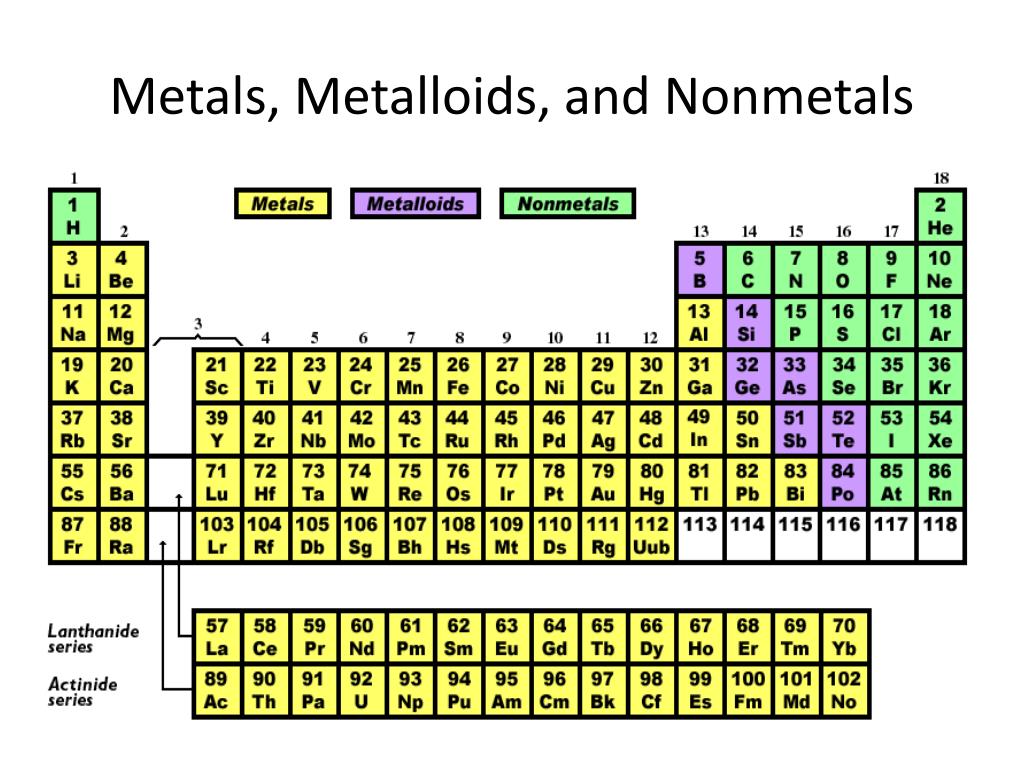
On the other side of the table, especially on the right, you find the nonmetals. They're fewer in number, but don't underestimate them! They have electrons that are held more tightly, making them generally poor conductors. Think of the air you're breathing, the water you drink (which is made of nonmetal elements hydrogen and oxygen!), and the very stuff your body is made of – carbon, nitrogen, oxygen – all nonmetals. It's like a massive team of metals, and a smaller but incredibly important squad of nonmetals.
And then, just to keep things interesting, there are some elements that are a bit of both. They’re called metalloids. They’re like the rebels, the ones who don’t fit neatly into either category. They have properties that are somewhere in between metals and nonmetals. For example, silicon is a metalloid. It's used in computer chips! It can conduct electricity, but not as well as a metal. It's like the element equivalent of being a little bit of everything. These metalloids are super important for technology, showing us that the line between "metal" and "nonmetal" isn't always so clear-cut. They’re the bridge, the diplomats of the element world.

But if we’re talking strict numbers, the metals are the clear champions. They take up a huge chunk of the Periodic Table. When you see that chart, just picture it: a vast expanse of shiny, clanky, conductive metals on one side, a smaller but vital collection of gases, solids, and liquids on the other, and a few tricky metalloids hanging out in the middle. It’s a beautiful, organized chaos. The sheer number of metals makes them the dominant force in terms of sheer quantity. It’s like a giant party, and the metals are the most numerous guests.
So, next time you look at that Periodic Table, you’ll know. Most of those little boxes are filled with metals. They’re the big players, the most abundant, the ones that give us our shiny coins, our strong tools, and our conductive wires. But don’t forget the nonmetals! They might be fewer, but they’re the breath in our lungs, the water in our oceans, and the very building blocks of life itself. Together, with the quirky metalloids, they create the amazing, diverse, and absolutely fascinating world we live in. It’s a constant reminder that even in something as seemingly simple as a list of elements, there’s a whole universe of wonder waiting to be discovered. Pretty entertaining stuff, wouldn't you agree? Makes you want to go find a Periodic Table and start pointing, doesn't it?