
Blood Draws And Tube Colors
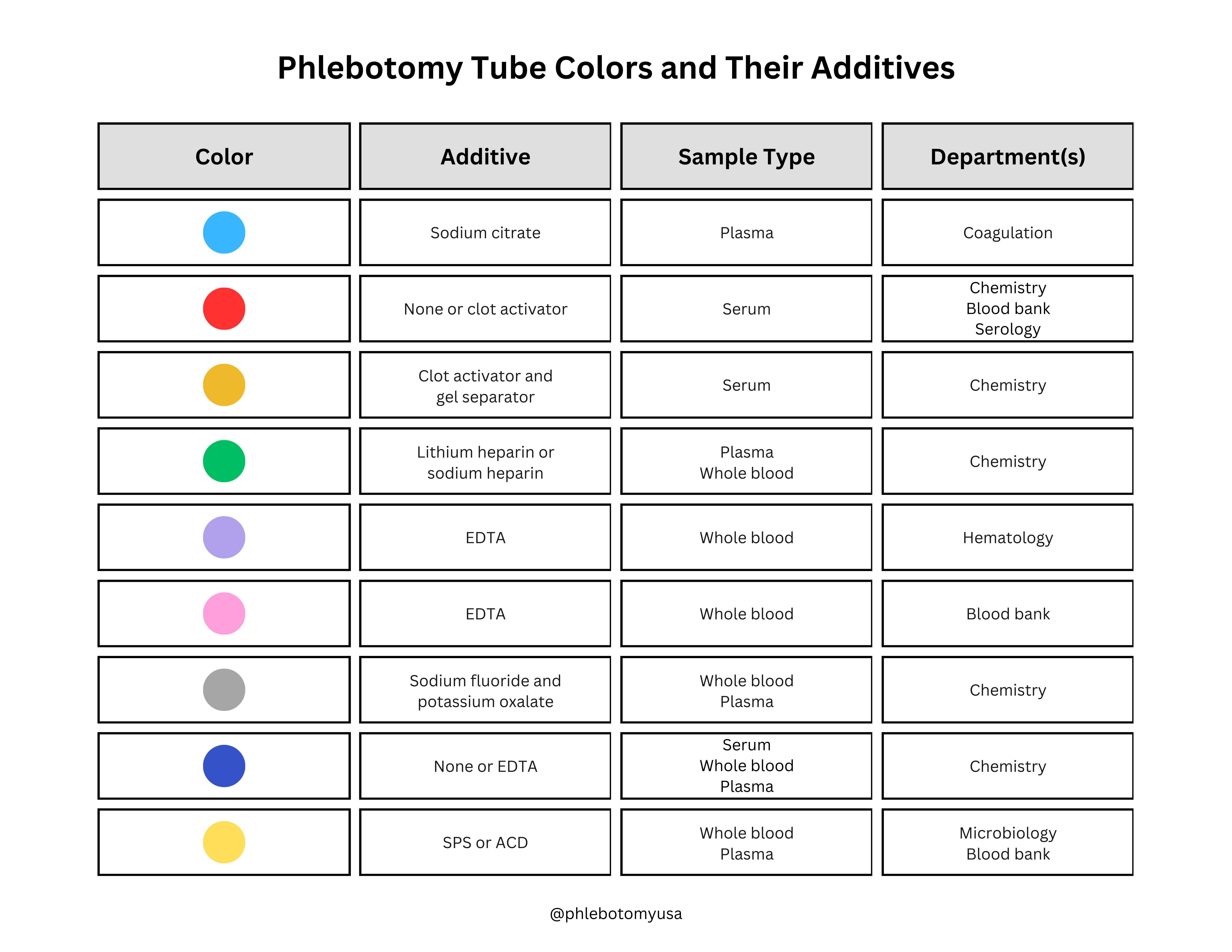
Ever found yourself staring at that colorful rack of blood tubes after a visit to the doctor or lab? It’s like a tiny rainbow of medical mystery, right? You've got the reds, the blues, the greens, the yellows… what’s the deal with all those different colors? Are they just trying to make things look pretty, or is there something more going on? As it turns out, there’s a super interesting and important reason behind each of those little vials, and it’s pretty cool when you think about it!
Think of it like this: imagine you’re a chef in a kitchen. You don’t just throw all your ingredients into one pot, do you? Nope! You’ve got specific tools and containers for different things. You’ve got your sauté pan for delicate veggies, your stockpot for hearty stews, and your measuring cups for precise amounts. Well, in the world of blood draws, those tube colors are kind of like the chef’s specialized kitchenware. Each color signifies a different purpose for the blood sample, ensuring it’s treated and tested exactly the way it needs to be.
The Science Behind the Colors
So, what’s actually in these tubes that makes them different? It’s usually a combination of two things: additives and the type of test they’re meant for. These additives are often things like anticoagulants (which prevent blood from clotting) or preservatives (which keep the blood stable). The type of test is crucial because different tests require blood to be treated in specific ways. Some tests need to look at the whole blood, while others need to separate the liquid part (plasma) from the solid part (cells).
It’s a bit like sending a package. If you’re sending something fragile, you’ll pack it carefully with bubble wrap and a sturdy box. If you’re sending documents, a simple envelope will do. The tube color is the lab’s way of saying, "This package needs special handling and a specific destination!"
Let’s Meet the Tube Family!
Alright, let’s dive into some of the most common tube colors you might encounter and what they’re all about. It's not just about aesthetics, it’s about making sure the right test gets done on the right sample.

The Classic Red: For When You Just Need the Serum
Ah, the good old red-top tube. This one is often one of the first you’ll see. You might also see some with a red and yellow swirl, sometimes called a "tiger top." The magic here is that these tubes usually contain no additives. So, what happens when you draw blood into a tube without anything to stop it? You guessed it – it clots!
After the blood clots, it’s spun down in a centrifuge. This separates the liquid portion, called serum, from the clotted cells. Serum is super useful for a whole bunch of tests, like checking your electrolytes, blood glucose levels, and kidney function. Think of it as the clear, golden liquid you might see at the top after a good, solid jello has set – all the good stuff is in the liquid part!
The Cool Blue: The Anticoagulant Champ
Next up, we have the light blue-top tube. These are your go-to for tests that involve blood clotting factors. Inside this tube is a substance called sodium citrate. Its job is to grab onto calcium, which is a key ingredient needed for blood to clot. So, by taking away the calcium, the citrate effectively says, "Nope, no clotting here!"

Why would you want to stop the blood from clotting? Well, for tests that look at how well your blood clots (like checking for bleeding disorders or monitoring blood-thinning medications), you need the blood to stay liquid. It's like trying to bake a cake – you need all your ingredients to be in their proper form before you start mixing! This tube ensures the blood stays in a uniform, liquid state for accurate clotting studies.
The Green Team: Heparin’s Healing Powers
The green-top tube is another common sight, and it usually contains heparin. Heparin is another type of anticoagulant, but it works a bit differently than citrate. It’s sort of like a natural anticoagulant found in our bodies, and it works by speeding up a natural process that prevents clotting.
Green-top tubes are great for a wide range of tests, including many blood chemistry tests. They allow the blood to be spun down to separate the plasma (the liquid part of blood that still contains clotting factors, unlike serum) from the cells. So, if you’re getting your electrolytes, kidney function, or liver enzymes checked and the lab uses a green-top, it’s because they want that plasma for their tests! It’s like having a handy tool that lets you quickly see what’s dissolved in a liquid without it solidifying.

The Lavender/Purple Squad: For the Cellular Deep Dive
Now, let’s talk about the lavender or purple-top tube. These are super important for tests that look at your blood cells. They contain an anticoagulant called EDTA (ethylenediaminetetraacetic acid). EDTA is another “calcium-chelator,” meaning it binds to calcium, preventing clotting.
Why is this color so special? Because it preserves the cells in your blood. This is absolutely essential for tests like a complete blood count (CBC), which examines the number and characteristics of your red blood cells, white blood cells, and platelets. It's also used for things like blood typing and looking for parasites within the cells. Think of it as a time capsule for your blood cells, keeping them perfectly preserved so the lab can examine them in detail.
The Gray Gang: Sugar and More
And finally, let’s not forget the gray-top tube. These tubes are usually used for glucose (sugar) testing and sometimes for lactate testing. They typically contain a combination of an anticoagulant (like potassium oxalate) and a preservative (like sodium fluoride).

The sodium fluoride is the real star here. It acts as a glycolytic inhibitor, meaning it stops the blood cells from using up the glucose. This is crucial because if the blood cells start to eat the sugar, the glucose level in the sample would drop, leading to inaccurate results. It’s like putting your leftovers in the fridge so they don’t go bad – the fluoride keeps the glucose from disappearing!
It’s All About Accuracy!
So, as you can see, each tube color isn't just for show. It's a deliberate choice made by medical professionals to ensure the accuracy and reliability of the tests being performed. If the wrong tube were used, the results could be skewed, leading to misdiagnosis or ineffective treatment. It’s a small detail, but it’s a vital part of the whole medical process.
Next time you see those colorful tubes, you can appreciate the clever science behind them. They’re not just random colors; they’re like a secret code, each telling the lab exactly how to handle your precious blood sample so they can get you the most accurate health information possible. Pretty neat, huh?