
Calculating Weight Of Steel Bar

Ever stared at a colossal steel bar, maybe in a construction site or a particularly robust piece of modern art, and wondered, "Blimey, how much does that behemoth actually weigh?" It’s a question that pops into your head, right between "Is that really legal?" and "Could I use that to fend off a rogue squirrel invasion?" Well, fear not, fellow ponderers of ponderous metal! Today, we’re diving headfirst into the surprisingly straightforward, and dare I say, exciting world of calculating the weight of a steel bar. Forget complicated calculus or secret handshake rituals. This is more like baking a cake, if the cake was made of iron and could withstand a small meteor shower.
First off, let’s set the scene. Imagine you’re a medieval blacksmith, or perhaps a modern-day sculptor with a penchant for brute strength. You’ve got this magnificent rod of steel, gleaming under the workshop lights. You don’t want to be hefting it around unnecessarily, or worse, underestimating its heft. That’s how you end up with a pulled something-or-other that rhymes with "back." We need precision, people! We need the magic number!
The Secret Ingredient: Density!
So, what’s the big secret? It’s not a hidden code, nor is it the number of angels dancing on its tip. It's something called density. Think of density as how much stuff is packed into a given space. Some things are super dense, like a black hole disguised as a pebble. Others are as light as a feather that’s been dieting. Steel, it turns out, is pretty darn dense. It’s like the bodybuilder of metals, compact and powerful.
For most common steels, the density is roughly 7,850 kilograms per cubic meter (kg/m³). That’s a mouthful, I know. You can also think of it as about 0.283 pounds per cubic inch (lbs/in³) if you’re more of a feet-and-inches kind of person. This number is your golden ticket, your Rosetta Stone, your… well, you get the idea. It's the key to unlocking the steel bar's gravitational embrace.
The Simple Formula (No, Really!)
Now, let’s get to the nitty-gritty. The formula is so simple, you’ll wonder why you never thought of it before. It’s basically:
Weight = Volume x Density
There, I said it. No complex equations, no cryptic symbols. Just two things you need to know to get your answer. If you can measure something and you know the density, you’re golden. It’s like knowing the ingredients and the oven temperature for your cake. Except, you know, steel cake.

Measuring Your Magnificent Metal
This is where you become the intrepid explorer of dimensions. You need to know the volume of your steel bar. And how do we do that? Well, it depends on the shape of your bar, doesn’t it? Is it a simple, elegant cylinder? Or is it something more… architectural?
For Those Roundabouts: The Cylindrical Steel Bar
Most steel bars you encounter will be nice and round, like a metal sausage. To find the volume of a cylinder, we need two things: its radius (half the width) and its length. You can measure the diameter (the full width) with a tape measure or, if you’re feeling fancy, a caliper. Then, just divide that by two to get your radius. And for the length, well, that’s usually pretty obvious. Unless you have a very, very long bar and a short tape measure, in which case, you might need to get creative. Maybe enlist a few friends, or borrow a giant’s ruler.
The formula for the volume of a cylinder is:
Volume = π x radius² x length

Where ‘π’ (pi) is that famous number that starts with 3.14 and keeps going for approximately infinity. For our purposes, 3.14159 is usually more than enough. So, you’ll square your radius (multiply it by itself), multiply that by π, and then multiply that by the length. Voila! You’ve got your volume in cubic meters (if you measured in meters) or cubic inches (if you measured in inches).
For Those Straight Shooters: The Square or Rectangular Steel Bar
Sometimes, steel comes in more angular forms, like a metal brick. For these straightforward shapes, it’s even simpler. You just need the width, the height, and the length.
The formula for the volume of a rectangular prism is:
Volume = width x height x length
See? Told you it was easy. Just multiply those three dimensions together. Again, make sure your units are consistent. Don't measure the width in millimeters and the length in miles, unless you're aiming for a truly absurd weight calculation.
Putting It All Together: The Grand Finale!
Okay, deep breaths. You’ve got your density (7,850 kg/m³ or 0.283 lbs/in³). You’ve calculated your volume. Now, for the moment of truth!
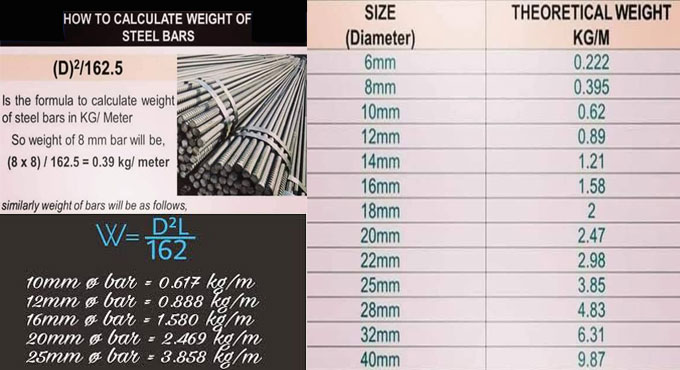
Let’s say you have a round steel bar with a diameter of 2 cm (which is 0.02 meters) and a length of 1 meter.
First, find the radius: 0.02 m / 2 = 0.01 m.
Next, calculate the volume: π x (0.01 m)² x 1 m = 3.14159 x 0.0001 m² x 1 m = 0.000314159 m³.
Now, the grand finale: multiply the volume by the density!
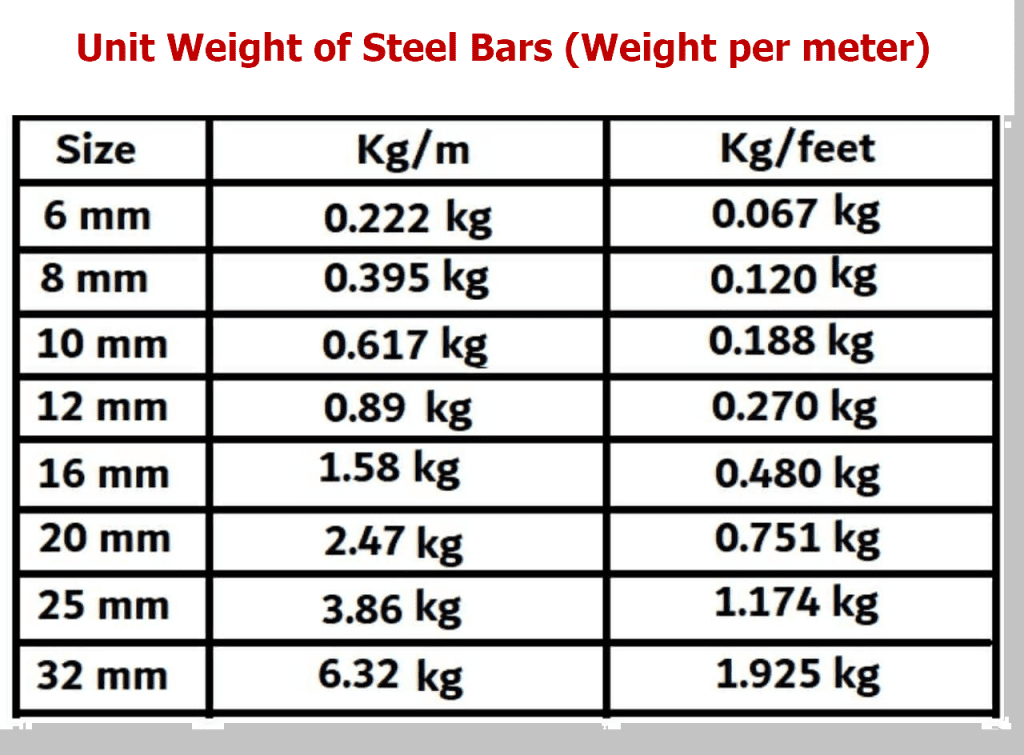
Weight = 0.000314159 m³ x 7,850 kg/m³ ≈ 2.47 kilograms.
There you have it! Your steel bar weighs approximately 2.47 kilograms. That’s about the weight of a large bag of sugar, or a particularly chunky house cat. Not bad for a piece of metal that could probably stop a runaway shopping cart.
A Surprising Fact to Blow Your Mind
Did you know that the Empire State Building used about 60,000 tons of steel? That’s roughly 54 million kilograms! Imagine calculating the weight of that bar by bar. You’d need a whole team of caffeine-fueled mathematicians and a very, very long tape measure. It makes our 2.47 kg feel like a feather in comparison, doesn’t it?
So, the next time you see a hefty piece of steel, don’t just gawk. Grab your tape measure (or your imagination, if you’re at a particularly abstract art exhibition) and have a go at calculating its weight. You’ll be a steel-weighing wizard in no time, impressing your friends, baffling your enemies, and possibly even winning bets at the pub. Just remember the golden rule: Volume times Density equals Weight. It’s the simple truth that holds up our world, one steel bar at a time.