
Chemical Equation Representing The Second Ionization Energy For Lithium
Have you ever wondered what makes certain elements behave the way they do? It’s a bit like trying to understand the personalities of different people – some are more eager to share, while others hold back a bit more. In the world of chemistry, this eagerness to share, or in this case, shed, electrons is a fascinating concept, and it helps us understand a lot about how matter works. Today, we’re going to peek at the second ionization energy for lithium, and trust me, it’s more engaging than it sounds!
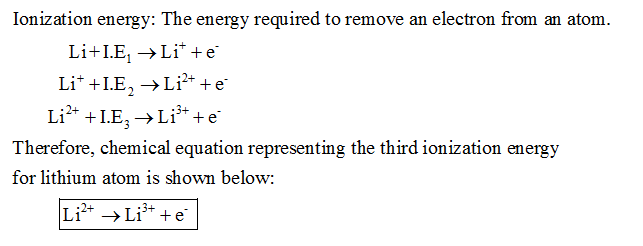
So, what exactly is ionization energy? Think of it as the energy required to remove an electron from an atom. Every atom has electrons, and these electrons are held in place by the positively charged nucleus. Removing an electron requires a little (or sometimes a lot!) of energy. The first ionization energy is the energy to remove the first electron. The second ionization energy, then, is the energy needed to remove the second electron from the atom after the first one is already gone. It’s like convincing a shy friend to tell you one secret, and then asking them to reveal another, even more personal, piece of information.
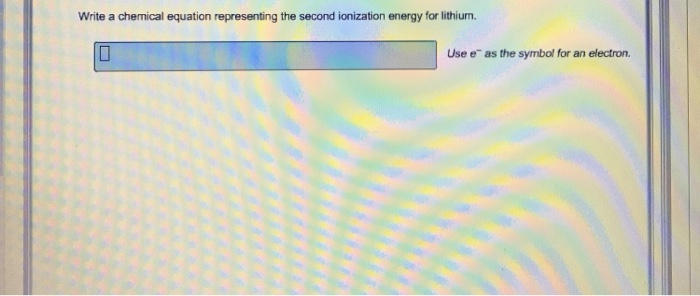
For lithium, a tiny alkali metal, this process is particularly telling. Lithium, with its atomic number 3, has three electrons. Its first ionization energy is quite low, meaning it readily gives up its outermost electron to form a stable ion. This is why lithium is so reactive. However, when we talk about the second ionization energy for lithium, we're looking at a much, much higher energy requirement. This is represented by the chemical equation:
Li+(g) + energy → Li2+(g) + e-
See that? We're starting with a lithium ion that has already lost one electron (Li+) and is now trying to remove a second electron. This second electron is much more tightly bound to the nucleus because the remaining electrons are now closer to the positive charge of the nucleus. It takes a significant amount of energy to pry that second electron away. This huge jump in ionization energy between the first and second electron removal is a hallmark of elements in the first column of the periodic table, like lithium.
Why is this useful? Understanding these energy differences helps chemists predict how elements will react. It explains why lithium compounds are so common and stable in their +1 charge state. In education, this concept is fundamental to teaching atomic structure and chemical bonding. It helps students grasp why certain elements form specific ions and how this dictates their behavior in chemical reactions. In daily life, while you might not be calculating ionization energies for your morning coffee, the principles are at play in everything from the batteries in your electronics (which often use lithium!) to the development of new materials.
Curious to explore this further? You don't need a full chemistry lab! A great starting point is to look up ionization energy trends on the periodic table. You'll see a clear pattern: ionization energy generally increases as you move across a period and decreases as you move down a group. You can also search for simple animations or diagrams that visualize electrons being removed from atoms. It’s a fun way to connect the abstract world of atoms to the tangible world around us!