
Coefficient Of Thermal Expansion For Metals

Hey there, science curious pals! Ever wondered why bridges sometimes make weird creaky noises, or why your metal fence posts might feel a little wiggly on a scorching hot day? Well, buckle up, buttercups, because we're about to dive into the super cool, surprisingly relatable world of the Coefficient of Thermal Expansion for metals. Don't let the fancy name scare you; it's basically a fancy way of saying that metals, like us, have a bit of a reaction when the temperature changes. And trust me, it's way more interesting than you might think!
So, what exactly is this "coefficient of thermal expansion" thingamajig? Imagine you have a perfectly fitted metal part, maybe a ring on a shaft. Now, what happens when you heat it up? Does it stay exactly the same size? Nope! It gets a teeny, tiny bit bigger. And what happens when you cool it down? You guessed it – it shrinks a little. This tendency for metals (and most other stuff, really) to change their size when the temperature goes up or down is called thermal expansion. The "coefficient" part? That's just a number that tells us how much it expands or shrinks for each degree of temperature change. Think of it as the metal's personal "size-changing sensitivity" rating!
Let's break it down with a little analogy. Imagine you’re at a party. Some people are super energetic and jump up and down with every little bit of excitement – they have a high "social expansion coefficient." Others are more laid-back, barely moving an inch. Metals are kinda like that. Some metals, like aluminum, are real party animals when it comes to heat; they expand quite a bit. Others, like invar (a special iron-nickel alloy), are total chillers, barely expanding at all, no matter how much you crank up the heat.
Why does this happen? It all comes down to the tiny, invisible particles that make up everything: atoms and molecules. In a solid metal, these little guys are packed together pretty tightly, all vibrating like they’re at a microscopic disco. When you heat the metal, you're essentially giving these particles more energy. They start vibrating faster and harder. It’s like everyone at the disco suddenly got a double shot of espresso – they start bouncing around more and pushing their neighbors a bit further away. This increased jostling and bumping leads to the overall material taking up more space, hence, it expands!
On the flip side, when you cool a metal, you're taking away that disco energy. The atoms and molecules slow down their vibrations, they stop pushing each other around so much, and they snuggle back closer together. This makes the whole shebang shrink. Pretty neat, right? It’s like the party’s winding down, and everyone’s getting ready to go home, giving each other a polite hug goodbye instead of a wild shove.
So, Why Should We Care About Metals Getting Bigger and Smaller?
You might be thinking, "Okay, so metal expands and contracts. Big deal." But this seemingly simple behavior has massive implications in the real world. Engineers and designers have to account for this all the time, or else things can go spectacularly wrong. Remember those creaky bridges? Often, that’s the sound of expansion joints doing their thing. Bridges are huge, and they’re exposed to all sorts of weather. Without special gaps or flexible sections, the metal would expand so much on a hot day that it could buckle and warp, causing serious damage. Those expansion joints are like the bridge's way of saying, "Phew, glad I have some room to breathe!"
Think about railway tracks too. You’ve probably seen gaps between sections of track. Those aren’t for decoration! On a hot summer day, the metal rails expand. If there were no gaps, the tracks could literally buckle, leading to derailments. It’s a serious safety concern, and the coefficient of thermal expansion is a crucial piece of the puzzle for ensuring those tracks stay safely in place, even when the sun is doing its best impression of a giant heater.
Even something as seemingly simple as a car engine relies on understanding this phenomenon. Engine parts are made of different metals, and they get incredibly hot when the engine is running. If the designers didn't account for how much each part would expand, it could lead to all sorts of problems, from parts seizing up to losing compression. It's like trying to fit two puzzle pieces together that you haven't accounted for shrinking or growing – they just won't fit right!
Different Metals, Different Personalities (and Expansion Rates!)
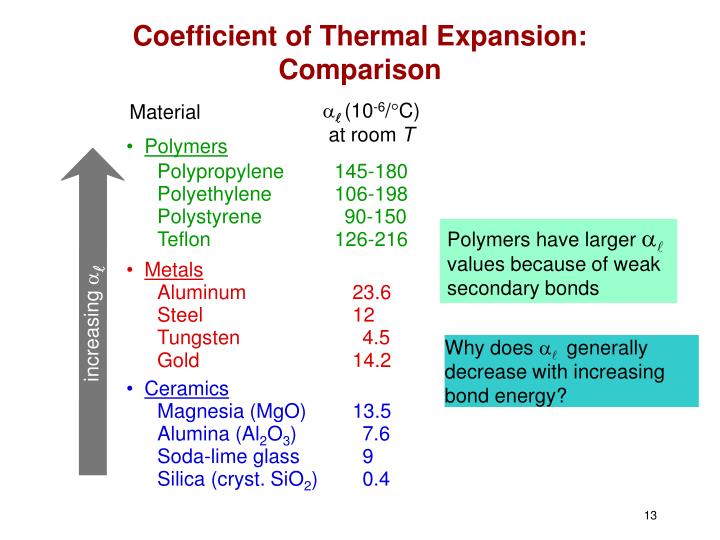
Here's where it gets really interesting. Not all metals are created equal when it comes to thermal expansion. They all have their own unique coefficient of linear thermal expansion (that’s the one for length, as opposed to area or volume, which have their own coefficients too). This coefficient is often represented by the Greek letter alpha (α). The units are usually per degree Celsius (°C⁻¹) or per degree Fahrenheit (°F⁻¹).
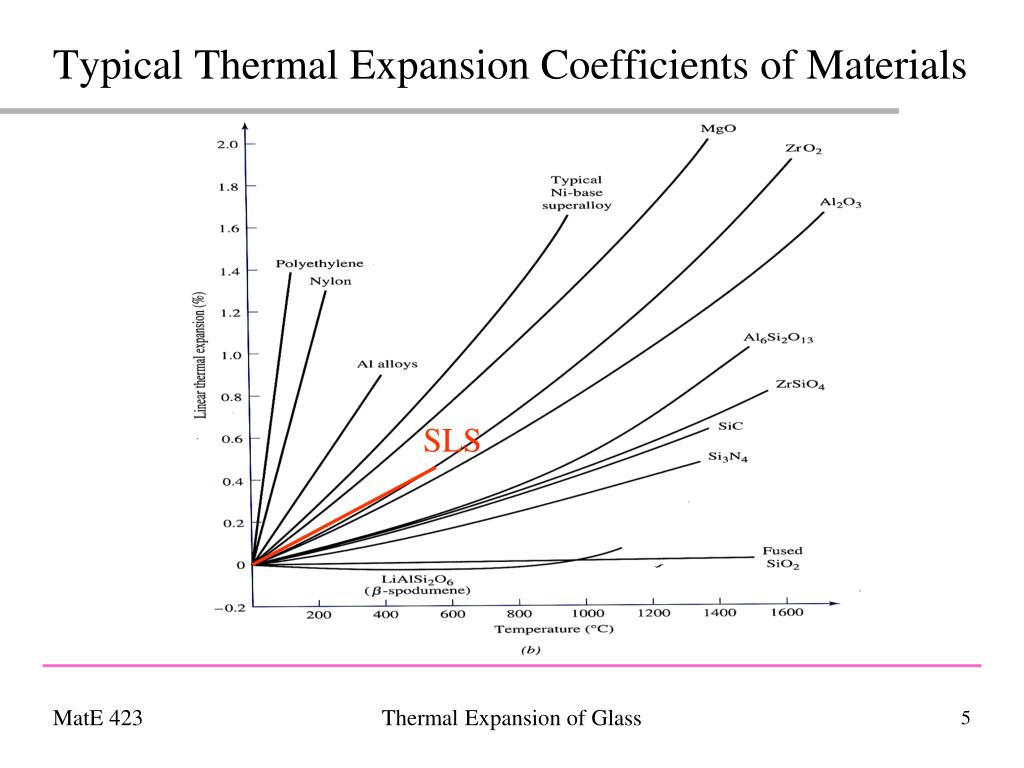
Let’s look at a few examples:
- Aluminum: This is a bit of a drama queen when it comes to temperature changes. It has a relatively high coefficient of thermal expansion. So, if you heat up a piece of aluminum, it's going to get noticeably bigger.
- Steel: Steel is a bit more of a middle-of-the-road kind of guy. Its coefficient of thermal expansion is lower than aluminum but higher than some other metals.
- Copper: Copper is similar to steel in its expansion behavior, often used in applications where some expansion is expected and manageable.
- Brass: Brass, an alloy of copper and zinc, also exhibits noticeable thermal expansion.
- Invar: Ah, invar! This is the ultimate chill dude of the metal world. It’s an alloy that was specifically designed to have a very low coefficient of thermal expansion. It barely moves, no matter how much you heat or cool it. It's a superhero for precision instruments and things where stability is absolutely paramount. Think of the delicate mechanisms in clocks or scientific equipment – invar is their best friend.
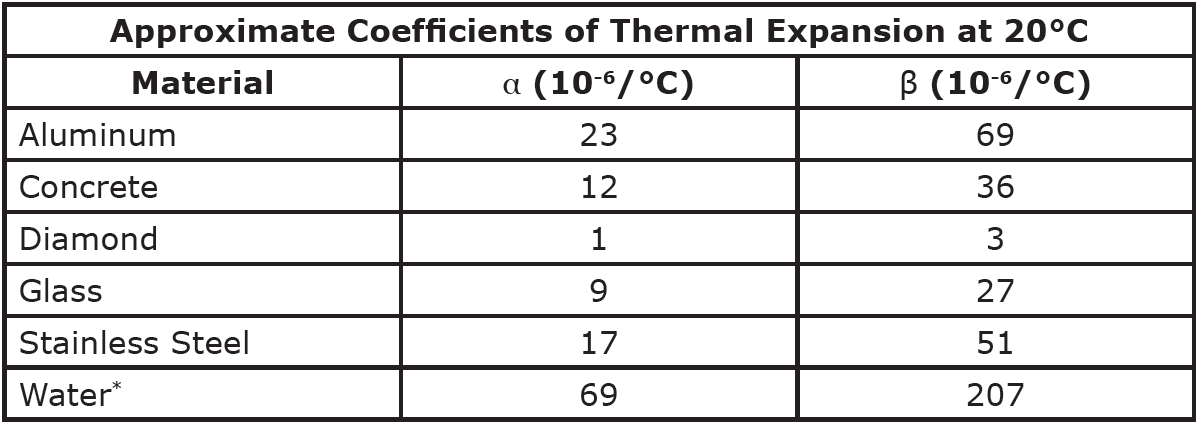
The actual values for these coefficients can be found in engineering handbooks and material science databases. They are usually quoted as values per degree Celsius or Fahrenheit. For example, aluminum might have a coefficient around 23 x 10⁻⁶ °C⁻¹, while invar might be around 1 x 10⁻⁶ °C⁻¹. See the difference? Aluminum is basically saying, "I'm gonna stretch out almost 23 times more than invar for every degree of heat!"
The Nitty-Gritty: How Do We Calculate This Stuff?
For the truly curious cats among us, let’s dip our toes into the math. The formula for calculating the change in length (ΔL) due to a change in temperature (ΔT) is pretty straightforward:
ΔL = α * L₀ * ΔT

Where:
- ΔL is the change in length (how much it grew or shrunk).
- α (alpha) is the coefficient of linear thermal expansion for the specific metal.
- L₀ is the original length of the object at a reference temperature.
- ΔT is the change in temperature (final temperature minus initial temperature).
So, if you have a steel rod that's 1 meter long (L₀ = 1 m) at 20°C and you heat it up to 80°C (ΔT = 60°C), and the coefficient for steel is, say, 12 x 10⁻⁶ °C⁻¹, you can calculate the change in length. It would be: ΔL = (12 x 10⁻⁶ °C⁻¹) * (1 m) * (60°C) = 0.00072 meters, or 0.72 millimeters. Not a huge amount, but imagine that happening to a mile-long bridge!
This formula is super useful for engineers designing anything that will experience temperature fluctuations. They use it to predict how much a part will expand or contract and then design accordingly. This might involve adding expansion joints, using materials with similar expansion rates to prevent stress, or even pre-stressing components to counteract expected expansion.
Practical Applications (Beyond Bridges and Trains!)
The concept of thermal expansion is woven into so many aspects of our lives, often in ways we don't even realize:
- Thermometers: Those old-school mercury or alcohol thermometers work because the liquid inside expands when heated and contracts when cooled, moving up or down a calibrated tube. The glass casing also expands, but the liquid's expansion is usually designed to be much greater, allowing for a visible reading.
- Bimetallic Strips: Ever seen an oven dial or a thermostat with a coiled metal strip? That’s likely a bimetallic strip. It’s made by bonding two different metals with different coefficients of thermal expansion together. When heated, one metal expands more than the other, causing the strip to bend. This bending can be used to activate switches or indicate temperature. It's like two dance partners with different styles trying to move to the same music – one will lead, and the other will follow, causing a bend!
- Precision Engineering: In high-precision industries like aerospace and microelectronics, controlling thermal expansion is paramount. Even microscopic changes can cause catastrophic failures. This is where materials like invar truly shine.
- Welding and Manufacturing: When metals are heated during welding, they expand. As they cool and contract, they can create internal stresses, which can sometimes lead to cracks. Understanding thermal expansion helps manufacturers control these stresses and ensure the integrity of their products.
- Power Lines: Those saggy power lines? They’re intentionally installed with a bit of slack. In the summer, they expand and sag more. In the winter, they contract and become tighter. If they were installed too tightly, they could snap in the cold. It’s all about giving them room to do their thermal tango!
It’s pretty mind-boggling how this simple physical property plays such a vital role in so many different fields, from the mundane to the highly technical. It’s a constant reminder that even the smallest particles have their own way of reacting to the world around them.
The Takeaway: A Little Expansion Goes a Long Way!
So there you have it! The Coefficient of Thermal Expansion for metals: not just a mouthful of words, but a fundamental principle that shapes our world. It’s the invisible force behind why bridges don’t crumble, why your car starts, and why some gadgets are incredibly precise. It's a testament to the fact that even seemingly inanimate objects have their own dynamic behaviors, responding to the warmth of the sun and the chill of the night.
Next time you see a metal structure, whether it's a towering skyscraper, a simple railing, or even your trusty pot on the stove, take a moment to appreciate the subtle dance of expansion and contraction happening within it. It’s a tiny bit of science making a huge difference, and that, my friends, is pretty darn cool. Keep looking around, stay curious, and remember that there’s a whole universe of fascinating science hiding in plain sight, just waiting for you to discover it. And who knows, maybe understanding thermal expansion will even help you win a trivia night! Cheers to the expanding, contracting, and utterly wonderful world of metals!