
Do Male Snakes Have Two Reproductive Organs

Let's talk snakes. Specifically, let's talk about those slithery fellows and their… well, let's call them their "gentleman's accessories." It's a question that might have you blushing or giggling behind your hand. Do male snakes have two of them?
Now, before you picture some sort of double-barreled reptile situation, let's get a bit more scientific. The answer is, surprisingly, a bit more complex than a simple "yes" or "no." It's a topic that often sparks a bit of confused head-tilting.
The general consensus, among snake enthusiasts and herpetologists (those are the snake scientists, by the way!), is that male snakes do indeed possess two reproductive organs. However, they don't quite work like you might imagine. They're not two separate, fully functional units hanging out independently.
These special snake parts are called hemipenes. Yes, that's "hemi" for half, and "penes" for… well, you know. So, literally, "half pens." It's a rather fitting name, wouldn't you agree?
Think of it like this: a male snake has a pair of these hemipenes, tucked away inside his body. They are typically found at the base of his tail. This is a key detail to remember. They aren't on the outside for all to see.
And here's the really cool (and slightly odd) part. During mating, a male snake only uses one of his hemipenes at a time. It's like having a spare, or maybe a backup. He doesn't deploy both simultaneously.
So, while the answer to the question is technically "yes," it's a nuanced "yes." It's not a straightforward "two for the price of one" situation. Nature, as usual, has found a rather ingenious solution.
Why would a snake need two? Well, it's thought that this dual-organ system offers some advantages. One hemipenis can be used while the other is "resting" or recovering. This might be particularly useful in the sometimes lengthy and energetic process of snake courtship.
Imagine the dedication! A snake might spend a considerable amount of time wooing a potential mate. Having a backup organ ready to go seems like a smart evolutionary move. It ensures the mission can be completed.

Furthermore, the hemipenes themselves are often quite elaborate. They can have spines, hooks, or other unique shapes. These features help to secure the male to the female during mating. It's like a specialized grappling hook system.
The design of each hemipenis can even vary between different snake species. This is an important detail for snake identification. Sometimes, examining the hemipenes is how scientists can tell one snake species from another. It's a bit like a secret handshake.
So, while the idea of two reproductive organs might sound a bit over-the-top, it's actually a sophisticated adaptation. It's a testament to the endless creativity of the natural world. Snakes are full of surprises, aren't they?
Now, let's address the elephant in the room (or rather, the snake in the grass). The term "penis" might conjure certain images. But snake hemipenes are quite different. They are often inverted, meaning they are turned inside out when not in use.
They are then everted, or turned right-side out, for their intended purpose. This turning-inside-out-and-back-again process is fascinating. It's like a tiny, biological magic trick.
Think about it from a snake's perspective. They need to reproduce, but they also need to move stealthily and efficiently. Having bulky external organs might get in the way. Tucking them away until needed is a sensible approach.
The hemipenes are housed in special sacs. These sacs are located near the cloaca. The cloaca is the single opening that snakes use for excretion and reproduction. It's a multi-purpose exit.

When it's time for action, the muscles surrounding the hemipenes contract. This forces them out of their sacs and into their functional position. It's a controlled, deliberate unveiling.
And remember, only one hemipenis is used per mating event. This is a crucial distinction. It's not a "two-pronged attack," so to speak. It's a focused, singular effort.
Some researchers believe that the two hemipenes might also have slightly different shapes or structures. This could allow for a better fit with the female's reproductive tract. It's a highly customized connection.
It's also worth noting that in some snake species, one hemipenis might be used more frequently than the other. This can be due to subtle differences in their anatomy or how they position themselves during mating. Nature likes its variety.
So, while we started with a simple question, we've uncovered a rather complex and intriguing aspect of snake biology. The male snake's reproductive setup is a masterpiece of adaptation. It's efficient, effective, and frankly, quite remarkable.
It’s easy to imagine them having two. It sounds a bit like a superhero's utility belt. But the reality is even more fascinating. It’s a hidden marvel.

When you see a snake slithering by, you might just give a knowing nod. You now understand a little bit more about their private engineering. It’s a secret they keep well.
The term hemipenes might sound intimidating, but it simply describes these paired organs. They are a testament to the diverse and sometimes quirky ways life finds to continue. Snakes are truly masters of their domain.
And who knew that a bit of snake anatomy could be so… entertaining? It certainly makes you look at them a little differently. With a newfound appreciation for their dual-wielding capabilities, sort of.
So, the next time someone asks about male snakes and their reproductive bits, you can confidently say they have two. But then, with a sly smile, you can add that they only use one at a time. It's a detail that makes all the difference.
It’s a bit like having two remote controls for your TV. You might have them both, but you only ever use one to change the channel. Unless, of course, you’re having a very intense channel-surfing session.
The world of snakes is full of wonder. And their reproductive strategies are no exception. It's a reminder that even the smallest details in nature can be incredibly sophisticated.
So, embrace the knowledge. Share the fun fact. And maybe, just maybe, you'll find yourself smiling at the thought of a snake's well-equipped, yet discreet, reproductive system. It's a wonderfully wild world out there.
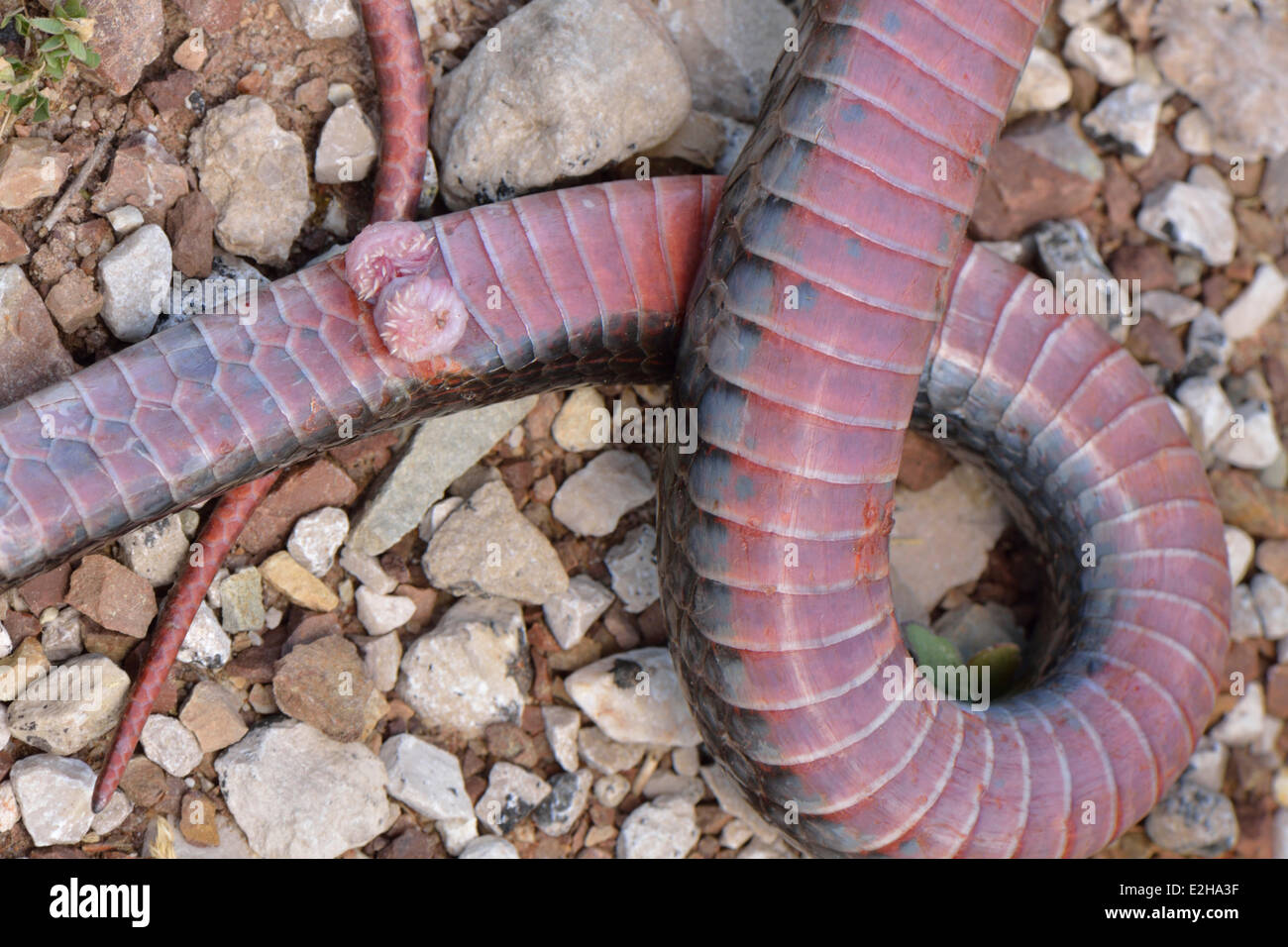
The hemipenes are a fascinating adaptation, allowing for efficiency and specialized function in snake reproduction. They are a prime example of nature's ingenuity.
It’s a concept that’s both surprising and a little bit comical. The idea of two, tucked away and ready for duty. It’s a quirky fact that sticks with you.
So, while they might not be outwardly obvious, those male snakes are packing a little extra something. It’s a secret weapon for propagation. A testament to their evolutionary journey.
The next time you see a snake, remember this little tidbit. It adds another layer to their mysterious allure. They are more intricate than they appear.
And that, my friends, is the delightful, slightly peculiar truth about male snakes and their two reproductive organs. A little bit of science, a dash of humor, and a whole lot of nature's brilliance.
It's a conversation starter, for sure. And a reason to appreciate the subtle wonders of the animal kingdom. Snakes, in all their scaly glory, continue to amaze.
So, the answer is a resounding, albeit qualified, "yes." They have two hemipenes, and that's a pretty cool fact to know.
It’s an "unpopular opinion" no more, because now you’re in on the secret. The secret of the double-barreled snake, sort of.