
Dropping Magnet Through Copper Tube

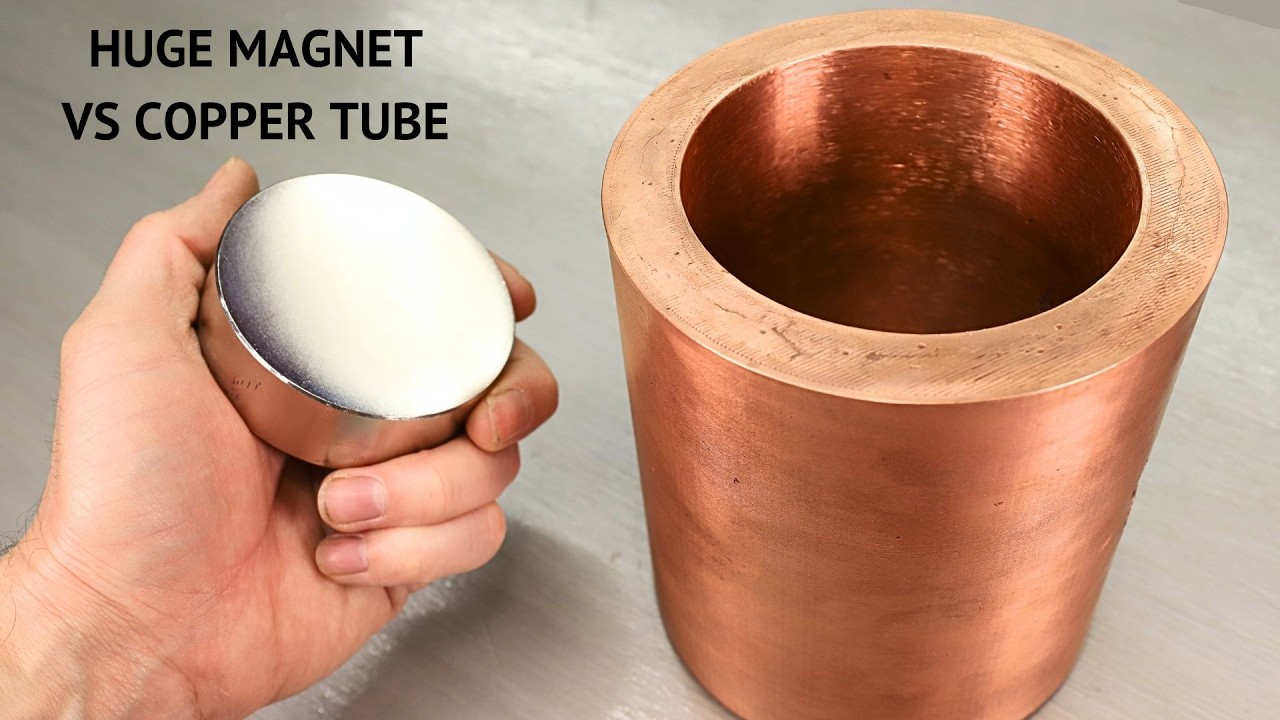
Ever seen a magnet fall through a copper tube and wondered what's going on? It looks like pure magic! A powerful magnet, heavier than you'd expect, slowly, almost gracefully, descends through a simple copper pipe. It’s a classic physics demonstration that never fails to captivate, whether you’re a seasoned scientist or just someone who enjoys a good "wow" moment. This isn't about making things disappear or defying gravity; it's about uncovering a fascinating principle that governs the world around us, a principle that has practical applications we often overlook. So, let’s dive into this captivating dance between magnetism and conductivity and discover why it’s so much more than just a cool trick.
The Slow-Motion Descent: What's the Big Idea?
The fundamental reason this phenomenon is so engaging is the stark contrast between our everyday expectations and what we observe. Drop a regular ball through a tube, and it plummets. Drop a metal ball through a copper tube, and it still falls pretty quickly. But drop a magnet through a copper tube, and it's like it’s wading through thick treacle. The magnet’s descent is dramatically slowed down, creating a mesmerizing, almost surreal experience. This slowdown isn't due to friction in the way we usually think of it, nor is the copper tube unusually sticky. The magic lies in an invisible force field and a phenomenon called electromagnetic induction.
When a magnet moves through a conductive material like copper, it creates a disturbance in the magnetic field. This disturbance, in turn, induces tiny electrical currents within the copper tube itself. These induced currents are known as eddy currents. Here’s where it gets really interesting: these eddy currents generate their own magnetic field, and this magnetic field opposes the motion of the original magnet. It's like the copper tube is actively pushing back against the magnet, trying to slow it down. This opposition is what causes the magnet's slow, steady fall. The stronger the magnet and the better the conductivity of the tube, the more pronounced this braking effect will be.
Why Should We Care? The Useful Side of Slow Magnets
While the visual of a slowly falling magnet is undeniably cool, the principles at play have significant real-world applications. Understanding this interaction between magnetic fields and conductive materials is crucial in many areas of engineering and technology.
One of the most direct benefits of understanding electromagnetic braking, which is the core principle here, is in the design of braking systems.
Think about roller coasters, high-speed trains, or even some industrial machinery. Instead of relying solely on friction-based brakes that can wear out and generate heat, magnetic braking systems offer a contactless, wear-free solution. These systems utilize the same principle: a magnetic field interacting with a conductive surface (often a rotating disc) induces eddy currents that create a braking force. This leads to smoother deceleration, less maintenance, and greater reliability.
Furthermore, the concept of induced currents is fundamental to how transformers work. Transformers are the unsung heroes of our electrical grid, allowing us to efficiently transmit electricity over long distances by stepping voltages up and down. The changing magnetic field produced by the alternating current in one coil induces a current in another coil, enabling this voltage transformation. The careful design of the conductive materials and magnetic cores in transformers directly relates to the principles demonstrated by the slow-falling magnet.
Beyond braking and power transmission, this phenomenon is relevant in areas like metal detection. Metal detectors work by generating a magnetic field and then sensing changes in that field caused by the presence of nearby conductive materials (like coins or jewelry). The eddy currents induced in the metal object by the detector's field create their own magnetic field, which is then picked up by the detector.

Even in the realm of scientific research, understanding and manipulating electromagnetic induction is vital. For instance, in fusion reactors, powerful magnetic fields are used to contain plasma, and understanding how these fields interact with conductive components is critical for safety and efficiency.
A Simple Demonstration, A Profound Principle
So, the next time you see or perform the classic magnet-through-a-copper-tube experiment, remember that you're not just witnessing a curious anomaly. You're seeing a tangible demonstration of fundamental physics that underpins much of our modern technology. It's a beautiful reminder that even the most seemingly simple demonstrations can reveal profound principles with far-reaching implications. It’s a testament to the elegance of nature’s laws and the ingenuity of human discovery that we can harness these invisible forces to power our world and create incredible innovations. The slow-motion ballet of the magnet is a gateway to understanding concepts that are both intellectually stimulating and incredibly practical. It’s a fun, accessible way to peek behind the curtain of how things work, making science feel a little less like a textbook and a lot more like an amazing, ongoing adventure.