
Elimination Method For Solving System Of Equations

Hey there, fellow humans navigating the beautiful, sometimes chaotic, labyrinth of life! Ever feel like you're juggling a dozen things at once, trying to keep all the balls in the air? Well, sometimes, life throws us problems that feel just like that – a complex mix of interconnected elements we need to untangle. Today, we’re going to chat about a super chill way to solve these kinds of head-scratchers, especially when they come in the form of math equations. Think of it as a culinary technique for your brain, a little bit of algebraic spice to make things… well, solveable.
We’re talking about the Elimination Method, a fantastic tool in your arsenal for tackling systems of equations. No need to break out in a cold sweat; we’re going to demystify this like explaining how to make the perfect avocado toast – simple, satisfying, and totally achievable.
The Zen of Systems: What's the Big Deal?
First off, what even is a system of equations? Imagine you’re trying to figure out how many lattes and croissants you can buy with a certain amount of money, and you have a couple of rules (like, the total cost can’t exceed your budget). A system of equations is just a fancy way of saying we have two or more equations that are all trying to tell us something about the same variables. Our goal is to find the specific values for those variables that make all the equations true. It’s like finding the “sweet spot” where everything aligns perfectly.
Think of it like the plot of a really good mystery novel. You have different clues (the equations), and each clue gives you a little piece of information. You have to put all those pieces together to figure out who did it, or in our case, what the values of our variables are. The Elimination Method is like a clever detective who knows just how to make conflicting clues cancel each other out to reveal the truth.
Meet the Elimination Method: Your New Algebraic Bestie
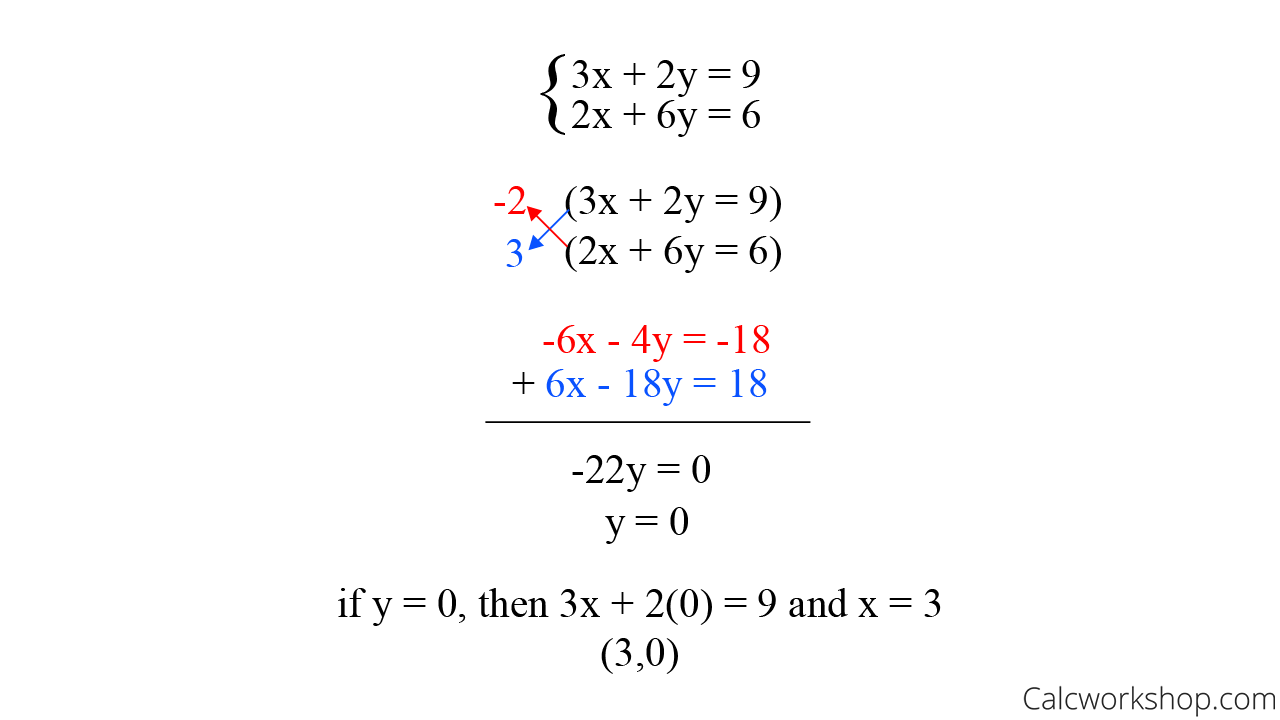
So, how does this magical elimination thing work? The core idea is elegantly simple: we want to get rid of one of the variables (either x or y, or whatever letters your equations are using) so we can solve for the other. We achieve this by manipulating our equations so that when we add or subtract them, one of the variables disappears, like a magician’s disappearing coin trick, but way more practical.
Let’s say you have two equations:
Equation 1: 2x + 3y = 7
Equation 2: 4x - 3y = 5
See those +3y and -3y? They’re practically begging to be eliminated! If we add Equation 1 and Equation 2 together, what happens to the ‘y’ terms?
(2x + 3y) + (4x - 3y) = 7 + 5
2x + 4x + 3y - 3y = 12
6x = 12
Poof! The ‘y’ variable is gone. How cool is that? Now we have a simple equation with just ‘x’, which we can easily solve:
x = 12 / 6
x = 2
See? We've eliminated one variable and found the value of the other. This is the fundamental charm of the Elimination Method. It’s direct, it’s efficient, and it feels like a real breakthrough when you see that variable vanish.
When Things Aren't So Obvious: A Little Tweak Here and There
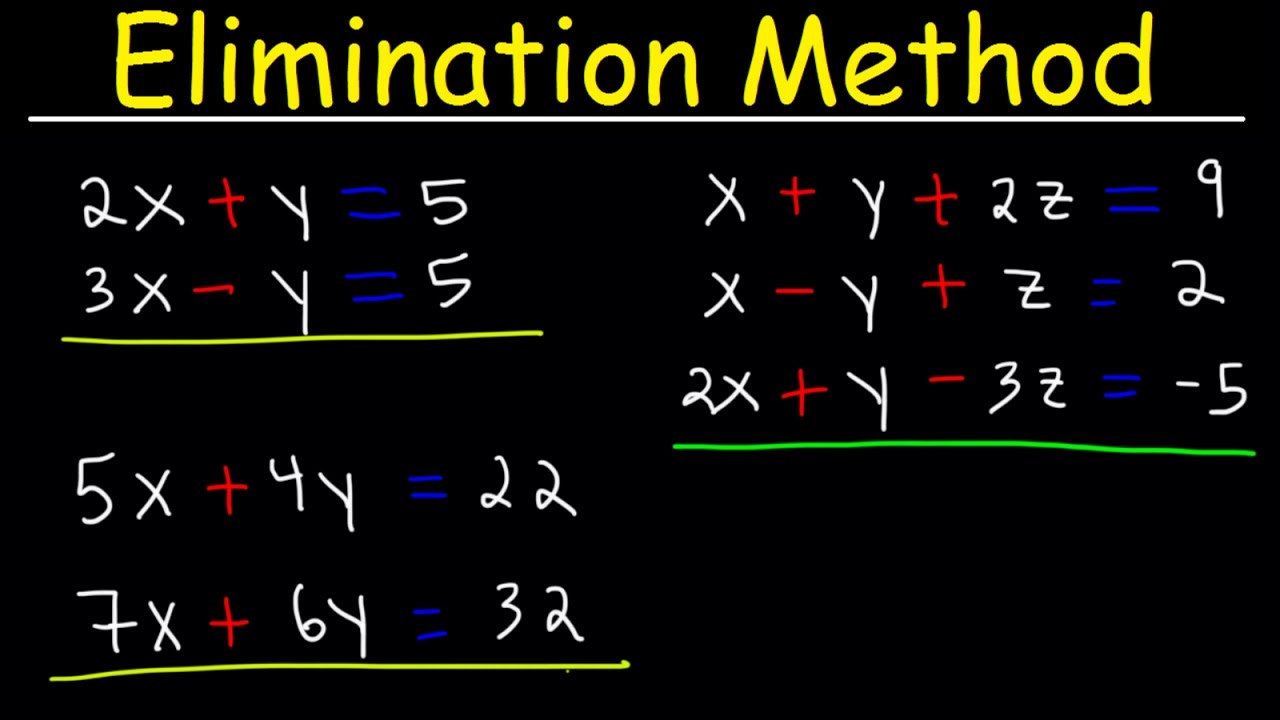
Now, not every system of equations is going to present us with perfectly aligned variables like our first example. Sometimes, the coefficients (those numbers in front of the variables) don’t cancel out neatly with a simple addition or subtraction. This is where a little bit of algebraic finesse comes in. We can multiply one or both of our equations by a specific number to make the coefficients match up for elimination.
Let’s look at this system:
Equation 1: x + 2y = 5
Equation 2: 3x + y = 10
Here, neither the ‘x’ nor the ‘y’ terms will cancel out if we add or subtract the equations as they are. But, what if we wanted to eliminate ‘y’? We need the coefficients of ‘y’ to be opposites (like +2y and -2y) or the same (like +y and +y, so we can subtract). Let’s make the ‘y’ term in Equation 2 match the ‘y’ term in Equation 1, but with the opposite sign.

We can multiply the entire Equation 2 by -2:
-2 * (3x + y) = -2 * 10
-6x - 2y = -20 (This is our new Equation 2)
Now, let's add our original Equation 1 and our new Equation 2:
(x + 2y) + (-6x - 2y) = 5 + (-20)
x - 6x + 2y - 2y = 5 - 20
-5x = -15
Voilà! The ‘y’ variable has been elegantly eliminated. Now we can solve for ‘x’:
x = -15 / -5
x = 3
This is a key skill with elimination: the ability to scale your equations. Think of it like adjusting the volume on your favorite playlist. You're not changing the song, just how loud it is. Multiplying an equation by a number just scales the entire relationship, keeping it true but making it work for our elimination goal.
Finding the Missing Piece: Substituting Back In
Once you’ve successfully eliminated a variable and solved for the remaining one, you’re almost there! You’ve found half of your answer. The next step is to plug the value you found back into either of the original equations to solve for the other variable. It’s like a satisfying conclusion to a story, where all the loose ends are tied up.
Using our last example, we found that x = 3. Let’s plug this back into the original Equation 1 (x + 2y = 5):
3 + 2y = 5
Now, we just solve this simple equation for ‘y’:
2y = 5 - 3
2y = 2
y = 1
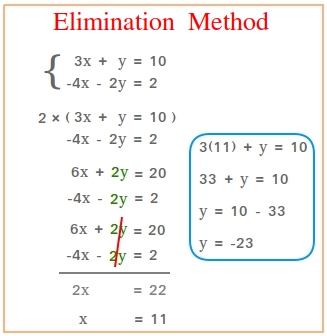
And there you have it! The solution to our system of equations is x = 3 and y = 1. You can always double-check your answer by plugging both values into the other original equation (Equation 2: 3x + y = 10) to make sure it holds true:
3(3) + 1 = 9 + 1 = 10. Perfect!
This substitution step is crucial. It’s the moment you confirm your detective work. Imagine you’re a chef perfecting a recipe. You’ve figured out the perfect amount of spice (the value of x), and now you’re adding the final ingredient (the value of y) to make the dish just right.
Fun Facts and Cultural Bites
Did you know that the concept of solving systems of equations dates back to ancient times? The ancient Babylonians, around 300 BCE, were already tackling problems that involved multiple unknowns and relationships between them. They used methods that were precursors to what we now call algebraic techniques!
Think about the incredible interconnectedness of things. Our world is full of systems: ecosystems, economies, even the way our favorite streaming service recommends shows based on your viewing habits. Understanding how these systems work, how different parts influence each other, is fundamental to navigating and improving them. The Elimination Method is a small, but powerful, glimpse into this fundamental principle of interconnectedness.
It’s also a bit like mastering a new language. At first, the grammar and vocabulary (the rules of algebra) might seem daunting, but with practice, you start to see the patterns, the elegant structures, and soon you’re conversing fluently (solving equations with ease!).
Practical Tips for Smooth Sailing
Here are a few pointers to make your Elimination Method journey as smooth as a well-mixed smoothie:
- Alignment is Key: Always make sure your equations are neatly aligned, with the ‘x’ terms, ‘y’ terms, and constants in their proper columns before you start adding or subtracting. It’s like organizing your spice rack before you start cooking.
- Watch Those Signs: Negative signs are like tiny gremlins that can wreak havoc if you’re not careful. Double-check every sign when you’re multiplying or adding/subtracting.
- Multiply Wisely: When you need to multiply an equation, choose the number that will make the coefficients of one of the variables opposites. This usually makes elimination the most straightforward.
- Check Your Work: Never underestimate the power of plugging your solution back into the original equations. It’s your safety net, ensuring you haven’t missed any steps or made any sneaky errors.
- Practice, Practice, Practice: Like any skill, the more you do it, the more intuitive it becomes. Grab a few practice problems and let your brain do its thing!
The Bigger Picture: Life, Math, and Everything In Between
So, why should we care about this Elimination Method? Beyond acing that math test, it’s about cultivating a problem-solving mindset. Life is rarely a single, isolated event. It’s a series of interconnected choices, consequences, and opportunities. Sometimes, to understand a situation, we need to look at the relationships between different factors.
Think about planning a trip. You have a budget (one equation), but you also have limited vacation days (another equation). You need to find a balance between flights, accommodation, activities, and how long you can stay. The Elimination Method, in its abstract mathematical form, is a simplified model of how we intuitively weigh multiple factors to find a viable solution.
It teaches us that sometimes, to see the whole picture clearly, we need to temporarily set aside certain elements to focus on others. It's about finding clarity by reducing complexity. It's about the satisfaction of untangling a knot, the quiet triumph of bringing order to what seems like chaos. And that, my friends, is a superpower that transcends any textbook. So, go forth, embrace the elegance of elimination, and solve your systems, both mathematical and metaphorical!