
How Did The Kansas Nebraska Act Nullify The Missouri Compromise

Hey there, curious minds! Ever feel like history books throw around big, fancy words that make your brain do a little somersault? Yeah, me too. Today, we're gonna tackle one of those: the Kansas-Nebraska Act and how it basically elbowed the Missouri Compromise right out of the way. Think of it like this: the Missouri Compromise was a really nice, carefully arranged peace treaty, and the Kansas-Nebraska Act was like that one friend who comes in and rearranges all your furniture without asking. Let's unpack it, shall we?
So, back in the day, America was still figuring itself out. We were a big, growing nation, and with growth comes…stuff. One of the biggest “stuffs” was the whole debate about slavery. Should it spread to new territories? Should it be contained? It was a hot-button issue, like arguing over the last slice of pizza at a party – everyone had an opinion, and feelings were running high.
The Missouri Compromise: A (Temporary) Truce
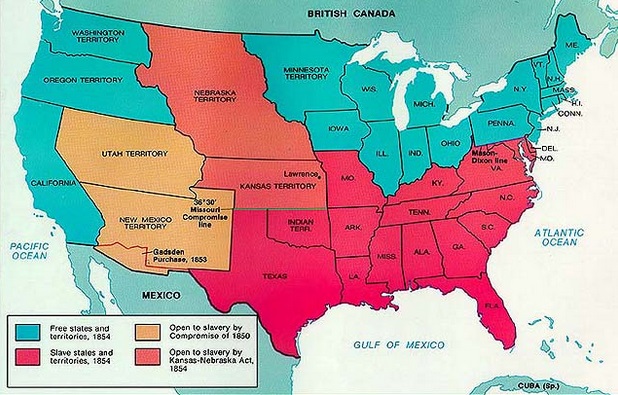
To keep things from totally imploding, people came up with the Missouri Compromise in 1820. Picture it as a really clever, albeit slightly shaky, agreement. It was like saying, "Okay, for now, let's draw a line in the sand." This line, roughly at the 36°30′ parallel, basically said: north of this line, no slavery (except in Missouri itself, because it was a package deal). South of this line, it was fair game. This kept the peace, sort of, for a good few decades. It was a bit like agreeing that you get the window seat on road trips and your sibling gets the middle seat – not ideal for everyone, but it avoided a full-blown sibling war.
This compromise was a big deal because it tried to balance the power between free states and slave states in Congress. For a while, it worked. It gave everyone a sense of order, a sense that there was a plan. It was the grown-up in the room, saying, "Let's not get ahead of ourselves."
Enter the Kansas-Nebraska Act: The Game Changer
Fast forward to the 1850s. Things were heating up again. People were pushing west, eager to settle new lands. And then, BAM! Along came the Kansas-Nebraska Act in 1854. This act, championed by a fellow named Stephen Douglas, was a real game-changer. It proposed organizing two new territories: Kansas and Nebraska.

Now, here’s where the Missouri Compromise got punted. The Kansas-Nebraska Act proposed something called "popular sovereignty." Sounds fancy, right? But in plain English, it meant that the people living in those territories would get to decide for themselves whether to allow slavery. Yes, you read that right. Instead of a pre-drawn line from the Missouri Compromise, the decision was being kicked down the road to the folks on the ground.
So, How Did This Nullify the Missouri Compromise?
This is the crux of it, and it's where the history books get a bit dry if you're not careful. The Missouri Compromise had explicitly said that slavery was banned north of the 36°30′ line. But the Kansas-Nebraska Act, by allowing popular sovereignty in both Kansas and Nebraska – both of which were north of that line – essentially said, "That old rule? Yeah, it doesn't really apply anymore."
Think of it like this: you have a rule at your house that no one is allowed to wear socks on the couch. Your mom made that rule. Then, your dad comes along and says, "You know what? If you really want to wear socks on the couch, you can ask your friends who are over if they're okay with it, and if they are, then go for it." The original rule is still technically there, but it's been completely undermined. The power has shifted, and the spirit of the original rule is gone.

The Kansas-Nebraska Act repealed the part of the Missouri Compromise that prohibited slavery in those northern territories. It didn’t explicitly say, "We're tearing up the Missouri Compromise and stomping on it!" but the effect was the same. It was like changing the recipe for your grandma’s famous cookies. The cookies might still look similar, but the core ingredient – the secret spice – is gone, and the taste is different.
Why Should We Care? (Besides the Drama!)
Okay, history buffs might get this, but why should you, the person who’s just trying to get through their Tuesday, care about an old law? Because, my friends, this was a huge turning point. The Missouri Compromise had been a band-aid, and the Kansas-Nebraska Act ripped it off, exposing the festering wound underneath.

When the decision of whether to allow slavery was handed over to the residents of Kansas and Nebraska, it didn’t lead to calm debates. Oh no. It led to violence. People from pro-slavery and anti-slavery factions rushed into Kansas, trying to sway the vote. It became known as "Bleeding Kansas." It was a miniature civil war, a precursor to the big one that was just around the corner.
Imagine your neighborhood suddenly being flooded with people from opposing political parties, all trying to convince your neighbors to vote your way. It wouldn't be peaceful. There would be shouting, maybe some angry lawn signs, and probably some tense potlucks. That’s what happened in Kansas, but with much higher stakes and much more bloodshed.
This act, by trying to solve the slavery issue by letting territories decide, actually ignited the conflict. It showed that popular sovereignty, in this case, was a recipe for disaster. It polarized the nation even further, pushing the North and the South closer to the brink of the Civil War. It was like trying to cool down a boiling pot of water by adding a tiny splash of cold water – it just made the steam even more furious.
The Domino Effect
The Kansas-Nebraska Act didn't just affect those two territories. It had a ripple effect. It made many Northerners feel that the federal government was favoring the South and that the spread of slavery was inevitable. It energized the abolitionist movement and led to the formation of the Republican Party, a party fundamentally opposed to the expansion of slavery.
On the other side, Southerners felt emboldened, believing their way of life was being defended. The compromise that the Missouri Compromise had represented for so long was shattered. It was like a glass vase that had been glued back together multiple times, and the Kansas-Nebraska Act was the final nudge that sent it crashing to the floor.
So, while the names "Kansas-Nebraska Act" and "Missouri Compromise" might sound like dry textbook entries, they represent a real, dramatic shift in American history. They show how attempts to find compromise can sometimes, unintentionally, lead to even greater conflict. And that’s why understanding them is still relevant – it’s a reminder that how we choose to solve our biggest disagreements matters, and sometimes, the simplest-sounding solutions can have the most profound and unintended consequences.