
How Do Planes Fly Straight If The Earth Is Round

Hey there, ever look up at a plane zipping across the sky and wonder, "How in the heck does that thing stay straight when the Earth is all wibbly-wobbly and round?" It’s a totally fair question, and honestly, it used to boggle my mind too! You picture a flat map, right? You draw a straight line from A to B. Easy peasy. But then you remember, "Oh yeah, the Earth’s a giant marble!" So, what gives? Let’s dive into this little mystery and have some fun with it.
First off, let’s give a huge round of applause to the engineers and pilots. They’re basically wizards, but with really impressive math skills and a lot less pointy hats. They’ve figured out how to navigate this spherical spaceship we call Earth, and it’s all about understanding a few key concepts. Think of it like trying to draw a straight line on a basketball. It’s not truly straight if you’re thinking in 2D, but for all intents and purposes, it feels straight as you move along the surface.
So, when a pilot sets a course, they aren't plotting a line on a flat piece of paper in the way you might think. They’re using something called a great-circle route. Sounds fancy, doesn't it? Like something out of a superhero movie! But it's actually pretty straightforward. Imagine you have a globe. Now, take a piece of string and stretch it taut between two points on that globe. The shortest distance between those two points, when you wrap that string around the globe, is a great-circle route. It’s the longest straight line you can draw on a sphere. See? Even on a round thing, you can still find the straightest possible path!
The Magic of Navigation
Pilots and air traffic controllers use incredibly sophisticated navigation systems. Back in the day, it was a lot more manual, relying on celestial navigation (staring at stars, which is pretty cool but less precise for daily flights) and radio beacons. But nowadays, we have GPS (Global Positioning System) and other advanced technologies. These systems are constantly pinpointing the plane's location with astonishing accuracy.
Think of GPS as a bunch of satellites playing a cosmic game of tag around the Earth. Your plane has a receiver that talks to several of these satellites at once. By measuring the time it takes for signals from different satellites to arrive, the receiver can calculate the plane’s exact position on the globe. It’s like a super-advanced triangulation, but with satellites!
So, when a pilot says they are flying "due north," they’re not just pointing the nose of the plane in a direction that looks north on a flat map they’re holding. They are maintaining a heading that, when continuously followed along the curved surface of the Earth, will lead them to their destination. It's all about staying on that invisible great-circle path.
Why It Feels Straight
Now, here’s where it gets really interesting. For the most part, when a plane is flying, say, from New York to London, the journey feels straight to the people inside. Why? Because the Earth is so incredibly big and the plane is relatively small. Imagine an ant walking on a basketball. To the ant, its path might feel perfectly straight for a good distance. It's only when you zoom out and look at the whole basketball that you see the curve. The same principle applies to planes. The distances are vast, and the curvature is gradual enough that for the duration of a flight, the sensation is one of straight-line travel.

The pilots are constantly making tiny adjustments, too. Their navigation systems tell them if they’re drifting off course, and they make small corrections to stay on their intended great-circle route. It's like steering a boat; you're always making little adjustments to keep it going in the direction you want. And these corrections are incredibly precise, thanks to those whiz-bang navigation tools.
It’s Not Really Flat, Though
Okay, a little joke here: If planes flew on a truly flat Earth, we'd probably have to worry about them falling off the edge, right? Phew, glad we don't have that problem! But seriously, the curvature of the Earth is a fundamental aspect of navigation. Pilots aren't ignoring it; they're actively working with it.
Think about it: if a pilot did try to fly a straight line in a 2D sense over a 3D Earth, they'd quickly find themselves in space, or plummeting towards the Earth’s core – neither of which is ideal for a holiday! The great-circle route ensures they’re following the shortest, most efficient path along the surface. It’s the equivalent of a straight line on our curved planet.
The Earth’s atmosphere also plays a role. Planes fly within the atmosphere, which is also curved. So, even if you imagine the plane’s flight path as a line in 3D space, it's a line that’s curving along with the Earth. It’s a beautiful dance between physics, geometry, and incredible human ingenuity.
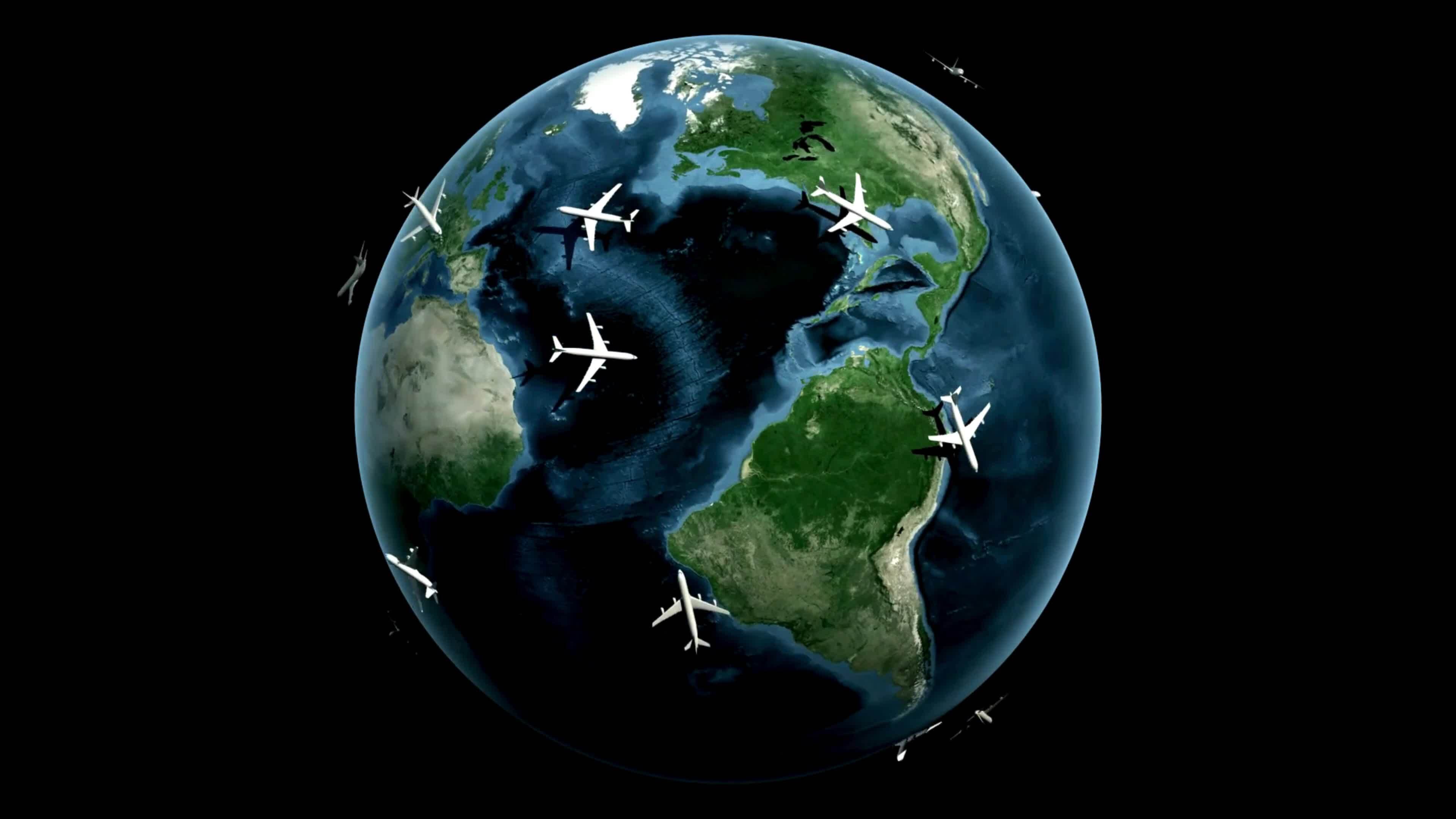
The Role of Air Traffic Control
And let's not forget the unsung heroes: air traffic controllers! They are the ultimate conductors of the sky symphony. They have an incredible overview of all the planes in a given sector and ensure that everyone is on their assigned flight paths, maintaining safe distances, and not accidentally crashing into each other. They use complex radar systems and communication to keep everything moving smoothly.
These controllers are also keenly aware of the Earth’s curvature and factor it into their planning. They’re managing air routes that are essentially segments of great circles. When you hear them saying things like "descend and maintain," or "turn right heading 270," they are guiding the planes along these strategically planned routes, which are designed to be the most direct and fuel-efficient paths on a round Earth.
What About Those Plane Tracks?
You know those cool lines you see on flight tracking websites, showing a plane's path? Those lines are usually representing the great-circle route. When you see a plane flying seemingly "curved" on a flat map, it's actually flying the shortest distance on a sphere. The flat map is distorting the reality of the spherical journey. It’s like looking at a peeled orange skin laid flat – it looks different, right?
For example, a flight from Los Angeles to Tokyo might look like it takes a bizarre, curved path on a typical Mercator projection map. But on a globe, or a more accurate projection, you’d see it’s the most direct route, often flying over parts of Alaska and Russia. It's a visual trick of the map, not a trick of the airplane!

So, Why Don't Planes Just... Fall Off?
This is a classic question, and it boils down to a few things. Firstly, gravity! The Earth’s gravity pulls everything towards its center. This means that no matter where you are on Earth, "down" is always towards the middle. So, a plane flying "straight" is actually maintaining a constant distance from the Earth's center, being held in place by gravity.
Secondly, the atmosphere is also curved around the Earth. Planes fly within this atmosphere. So, as the Earth curves, the air the plane is flying through also curves. It’s a stable system. It’s not like the plane is trying to defy the Earth’s shape; it’s moving with it, within its enveloping atmosphere.
Think of it like this: if you're walking on a beach, and you try to walk in a "straight line" away from the ocean, you’re naturally following the curve of the coastline, right? You’re not going to suddenly veer off into the desert unless you actively choose to. Planes, guided by their navigation systems, are doing the same, but on a much grander, more precise scale.
A Little Math Never Hurt Anyone (Except Maybe Hypatia)
The math behind flight path calculations is super advanced. It involves spherical trigonometry and calculus. But at its heart, it’s all about finding the shortest distance on a sphere and ensuring the aircraft maintains that path. The instruments in the cockpit are constantly feeding data about the plane's position and attitude (its orientation in space) back to the pilots and the autopilot systems.

These systems are designed to interpret that data in the context of a spherical Earth. So, when the autopilot is engaged, it’s not just blindly following commands; it's actively calculating and executing the minute adjustments needed to keep the plane on its great-circle route, compensating for wind, air density, and the Earth’s curvature. It’s a marvel of modern engineering!
The Takeaway?
So, next time you’re soaring through the clouds, don't worry about the Earth’s roundness causing any aerial anarchy. The pilots and their amazing technology are totally in control! They are experts at navigating our beautiful, spherical planet, charting courses that are the most efficient and direct paths possible.
It’s a testament to human ingenuity and our ability to understand and work with the laws of physics. Planes fly "straight" by following great-circle routes, which are the shortest paths on a sphere, and by constantly adjusting their course with incredible precision. They're not fighting the Earth's curve; they're elegantly riding it.
And that, my friends, is pretty darn cool. So, wave to those planes as they fly by. They’re not just dots in the sky; they’re symbols of our incredible journey of exploration and our mastery of the skies, all while gracefully dancing on the surface of our magnificent, round Earth. Keep looking up, and keep wondering!