
How Do U Change Improper Fractions To Mixed Numbers
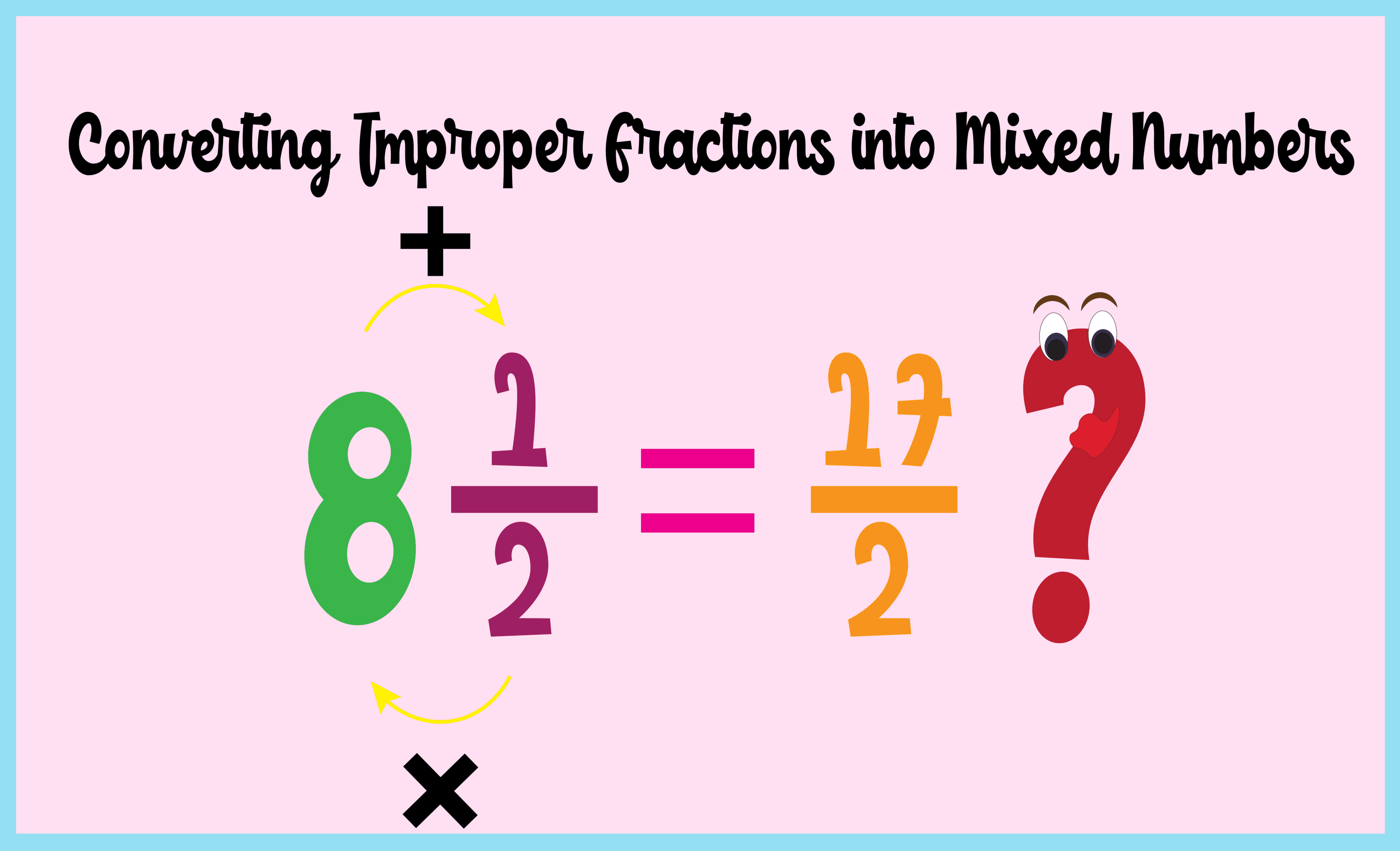
Hey there, fellow adventurers in the land of numbers! Ever stared at a fraction like 7/3 and felt a tiny bit… confused? Like, "Seven pieces of what? And how many wholes is that supposed to be?" Don't worry, you're not alone! We've all been there. But guess what? Transforming these sometimes-clunky improper fractions into friendly, easy-to-understand mixed numbers is actually a super fun and empowering skill. It’s like unlocking a secret level in your math game, and trust me, it can make your whole numerical life a little bit brighter!
So, what is an improper fraction, anyway? Think of it as a fraction that’s a little bit too enthusiastic. The top number (the numerator) is bigger than or equal to the bottom number (the denominator). It's like having a pie that's overflowing – you've got more filling than the crust can hold! Examples? We've got plenty: 5/2, 10/4, 13/5. They’re perfectly valid, but sometimes, a little rearranging makes them way more digestible.
And a mixed number? Ah, the charming cousin! It's a combination of a whole number and a proper fraction. Think of it as saying, "Okay, I definitely have one whole pie here, and then I have this much extra." For instance, 2 and 1/2. See? So much clearer, right? It’s like going from a chaotic jumble to a neat and tidy bookshelf. Much more satisfying!
The Grand Transformation: How To Do The Magic!
Ready for the big reveal? The process is surprisingly straightforward and, dare I say, elegant. It all boils down to a little bit of division. Yep, that’s it! You’re just figuring out how many whole things you can make from your pieces and what’s left over.
Let’s grab an example and have some fun with it. How about 7/3? Imagine you have seven delicious slices of pizza, and each pizza is cut into three slices. How many whole pizzas can you make?
This is where our trusty division comes in. You’re going to divide the top number (the numerator) by the bottom number (the denominator). So, for 7/3, we do 7 ÷ 3.
What do you get? Well, 3 goes into 7 two times (2 x 3 = 6). And what’s left over? You have 7 - 6 = 1. So, you have 2 whole pizzas and 1 slice remaining.
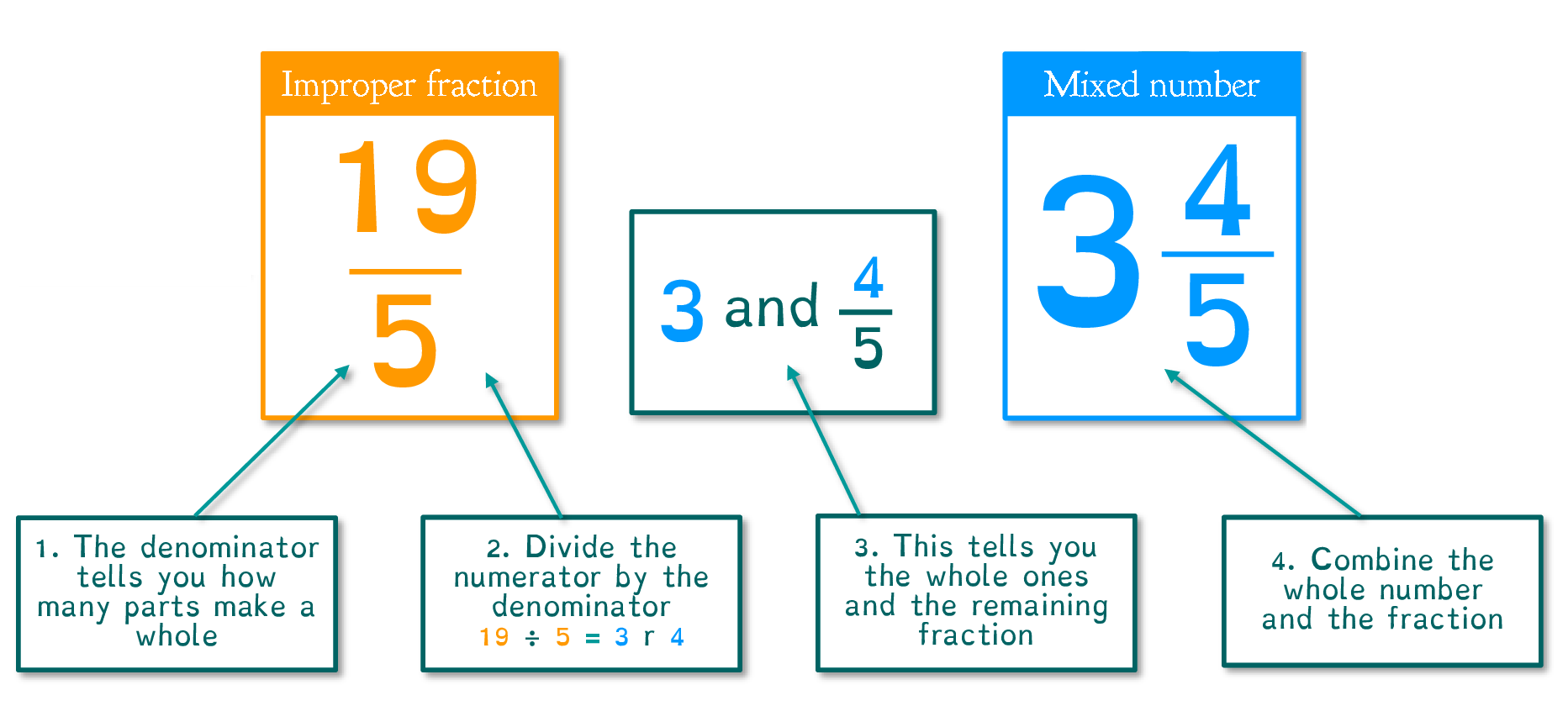
And that, my friends, is the secret sauce! The result of the division is your whole number part. In our 7/3 example, that’s the 2. Ta-da!
Now, what about that leftover bit? That single slice? That’s going to become our new fraction part. And here’s the really neat part: the denominator of your new fraction stays the same as the original improper fraction. It represents the size of the slices you started with.
So, that 1 leftover slice, with a denominator of 3, becomes 1/3. Combine your whole number and your new fraction, and you’ve got it: 7/3 is the same as 2 and 1/3!
Let’s Try Another One (Because Practice Makes Perfect… and More Fun!)
Feeling a little bolder? Let’s tackle 10/4. Imagine you have ten cookies, and each cookie recipe requires four cups of flour. How many full cookie batches can you make?
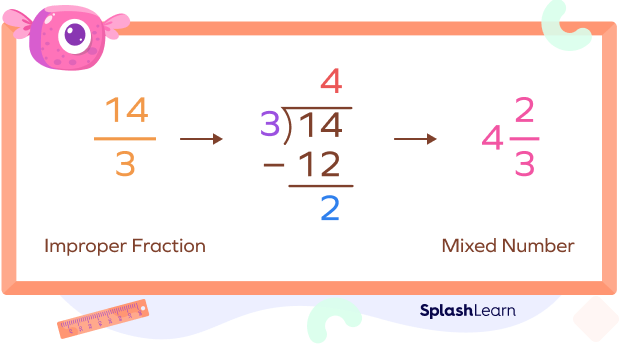
Again, we divide the numerator by the denominator: 10 ÷ 4.
How many times does 4 go into 10? It goes in 2 times (2 x 4 = 8). What’s the remainder? 10 - 8 = 2.
So, our whole number is 2. We’ve made 2 full batches of cookies!
Our leftover is 2. And what’s our denominator? It stays the same, which is 4. So, our fraction part is 2/4.
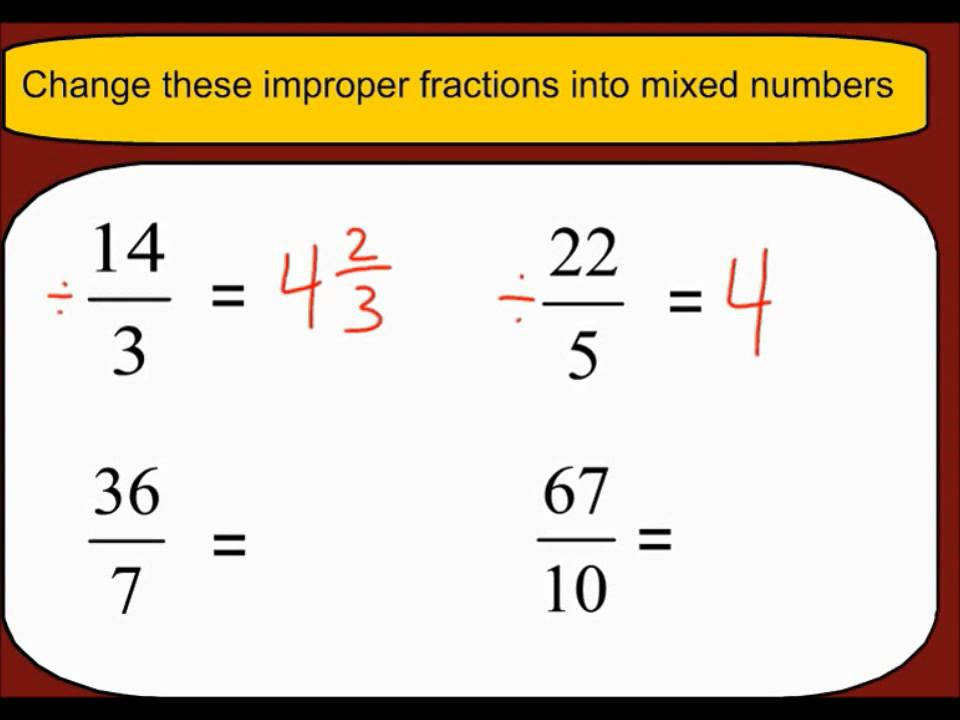
Putting it all together, 10/4 is equal to 2 and 2/4!
Now, some of you might be thinking, "Hey! 2/4 can be simplified!" And you are absolutely, wonderfully correct! That's a fantastic observation. We can divide both the numerator and denominator of 2/4 by 2 to get 1/2. So, 10/4 is also equal to 2 and 1/2. Isn't math just full of delightful little shortcuts and connections?
Why Should We Even Bother?
You might be wondering, "Why go through all this trouble? Why not just stick with the improper fractions?" Great question! Think of it this way: when you're talking to a friend about how much pizza you ate, would you say, "I ate 7/3 of a pizza," or "I ate 2 and 1/3 pizzas"? The second one is so much easier to visualize, right? It paints a clearer picture in your mind.
Mixed numbers are our friends because they give us an immediate sense of quantity. They tell us not just how many pieces we have, but how many full units and then the little bit extra. This makes it incredibly helpful when you're:
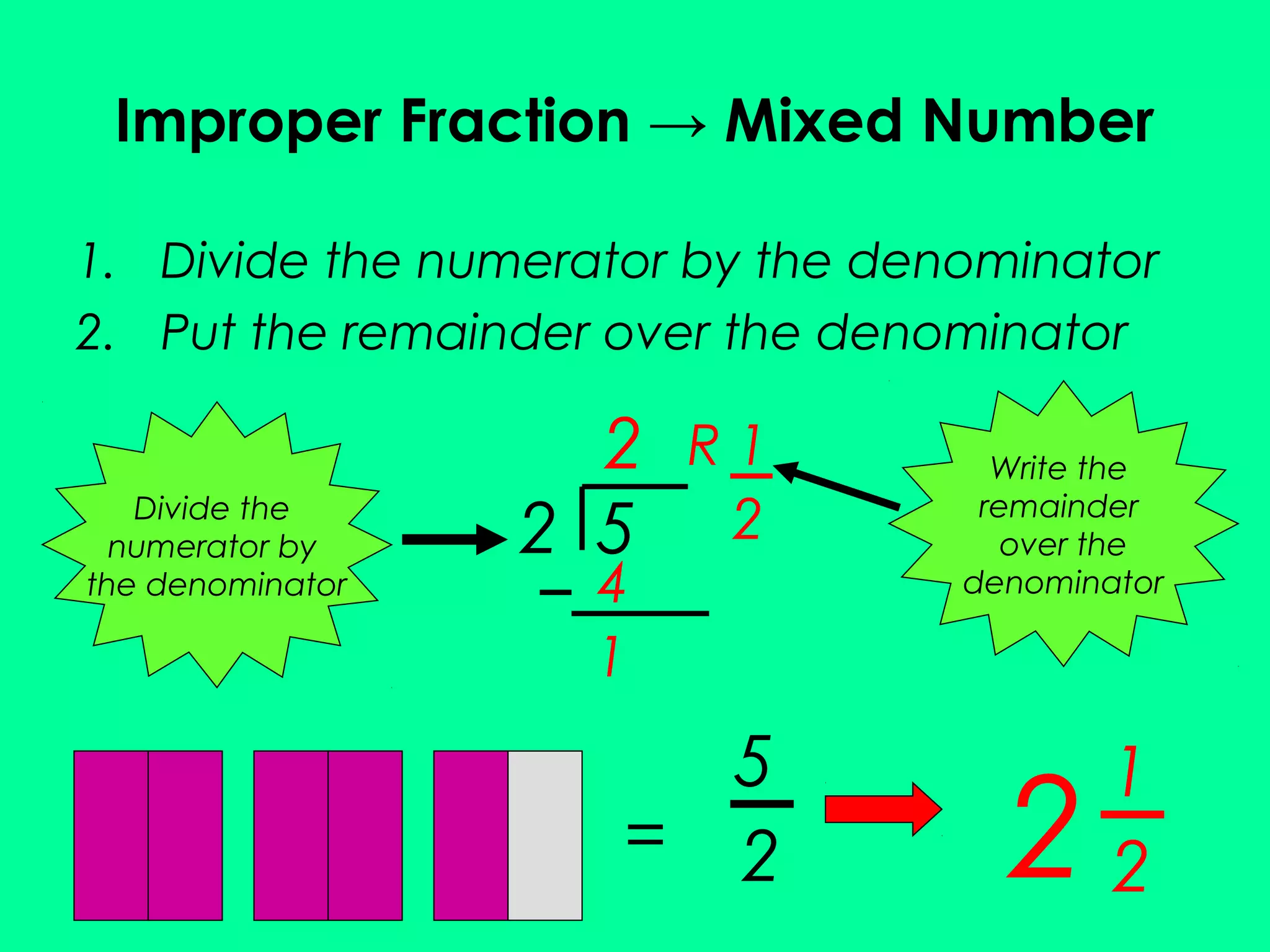
- Baking: Imagine a recipe calling for 5/2 cups of flour. That’s a lot of flour! But 2 and 1/2 cups? Much more manageable to measure out.
- Measuring: Trying to figure out if you have enough fabric for a project? Seeing it as a mixed number gives you a much better idea than a large improper fraction.
- Sharing: If you have 9/4 cookies to share, it's easier to figure out that each person gets 2 whole cookies and 1/4 of another.
It's all about making math more relatable and practical. It’s about translating abstract numbers into concrete, understandable amounts. And that, my friends, is a superpower!
Embracing the Numerical Journey
Learning to convert improper fractions to mixed numbers isn't just about solving problems; it's about building your confidence and your understanding of how numbers work together. It's like learning a new language – the more you practice, the more fluent you become, and the more doors it opens for you.
So, the next time you see an improper fraction, don't shy away. Embrace it! See it as an opportunity to practice your division skills and to transform it into something even more intuitive. Every conversion is a small victory, a step towards greater mathematical mastery.
Keep practicing, keep exploring, and remember that numbers, when understood, can be incredibly powerful and, yes, even a little bit delightful. You've got this!