
How Do You Find The Volume Of An Irregular Shape

Ever looked at a lumpy, bumpy, wonderfully weird object and thought, "Gosh, I wonder how much stuff fits inside that?" You know, like that perfectly imperfect seashell you found on vacation, or maybe even that delightfully squishy stress ball you can't stop fidgeting with. We're talking about volume, folks! The amount of 3D space something takes up. And for those regular, everyday shapes like cubes and cylinders, it's pretty straightforward. But what about the rebels? The ones that defy easy geometric description? Well, fear not, my curious companions, because finding the volume of an irregular shape isn't some ancient, arcane secret reserved for rocket scientists. It's actually a whole lot of fun, and I'm here to spill the (metaphorical) beans!
Think about it. Life is full of irregular shapes! From the magnificent curves of a mountain to the delightfully chaotic sprawl of your kid's LEGO creations, the world isn't exactly built with protractors and compasses. And understanding how to measure them? Well, that just adds another layer of awesome to your everyday observations. It’s like unlocking a secret level in the game of life, where you can suddenly appreciate the oomph of things.
So, how do we tackle these wonderfully oddball objects? We're going to dive into the most universally accessible and downright charming method: water displacement. Yep, you heard that right. We're going to get a little bit wet, and it's going to be brilliant.
The Magic of Water Displacement
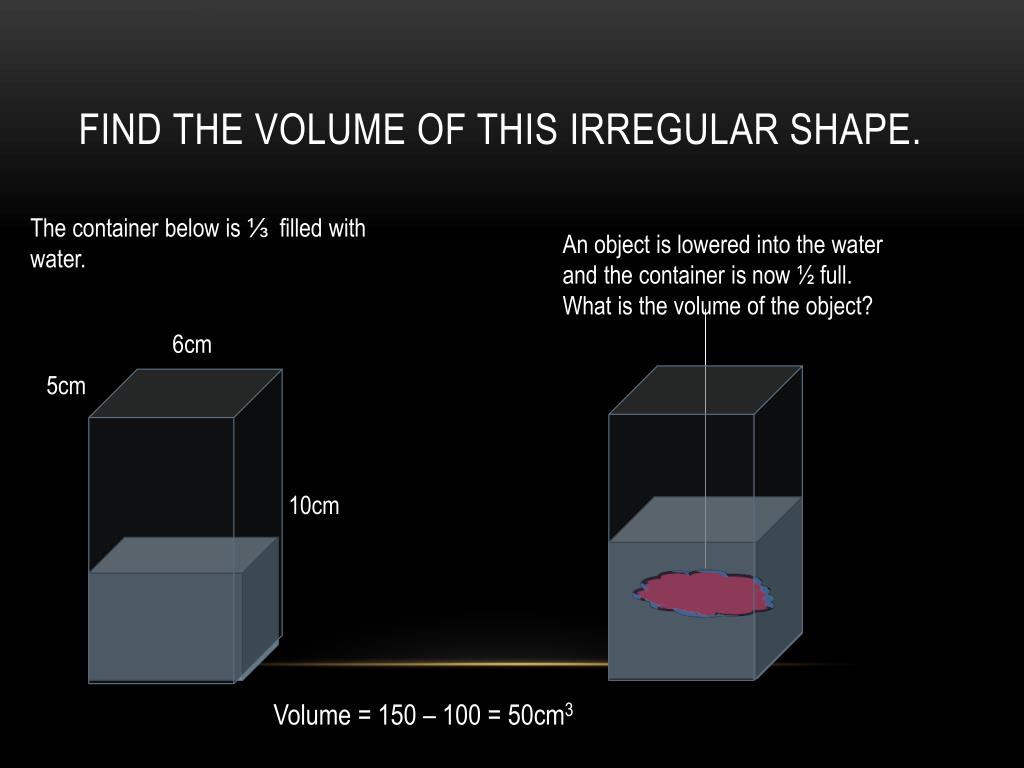
Imagine you have a perfectly sized measuring cup, and you fill it with water to a nice, clear line. Now, what happens when you carefully plop your irregular object into that water? Does the water level stay the same? Of course not! It rises, right? That extra water that's now occupying space has been pushed out of the way by your object. And here's the mind-blowing part: the amount of water that's been displaced is exactly equal to the volume of your object!
It’s like the object is saying, "Excuse me, water, I'd like to take up this much space now. Thanks!" And the water, being a good sport, obliges and spills over or rises up to make room. It’s a simple, elegant principle that works for pretty much anything you can submerge. Pretty neat, huh?
Getting Your Hands (and Objects) Wet
Alright, enough theory, let's get practical! What do you need for this aquatic adventure? For starters, you'll need a container. A tall, clear one is ideal so you can easily see the water level. Think of a graduated cylinder if you're feeling particularly scientific, or even a tall glass or a sturdy jar will do just fine. You also need your mystery object. Make sure it's something that won't dissolve in water, obviously. No soggy sandwiches for volume measurements!
And, of course, you need water. Tap water is perfectly peachy. Now, before you plunge your item in, take a good, long look at the water level. Mentally (or, if you’re feeling fancy, with a marker on the outside of the container!) mark that initial level. This is your starting point, your baseline, the calm before the volume storm.
Next, carefully submerge your irregular shape into the water. Make sure it's fully covered. If your object floats, this is where things get a little cheeky. We’ll address that in a moment, but for now, let's assume it sinks like a charming little stone.
Once your object is happily nestled at the bottom, look at the water level again. See how it's gone up? That's your displaced water! Now, you just need to measure the difference between the new water level and your original mark. If you're using a graduated cylinder, it's as simple as reading the markings. If you're using a regular jar, you might need to pour the water into a separate measuring cup afterwards to get an exact reading. The volume of that spilled or risen water is your object's volume!
Think about that seashell again. You can finally put a number to its beautiful, intricate curves! Or that oddly shaped potato from the grocery store? Now you know its precise potato-ness in terms of volume.
What About Those Floaty Friends?
Okay, so what if your object is a bit of a rebel and decides to bob on the surface instead of taking a dive? No problem! We just need to give it a little nudge. You can use a thin rod or even a pencil to gently push the object down until it's fully submerged. Just remember to only count the volume of the water displaced by the object itself, not the volume of the rod you used to push it down. You can even try to measure the rod's volume separately and subtract it, but that’s getting a bit more advanced and might detract from the simple joy of the initial measurement.

Alternatively, you can add weight to your floating object. A small, dense object that sinks easily (like a few metal washers) can be tied to your floating item to ensure it goes under. Just make sure the weight itself is accounted for in your initial water measurement or measured separately afterwards if you want to be super precise. The goal is to have the entire object contributing to the water displacement.
Beyond the Bathtub: Why This Matters
Why bother with all this watery business? Well, beyond the sheer satisfaction of solving a little mystery, understanding volume has all sorts of fun applications. Imagine you're baking and the recipe calls for a certain volume of flour, but you only have a strangely shaped scoop. Or you want to know how much paint you'll need for a uniquely sculpted birdhouse. This skill is your secret weapon!
It teaches you to think creatively about problem-solving. You're not just following a formula; you're observing, experimenting, and adapting. It’s a hands-on way to connect with the physical world and appreciate the properties of everyday objects in a new light. It’s about seeing the world not just as shapes, but as volumes waiting to be discovered.
And honestly? It’s just plain fun. There’s a certain childlike wonder in seeing how much space something takes up, in the simple act of observation and measurement. It’s a little bit of science that’s accessible to everyone, and it can spark curiosity in all sorts of directions.
Unlocking Your Inner Explorer
So, the next time you encounter an object that makes you scratch your head and wonder about its volume, don't shy away. Grab a container, some water, and your adventurous spirit. You might be surprised at how empowering and enjoyable it can be to unlock the secrets of these wonderfully irregular shapes. This simple technique is a gateway to understanding so much more about the world around you. It’s a reminder that learning doesn't have to be confined to textbooks; it can be found in a glass of water, a quirky object, and a curious mind.
Go forth and measure! The world is full of volumes waiting to be discovered, and you've got the tools to find them. Who knows what other fascinating scientific discoveries you'll stumble upon when you start looking at the world with such an inquisitive eye? Happy measuring!