
How Does A Cathode Ray Tube Work
Hey there! So, you’ve probably seen those chunky old TVs, right? The ones that weigh about as much as a small elephant and take up half the living room? Yeah, those. They used something called a Cathode Ray Tube, or CRT for short. Pretty neat, huh? It’s like a magic box that throws pictures at you, but it’s all science. Let’s dive in, shall we?
Imagine, if you will, a giant, fancy light bulb. That’s kind of what a CRT is, but instead of just glowing, it’s got a mission: to make images appear on your screen. Think of it as a very, very sophisticated laser pointer, but instead of one bright dot, it’s painting with millions of tiny dots. Wild, right?
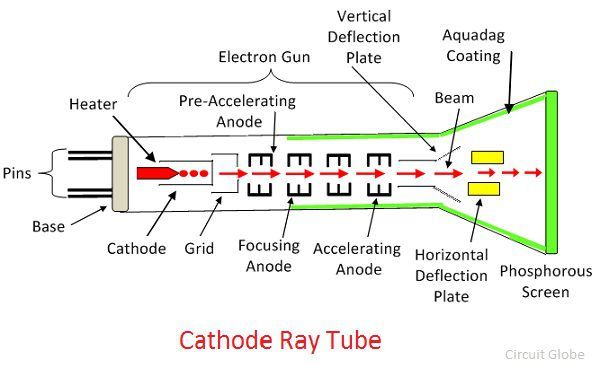
So, how does this whole shebang get started? It all begins at the back of the tube, in a place called the electron gun. This is where the magic really kicks off. It’s like the conductor of our little orchestra, ready to send out the main players: electrons. Lots and lots of electrons. We’re talking about tiny, subatomic particles here, so small you’d need a microscope the size of a planet to see one. And we’re firing them out like tiny bullets. Exciting stuff!
The electron gun has a few key components. First, you’ve got a heated filament. Think of it like the heating element in your toaster, but way more advanced. When this filament gets hot enough, it does something amazing: it releases electrons. It’s like a faucet that starts dripping electrons. Science is cool, isn’t it?
Then, these freed electrons get a little nudge, a push forward. This is usually done by something called an accelerating anode. It’s basically a positively charged plate that really wants those negatively charged electrons to come its way. It’s like a magnet for electrons. Zing! They go flying towards it.
But we don’t just want a wild, uncontrolled blast of electrons. Oh no. We want precision. This is where the focusing anode comes in. Its job is to gather all those scattered electrons and make them form a nice, tight beam. Imagine you’re trying to spray water from a hose. Without a nozzle, it’s just a messy spray, right? The focusing anode is like the nozzle, making sure our electron beam is sharp and defined. So much for a messy spray! We’re talking a super-focused beam here.

Now, this electron beam, all nice and focused, is zooming towards the front of the tube, where your picture is supposed to appear. But how does it know where to go? It doesn’t just randomly hit the screen, does it? Nope! This is where things get really interesting, and a bit mind-boggling if you think about it too much. We have these things called deflection coils, or sometimes a deflection plate system.
These deflection coils are placed around the neck of the CRT, kind of like a collar. They create magnetic fields. And what do magnetic fields do? They influence moving charged particles, like our electron beam! By changing the strength and direction of these magnetic fields, we can steer the electron beam left, right, up, and down. It’s like having invisible hands guiding our electron beam. Pretty clever, eh?
The electronics in the TV are constantly telling these deflection coils what to do, thousands, even millions of times a second. They tell the beam where to move to draw the picture. It’s a dance, a high-speed electron dance! Imagine a tiny, invisible pen drawing on a canvas, but instead of ink, it’s electrons, and instead of a canvas, it’s the inside of a glass screen.
So, the beam is zooming, it’s being steered, but what makes the picture appear? This is where the front of the tube comes into play. The inner surface of the glass screen is coated with a special material called phosphor. Phosphors are these amazing little substances that glow when they’re hit by something energetic, like our electron beam.
Think of it like glow-in-the-dark stars you stuck on your ceiling as a kid. When you shine a light on them (or in our case, hit them with electrons), they absorb that energy and then release it as light. The type of phosphor used determines the color of the glow. So, you have phosphors that glow red, green, and blue. These are the primary colors of light, and by mixing them, you can create pretty much any color you can imagine. Mind. Blown.
Now, a single electron beam can only light up one spot at a time. To create a full picture, especially a color picture, we need a little more sophistication. In color CRTs, there are actually three electron guns! One for red, one for green, and one for blue. And the screen isn't just coated with one type of phosphor, oh no. It’s a fine mesh of tiny dots of red, green, and blue phosphors. Super precise!
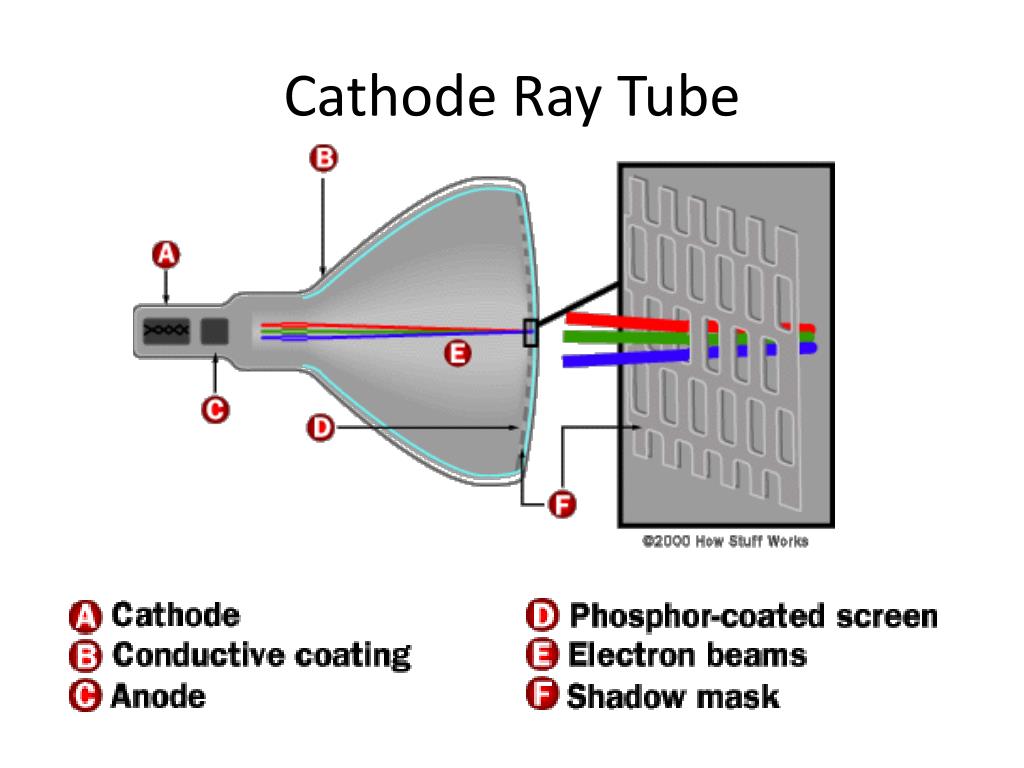
But how do we make sure the red electron beam only hits the red phosphor dots, the green beam only hits the green, and so on? This is where a brilliant piece of engineering called a shadow mask or an aperture grille comes in. This is a metal plate with tiny holes or slots, placed just behind the phosphor screen. The holes are strategically placed so that the red electron beam can only pass through to hit the red phosphors, the green beam to the green, and the blue beam to the blue. It’s like a super-accurate sieve, making sure each electron beam goes exactly where it’s supposed to. No cross-contamination of colors allowed!
So, the electron guns fire their beams, the deflection coils steer them across the screen, and as each beam hits the phosphor dots, they light up. The intensity of the electron beam can be varied, meaning it can make the phosphor glow brighter or dimmer. This variation in brightness, combined with the scanning pattern across the entire screen, creates the illusion of a moving image. It’s a masterpiece of controlled chaos!
The scanning process itself is pretty fascinating. The electron beam draws the image by sweeping across the screen very quickly, line by line, from top to bottom. This is called raster scanning. The entire screen is painted, or rasterized, many times per second. For old analog TVs, this was typically done at a rate of 60 times per second (60 Hz). That’s why older TVs could sometimes produce that annoying flicker, because our eyes could actually perceive the lines being drawn if the refresh rate wasn't high enough. Imagine trying to read a book that was being rewritten page by page in front of your eyes, sixty times a second! It’s a wonder we didn’t all get dizzy.

The signal that the TV receives from the antenna or cable tells the electron guns how intense each of the red, green, and blue beams should be at any given moment, and the deflection coils how to position those beams to paint the picture. It's a constant, rapid-fire process. Thousands of individual points of light, each with a specific color and brightness, are being switched on and off and moved around faster than your eye can track, all to create the smooth motion you see on your screen. It’s like an incredibly detailed, high-speed paint-by-numbers, but with light and electrons!
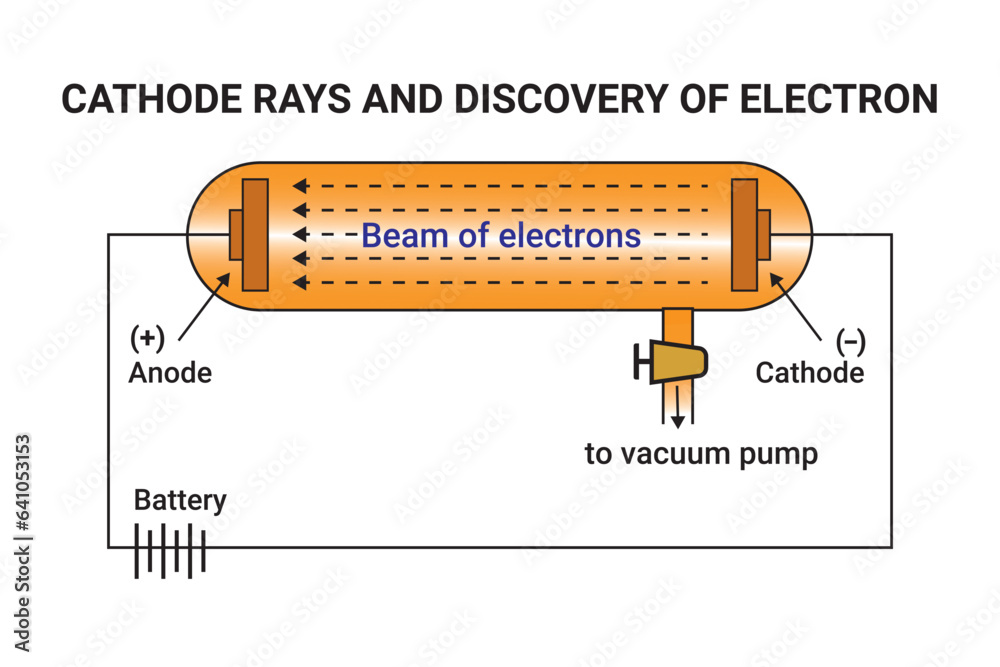
And the vacuum inside the tube? Crucial! The whole thing is a vacuum. Why a vacuum, you ask? Well, electrons, those tiny little guys we’re firing around, would have a really hard time traveling through air. They'd bump into air molecules and get scattered, or their energy would be reduced. So, by removing all the air, we create a clear path for our electron beams to travel from the gun to the screen unimpeded. It’s like clearing the runway for an airplane. Gotta have a clear path!
Think about it: you’re firing these super-fast, tiny particles, and you need them to travel a significant distance without hitting anything. If there were air in there, it would be like trying to play a game of pinball in a room full of balloons. Not going to work very well, is it? The vacuum ensures that our electron beams are as controlled and precise as possible. It’s a silent, invisible hero of the CRT system.
So, to recap: you've got an electron gun spewing out electrons, a focusing system making them into a tight beam, deflection coils steering that beam all over the screen, and a phosphor coating that lights up when hit. All orchestrated by the TV's electronics, receiving signals that tell it what to draw and where. It’s a beautiful symphony of physics and engineering, all happening inside that big glass box. Pretty amazing, right? It’s no wonder these things were the king of home entertainment for so long, before the sleek, flat screens took over. They were a marvel of their time, a true testament to human ingenuity. Next time you see one of those old behemoths, give it a nod of respect. It’s a little piece of history, packed with some seriously cool science.