
How Does A Pitot Tube Work

Ever look up at a sleek airplane and wonder how it knows how fast it's zipping through the sky? It’s not magic, though it sometimes feels like it! Nestled on the wings or fuselage, you'll often spot a tiny, pointy little thing. It looks a bit like a miniature rocket nozzle or maybe even a very serious, very permanent straw. This humble gadget is called a Pitot tube, and it's the unsung hero of airspeed measurement. Think of it as the airplane's very own speedometer, but way cooler.
So, how does this little tube work its magic? Imagine you're sticking your hand out of a car window (safely, of course!). You feel the wind pushing against you, right? The faster you go, the harder the wind pushes. A Pitot tube does something similar, but with a lot more precision and a lot less hair-messing.
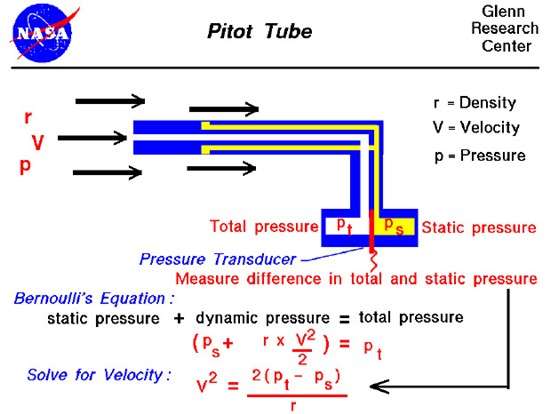
Inside this seemingly simple tube are actually two parts. One part is the bit that faces directly into the oncoming air. This is the stagnation port. When the airplane is flying, the air rushes into this port. But here’s the clever bit: when the air hits the blockage inside the tube, it stops moving. It’s like running full tilt into a brick wall – all that energy has to go somewhere! In the case of the air, it gets squished and its pressure goes up. This increased pressure is called stagnation pressure. It’s like the air giving the Pitot tube a big, firm hug.
Now, for the second part. Around the stagnation port, there’s a little hole, or a series of holes, that are open to the air around the tube. This isn't facing directly into the wind. Think of it as the air casually blowing past, not stopping to say hello. The pressure here is just the normal air pressure, or what pilots call static pressure. It’s the air giving the Pitot tube a gentle pat on the back.
The magic happens when these two pressures are compared. The airplane has a clever device that measures the difference between the stagnation pressure (the big hug) and the static pressure (the gentle pat). This difference, this pressure sandwich, is directly related to how fast the air is moving relative to the airplane. The bigger the difference, the faster the airplane is flying! It's a beautiful, simple principle that has been around for ages, all thanks to a French engineer named Henri Pitot. He was tinkering with this idea way back in the 1700s, long before the Wright brothers even dreamed of flying.

It’s almost poetic, really. This little metal tube, barely bigger than your finger, is essentially using the power of the wind itself to tell us how fast we're traveling through it. It’s like a bird feeling the currents to know its speed, but with a bit more engineering and a lot less chirping.
But there's a funny quirk to our friend the Pitot tube. While it’s brilliant at its job, it’s also a bit sensitive. Remember that open port? It's like a little mouth waiting to swallow anything. This means that sometimes, during winter flights, ice can form around the Pitot tube. If that happens, the stagnation port can get blocked. Imagine trying to measure your speed when your speedometer is covered in a giant ice cube! The readings would be all wrong.

To combat this frosty foe, many Pitot tubes have a built-in heater. Yes, a little heater! So, while the airplane is soaring through icy altitudes, its Pitot tube is keeping itself nice and warm, diligently doing its job. It's like a tiny, brave soldier fighting off the cold so everyone can know how fast they're going. It’s a surprisingly heartwarming thought, isn't it? This tiny piece of metal, working tirelessly, often battling the elements, all for the sake of a safe and accurate flight.
And it’s not just big airplanes! Even small propeller planes, the ones you might see at local airports, rely on these trusty Pitot tubes. They’re the little guys that help pilots navigate, land, and take off with confidence. So, the next time you see one of these slender tubes on an aircraft, give it a little nod of appreciation. It’s a testament to ingenious engineering, a bit of scientific poetry, and a surprisingly cozy heated component, all working together to keep us safely moving through the skies.
It's a bit like using a straw to blow air and measure how hard you're blowing just by the resistance you feel. Simple, yet incredibly effective.
The beauty of the Pitot tube lies in its elegance. It doesn't need complex computers to sense speed; it just needs to feel the air. This fundamental principle, harnessing the direct force of motion, is what makes it so reliable and so enduring. It’s a reminder that sometimes, the simplest solutions are the most brilliant.
Think about it: the entire complex ballet of air traffic control, the thousands of miles traveled, the incredible journeys undertaken – all partly orchestrated by this tiny, unassuming tube measuring a difference in air pressure. It’s a small detail that makes a world of difference, a quiet guardian of our aerial adventures. So, next time you’re on a plane, take a peek out the window. If you see that little probe, you’ll know you’re looking at a marvel of engineering, a testament to human ingenuity, and the hardworking heart of how an airplane knows it’s flying.