
How Strong Is The Gravity Of A Black Hole
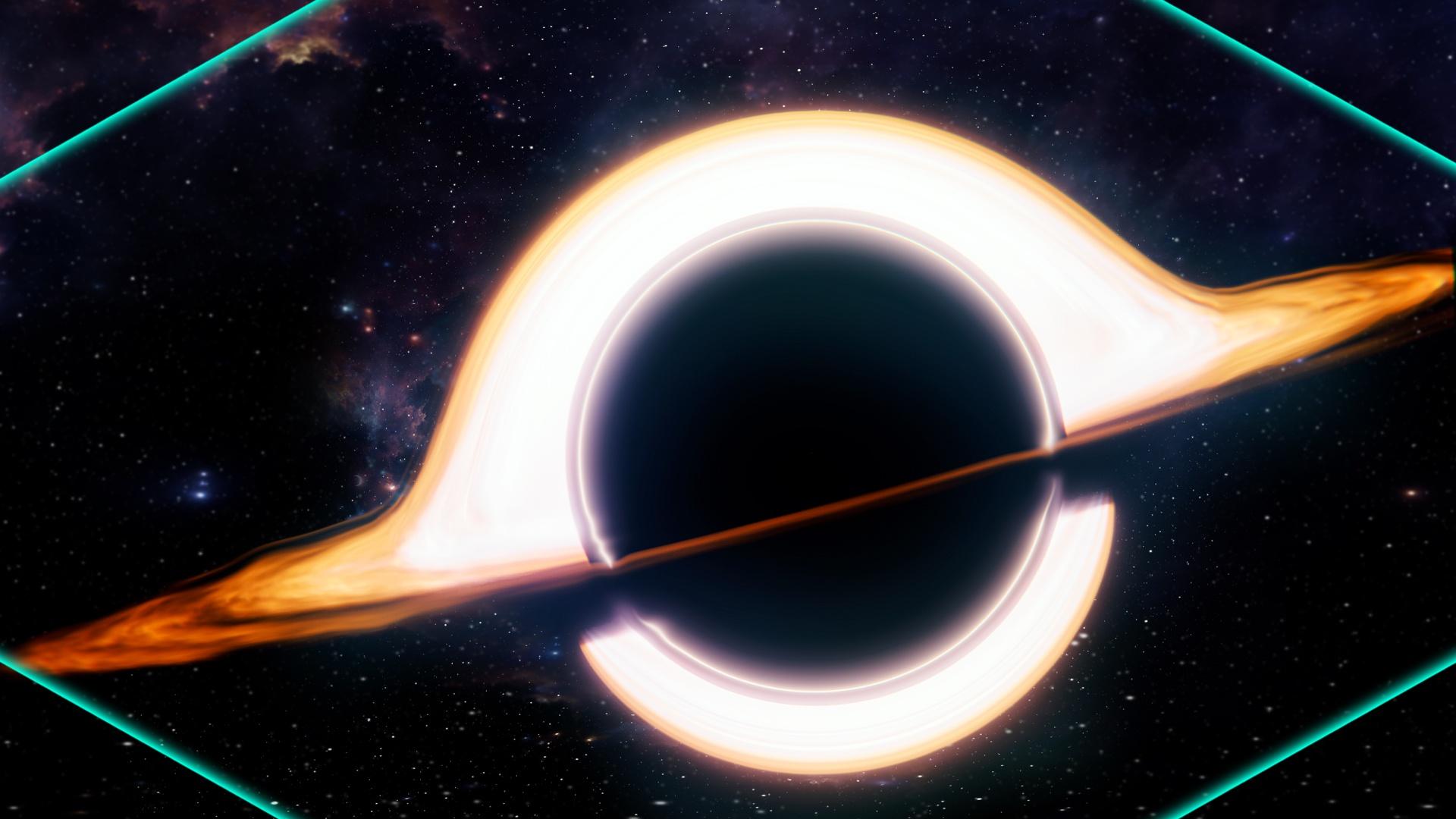
Imagine a cosmic vacuum cleaner, but instead of dust bunnies, it sucks up anything that gets too close. That’s kind of like a black hole! These incredible objects in space are famous for their super-duper strong gravity. It's so strong, not even light, the fastest thing in the universe, can escape its pull. Think of it like trying to jump off a trampoline with a giant bowling ball sitting in the middle – you just keep getting pulled back down!
But what does "super-duper strong" really mean? Let's break it down with some fun comparisons. If you were to stand on Earth and jump, you’d come right back down, of course. If you were on the Moon, you could jump much higher because the Moon's gravity is weaker. Now, imagine being near a black hole. Jumping would be… well, impossible. You'd be stuck!
The "strength" of a black hole's gravity isn't about its size in the way we usually think of things. A bowling ball is bigger than a marble, so it's heavier, right? With black holes, it's more about how much "stuff," or mass, is crammed into a really, really tiny space. It's like squishing an entire mountain into the size of a pea. Suddenly, that tiny pea has an unbelievable amount of gravitational pull.
Let’s talk about the amazing event horizon. This is like the black hole’s "point of no return." Once you cross this invisible line, you’re pretty much a goner. It’s not a physical wall, mind you. It’s more like a cosmic speed limit sign. Inside the event horizon, you’d have to travel faster than light to get away, and we know that’s not possible.
So, how strong is this gravity? If you were close enough to a black hole to feel its pull strongly, it would be like being hugged by the universe with an iron grip. Imagine all the gravity of the Earth trying to pull you in, but multiplied by… well, a LOT. It’s a force that can stretch and squeeze things in truly bizarre ways. Scientists call this effect "spaghettification." Yes, spaghettification!
Think about it: if you were to fall feet-first into a black hole, the gravity pulling on your feet would be much stronger than the gravity pulling on your head. This difference in pull would stretch you out like a noodle. It's a rather dramatic and, let's be honest, slightly comical image. Poor noodle person!
But don't worry, you don't have to avoid your next trip to space because of this. The black holes we know about are incredibly far away. Our Sun, bless its sunny heart, isn’t big enough to become a black hole. So, we’re safe from being spaghettified by our own star!
The amazing thing is, the gravity of a black hole behaves just like the gravity of anything else outside of its event horizon. If our Sun magically turned into a black hole of the same mass, Earth would continue to orbit it just fine. The only difference would be that it would be a lot, lot darker and colder!
This highlights a crucial point: a black hole's immense gravity is only truly inescapable once you’re inside the event horizon. If you were to orbit a black hole at a safe distance, just like a planet orbits a star, you’d be perfectly fine. You could even imagine a spaceship zipping around one, enjoying the spectacular, albeit dark, views.

Now, let's consider the different sizes of black holes. There are stellar black holes, which are born when massive stars die. These are usually a few times the mass of our Sun. Then there are supermassive black holes, which are millions or even billions of times the mass of our Sun!
These supermassive behemoths are found at the centers of most galaxies, including our own Milky Way. Ours is called Sagittarius A* (pronounced "Sagittarius A-star"). It's like the boss of our galaxy, keeping everything in line with its incredible gravitational might.
The gravity of a supermassive black hole is so strong that it can gobble up entire stars. Imagine a giant cosmic gulp! It pulls gas and dust into swirling disks around it, creating some of the brightest and most energetic phenomena in the universe. It's like a celestial buffet, but with much more dramatic consequences.
So, while the thought of a black hole's gravity can sound terrifying, it's also a testament to the incredible forces at play in the cosmos. It’s a reminder of how much we still have to learn and explore.

Think of it this way: the extreme gravity of a black hole is what makes it so special. It bends space and time around it in ways that fascinate scientists. It’s like the universe’s ultimate puzzle, a mystery waiting to be unraveled.
The sheer power of a black hole’s gravity shapes the galaxies they inhabit. They influence the orbits of stars and gas, playing a vital role in the cosmic dance of the universe. It’s a grand, unseen hand guiding the celestial ballet.
Even though we can't see black holes directly because they don’t emit light, we know they're there by the way their gravity affects things around them. It’s like feeling a strong wind, even though you can’t see the wind itself. You see the trees swaying, and you know the wind is there!
So, the next time you look up at the night sky, remember these incredible objects. Their gravity is not just a force of destruction, but also a fundamental part of the universe's structure and evolution. They are the silent, powerful architects of the cosmos, and their strength is truly awe-inspiring.
It's the ultimate cosmic hug, a pull so strong it defines the very fabric of reality around it. And while we'll likely never get close enough to experience it firsthand, the thought of such immense gravitational power is a wonderful thing to ponder. It's a reminder of the vast, mysterious, and utterly amazing universe we live in!
Remember, the gravity of a black hole is a gentle giant from afar, but an unyielding titan up close. It's a duality that makes them one of the most captivating subjects in all of astronomy. We love them, we fear them, and we are endlessly curious about them!
The strength of a black hole's gravity is not just about what it pulls in, but also what it allows us to understand about the universe. It pushes the boundaries of our knowledge and inspires us to keep asking "what if?" and "how?" It's the ultimate cosmic motivator!