
How To Calculate Thickness Of Aluminum Foil
Ever stared at a roll of aluminum foil, the kind that gleams like a superhero's cape in your kitchen drawer, and wondered… just how thin is this stuff, anyway?
I mean, we all know it's thin. It's foil, after all. It tears if you look at it funny, it crinkles like a mischievous goblin's laughter, and it’s basically the culinary equivalent of a high-five for your leftovers. But have you ever stopped to think about the actual, honest-to-goodness, scientifically-measurable thickness?
Probably not. And that's okay! Most of us are too busy trying to wrangle it into covering that ridiculously shaped bowl of pasta without it looking like a collapsed tent. But for those of us who are just a tad more curious, the kind of person who wonders why socks disappear in the dryer or if pigeons have existential crises, this is for you.
Calculating aluminum foil thickness isn't some arcane wizardry. It’s actually quite approachable, even if you haven't touched a ruler since you were forced to measure your height in elementary school (and felt vaguely violated by the whole process).
The "Why Bother?" Section (A.K.A. Because We're Nosy)
So, why would anyone want to know the thickness of their kitchen foil? Besides the sheer, unadulterated joy of knowing things? Well, sometimes it actually matters!
Think about it. That super-duper, heavy-duty foil you bought for Thanksgiving turkey requires a bit more oomph to tear than the bargain-bin stuff. That's because it's thicker. Higher thickness often means more strength, better heat distribution (especially for grilling), and less chance of it disintegrating like a bad dream when you're trying to wrap up that last piece of foil-wrapped potato.
And then there’s the environmental angle. Thicker foil uses more aluminum. So, understanding thickness can be a tiny, albeit nerdy, step towards making more informed choices, or at least appreciating the resources that go into making that shiny sheet.
Or, let's be honest, it's just a fun little experiment to do on a rainy Sunday when the most exciting thing happening is watching paint dry. You can impress your cat. Or, you know, yourself. That's a win.
The Tools of the (Slightly) Scientific Trade
Alright, let's get down to brass tacks. What do you need to embark on this thrilling thickness-finding mission?
You don't need a particle accelerator or a PhD in metallurgy. We're talking about everyday stuff. Think of it like baking a cake – you don't need a Michelin-star kitchen, just the basic ingredients and a willingness to get a little flour on your nose.
- Your Aluminum Foil Roll: This is kind of crucial. Unless you're planning to measure the thickness of imaginary foil, which, while a noble pursuit, isn't what we're going for today.
- A Ruler (or Measuring Tape): The good old reliable. Doesn't have to be a fancy architect's ruler. Your kid's school ruler will do just fine.
- A Calculator: For when your brain decides to take a tea break.
- A Small, Dense Object (Optional but helpful): Like a coin, a button, or a really smooth pebble. This will help you get a more consistent reading.
- A Sense of Adventure: This is non-negotiable.
That's it! See? We're not asking you to invent a time machine here. Just some basic household items and a sprinkle of curiosity.
Method 1: The "Layering is Caring" Approach
This is probably the most intuitive and easiest way to get a rough idea of your foil's thickness. It’s like stacking cookies to figure out how thick a single cookie is – a concept we've all intuitively grasped, probably during a late-night snack session.
Here’s the lowdown:
- Grab Your Foil: Gently unroll a good length of your aluminum foil. We're talking a decent chunk, maybe a foot or two. Try to keep it as flat as possible. No need for surgical precision here, but don't crumple it into a ball like a frustrated chef.
- Make Some Layers: Now, carefully fold this length of foil over on itself. Keep folding. Fold it in half. Then fold it in half again. And again. And again. Aim for a substantial stack. The more layers you have, the more accurate your measurement will be. Think of it as building a really, really thin pillow. Aim for at least 10-20 layers, but more is generally better.
- Measure the Stack: Once you have a nice, thick stack of folded foil, use your ruler to measure the total height of the stack. Try to place the ruler flat against it and get a clear reading. Be as precise as you can. This is where your little dense object might come in handy – place it on the ruler to keep it steady against the foil.
- Do the Math (The Fun Part!): Now for the brainy bit. You know the total height of your stack, and you know how many layers you folded. So, to find the thickness of one layer, you simply divide the total height of the stack by the number of layers.
Example: Let's say you folded your foil 16 times, and your stack measures 0.8 centimeters. The calculation would be: 0.8 cm / 16 layers = 0.05 cm per layer. Ta-da! You've just calculated the thickness of your foil. (And if you want to convert that to millimeters, just multiply by 10 – so 0.5 mm. See? You're practically a scientist now).
This method is great because it amplifies the tiny measurement, making it easier to read. It’s like looking at a single drop of water versus a whole puddle – much easier to see the characteristics of the water when it's in bulk.
Method 2: The "Weighty Matter" Approach (For the Truly Dedicated)
This method is a little more involved and requires a kitchen scale, but it can be quite accurate. It’s like figuring out how much a single grain of rice weighs by weighing a whole bag and dividing. Ingenious, right?
Here’s how it works:
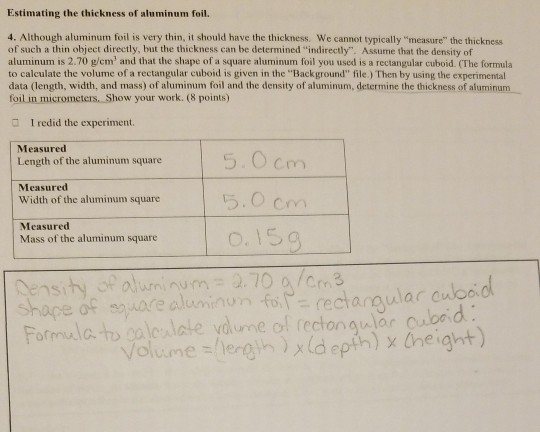
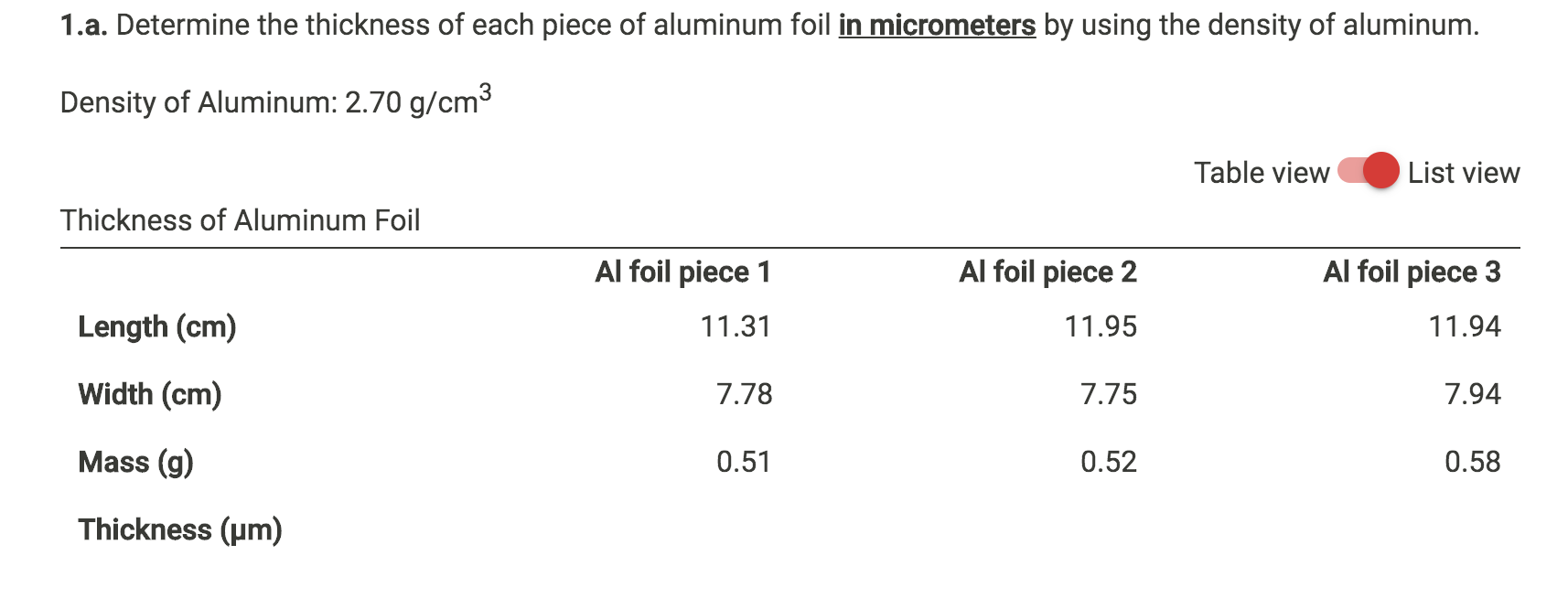
- Get Your Foil (Again): You'll need a known area of foil. The easiest way to do this is to measure the dimensions of your foil roll (or at least the width, if you have that information readily available). Let’s say your foil roll is 30 cm wide.
- Cut a Precise Rectangle: Cut a specific, measured rectangle of foil. For example, cut a piece that is 30 cm wide and 50 cm long. This gives you a known surface area.
- Weigh Your Rectangle: Place your measured rectangle of foil on your kitchen scale and record its weight. Let's say it weighs 2.5 grams.
- Find the Density of Aluminum: This is the part where you might need to do a tiny bit of Googling. The density of pure aluminum is approximately 2.7 grams per cubic centimeter (g/cm³). You can usually find this with a quick search for "density of aluminum."
- Calculate the Volume: Now, we know the weight and the density. We can calculate the volume using the formula: Volume = Weight / Density.
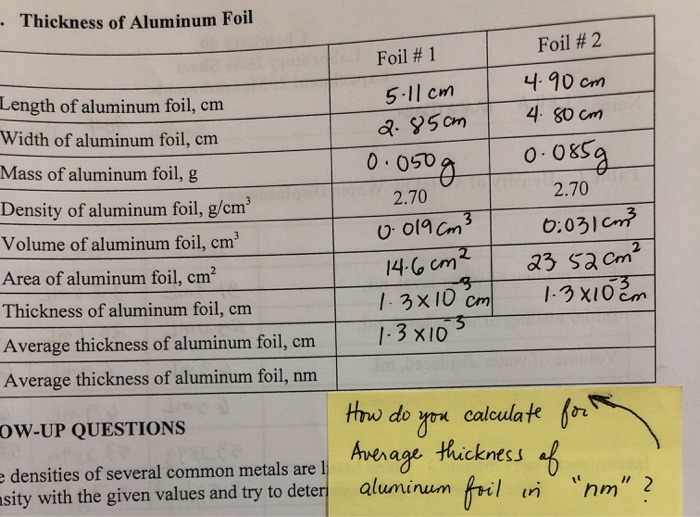
Example: Using our numbers, the volume of your foil rectangle is: 2.5 grams / 2.7 g/cm³ = approximately 0.926 cm³.
Calculate the Surface Area: We already know our foil is 30 cm wide and we cut it 50 cm long. So, the surface area is 30 cm * 50 cm = 1500 cm².
Calculate the Thickness: Finally, we can find the thickness by dividing the volume by the surface area: Thickness = Volume / Surface Area.
So, in our example: Thickness = 0.926 cm³ / 1500 cm² = approximately 0.000617 cm.
To make that number more digestible, let's convert it to millimeters (multiply by 10): 0.00617 mm. This is a more precise measurement, and it's the kind of number you'd typically see for standard kitchen foil. Often, foil is measured in microns (a micron is one-thousandth of a millimeter). So, 0.00617 mm is about 6.17 microns.

This method is a bit more involved, but if you're feeling particularly scientific and have a scale handy, it's a fun way to get a more precise answer. It’s like figuring out the weight of a single sequin by weighing an entire ball of sequins and doing some math. Definitely more involved, but satisfying if you nail it.
What If My Foil Has Two Sides? The Mystery of the Dull and Shiny
Ah, the age-old question: why is one side of aluminum foil shiny and the other dull? And does it affect our thickness calculation? The short answer is: no, it doesn't affect the thickness calculation itself.
The dull side and the shiny side are a result of the manufacturing process. During the final rolling stage, two sheets of foil are often rolled together. The side that comes into contact with the polished rollers becomes shiny, while the side that's against the other sheet of foil becomes dull.
So, whether you measure the dull side or the shiny side, the actual thickness of the aluminum is (mostly) the same. Think of it like a piece of toast: the crispy side and the slightly softer side are still the same piece of bread, just with different surface textures.
The "Is My Foil Even Real?" Panic
Sometimes, after all your careful measuring and calculating, you might get a number that seems ridiculously small. Like, "Wait, this much aluminum is thinner than a single hair?" And that’s when the panic might set in.
But remember, aluminum foil is designed to be incredibly thin. Standard kitchen foil is typically between 10 and 20 microns thick (0.01 to 0.02 mm). Heavy-duty foil might be 25 microns or more.
So, if your calculation gives you a number in that ballpark, congratulations! You've successfully measured the near-microscopic wonder that is aluminum foil.
If you get a number like "10 centimeters," you've probably made a slight miscalculation. Or perhaps you've accidentally invented a new, incredibly thick form of aluminum foil. In which case, please contact the Guinness World Records immediately. And maybe a local metal supplier.
The key is to trust your process and double-check your math. And remember that even slight variations in your measurements can lead to different results. It's okay to be a little off – the goal here is fun and understanding, not scientific perfection.
The Grand Finale: Appreciating the Foil
So, there you have it! You’ve delved into the world of aluminum foil thickness, armed with nothing more than your wits and a few household items. You’ve performed calculations that would make your math teacher proud (or at least mildly surprised).
The next time you reach for that roll of foil, you can do so with a newfound appreciation. You understand that it’s not just a shiny sheet; it’s a carefully engineered marvel of modern manufacturing, designed to be just the right thickness for keeping your food fresh, your grilling successful, and your kitchen adventures a little bit easier.
You might even find yourself casually mentioning to friends, "Oh, this foil? It's about 15 microns thick, you know," and watching their eyes widen in a mixture of admiration and mild confusion. You’ve officially become a foil expert. Go forth and impress!
And if, after all this, you just decide it's still easier to just eyeball it and hope for the best when covering that awkwardly shaped casserole dish, well, that's perfectly fine too. Because ultimately, the most important thing about aluminum foil is its ability to get the job done, no matter how thin it might be.