
How To Determine The End Behavior Of A Function
Alright, so you're staring at a function, maybe it looks like a squiggly line on a graph, or maybe it’s just a jumble of letters and numbers that’s supposed to represent something in the real world. And you’re wondering, "Where is this thing going? What's it going to do when things get really, really big, or really, really small?" Think of it like this: you’re at a party, and the band is playing. You can tell if they’re about to launch into a mellow ballad or a full-blown mosh pit anthem just by listening for a little while, right? That’s kind of what we're doing with functions – we're trying to get a sneak peek at their ultimate vibe.
Determining the end behavior of a function is basically your way of asking, "What's the long-term outlook for this mathematical relationship?" It's like predicting whether your sourdough starter is going to be a consistently bubbly delight or a sad, flat pancake by next week. We're not talking about the nitty-gritty details in the middle, nope. We're focusing on the extremes. The edges. The "what happens when time flies by so fast you can't even blink" scenarios.
The Big Picture: Where's It Headed?
Imagine you're watching a movie. You don't need to know every single plot twist to guess if it's going to be a tear-jerker, a laugh-out-loud comedy, or a suspenseful thriller. You get a feel for it based on the overall tone, the characters' expressions, and those little hints the director drops. End behavior is the same for functions. It’s the big picture.
So, how do we do this without actually, you know, running the function for a gazillion years? Because, let's be honest, nobody has that kind of time. Or processing power. Unless you're a supercomputer that moonlights as a barista, in which case, teach me your ways!
Polynomials: The Predictable Pals
Let's start with our old friends, the polynomials. These are your classic mathematical expressions – things like $x^2 + 3x - 1$ or $5x^3 - 2x$. They're like the sturdy, reliable furniture in your house. You generally know what you're going to get.
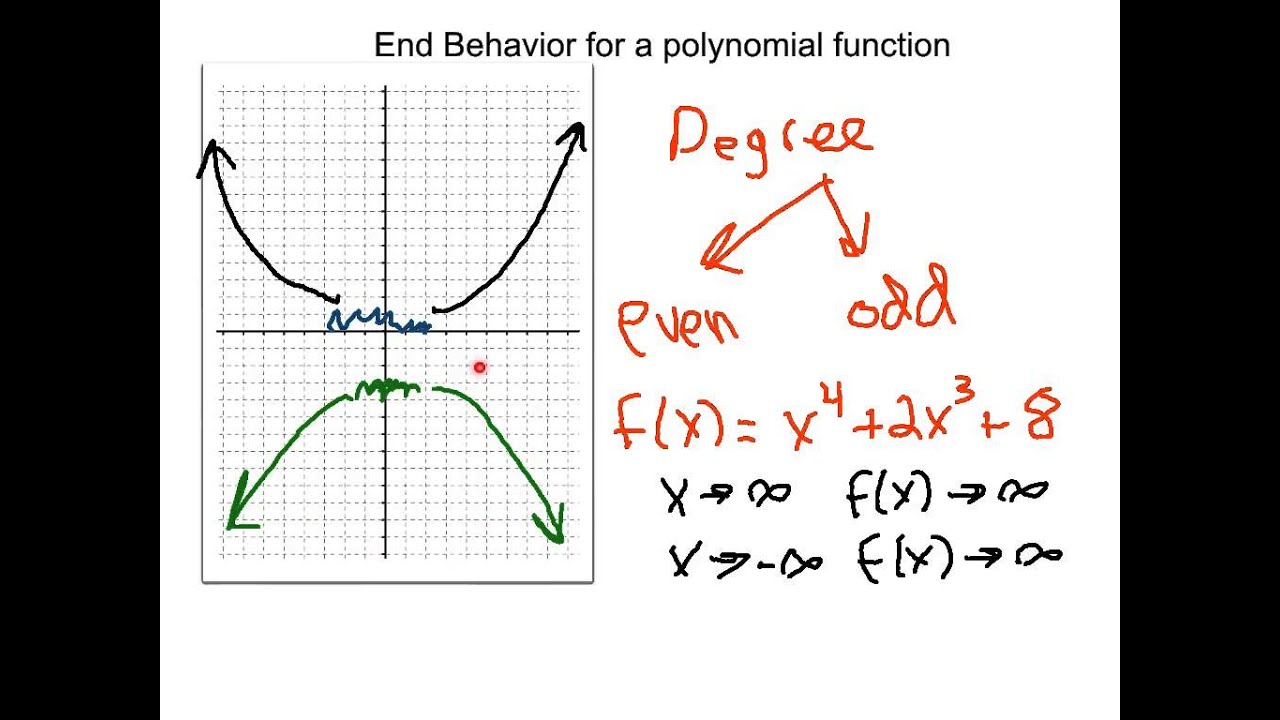
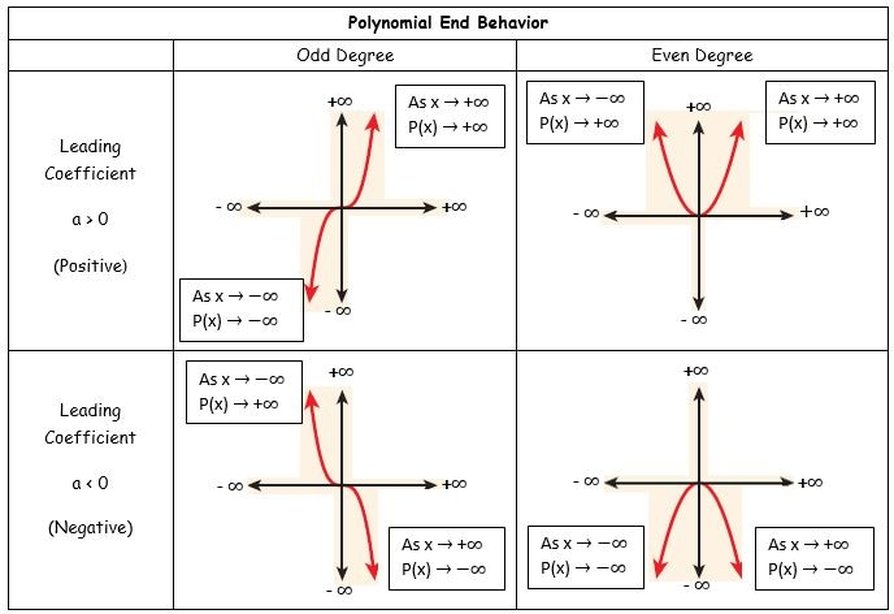
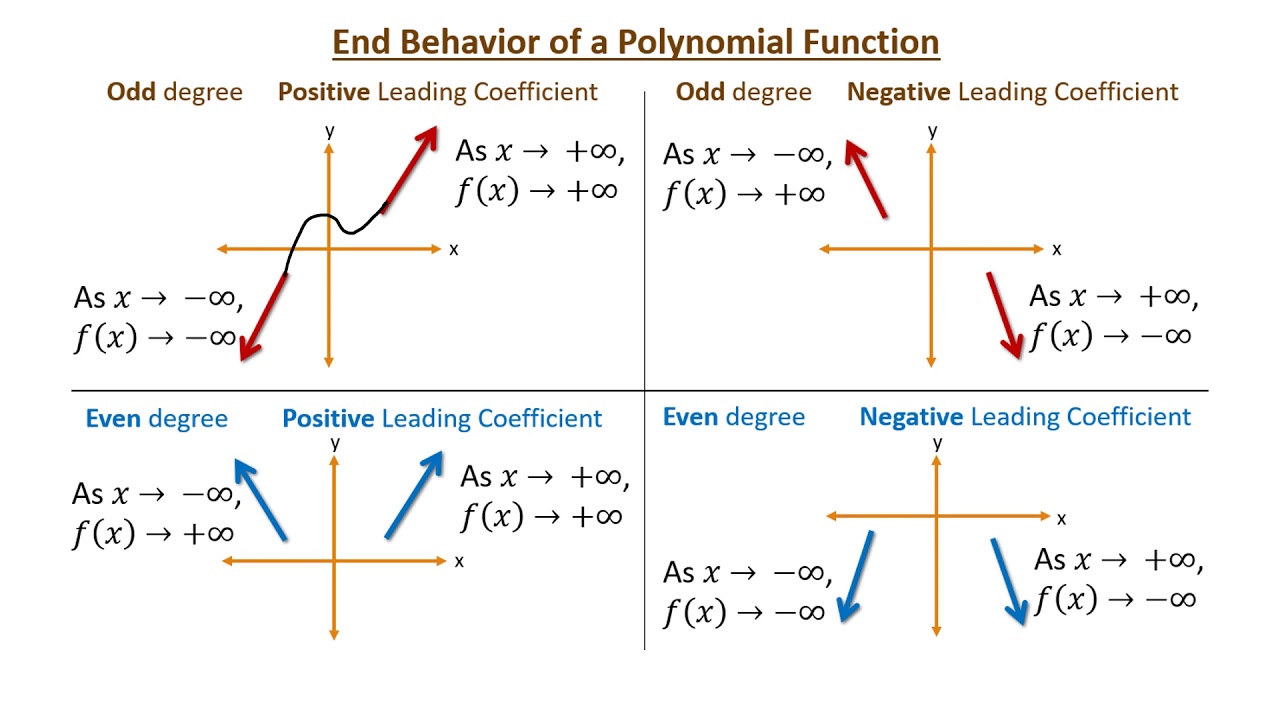
For polynomials, the end behavior is almost entirely determined by the term with the highest power – that’s called the leading term. Think of it as the star player on a sports team. The rest of the team might be good, but that star player is often the one who dictates the game's overall momentum. So, if your leading term is $x^4$, we're looking at something that goes up on both sides. Like a happy little U shape, or a bit of a W if you have some wiggles in between. But ultimately, as $x$ gets super big (positive infinity, baby!), $x^4$ gets super big too. And as $x$ gets super small (negative infinity, bracing for impact!), $x^4$ also gets super big because any negative number raised to an even power turns positive. It’s like a grumpy cat turning into a fluffy kitten when you tickle its belly – a transformation!
Now, what if the leading term is $x^3$? Ooh, things get a bit more dramatic. As $x$ goes to positive infinity, $x^3$ goes to positive infinity. But as $x$ goes to negative infinity, $x^3$ goes to negative infinity. This is like a rollercoaster. It starts climbing up, and then plunges down. The graph will go up on one side and down on the other. It’s less predictable than the $x^4$ but still has a definite direction at the edges.
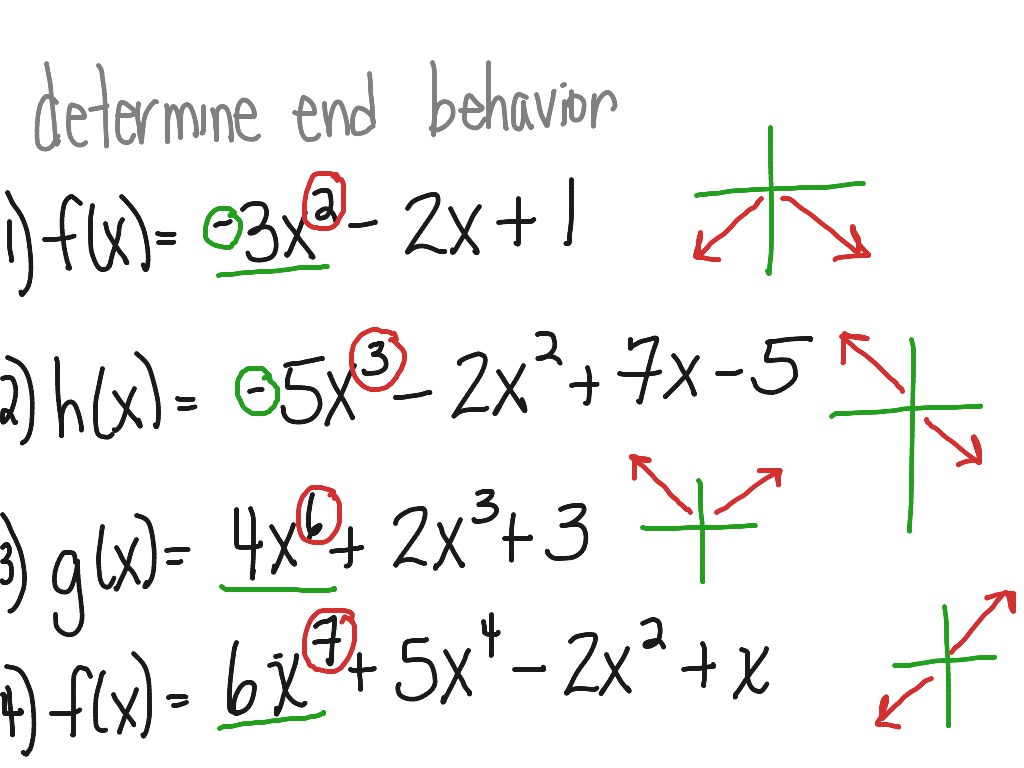
The degree of the polynomial (that’s the highest power) tells you how many times the graph can change direction, like a squirrel deciding which tree to climb. But the leading coefficient (the number in front of the leading term) tells you which way it’s generally pointing at the very ends. If it’s positive, it’s going up on the right. If it’s negative, it’s going down on the right. So, $-2x^5$ will go up on the left and down on the right. It's like a defiant teenager – always going against the grain!
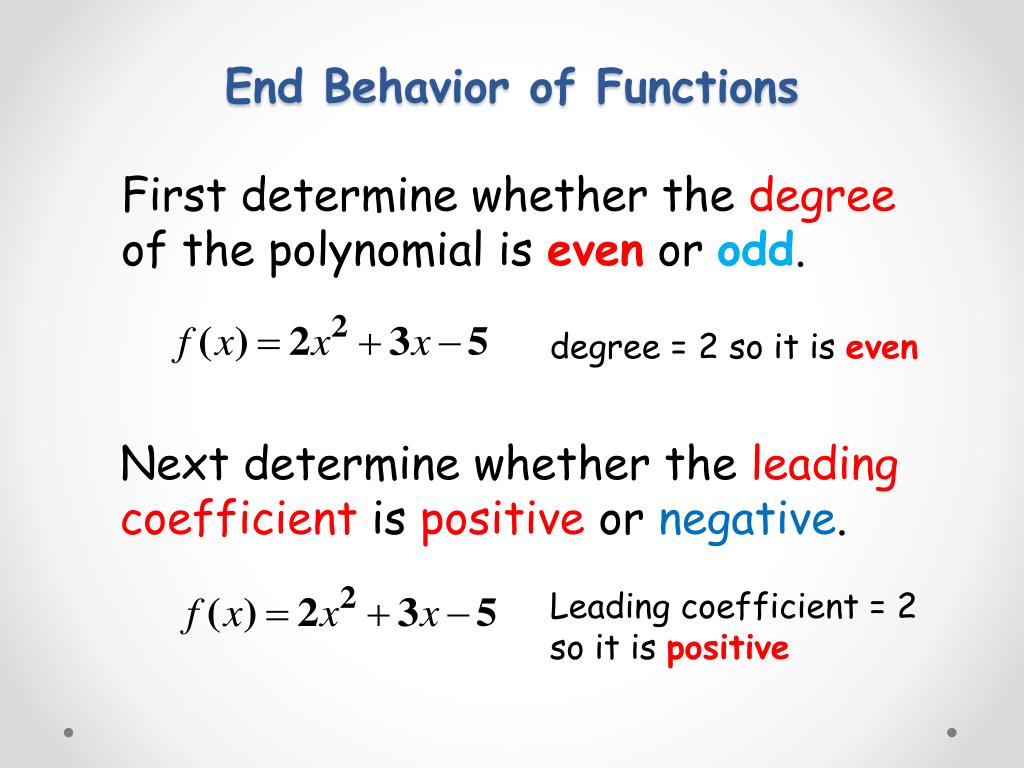
So, for polynomials, the trick is to find that highest power term and then just look at the exponent and the number in front. Easy peasy, lemon squeezy. You don't need to get bogged down in the weeds. It’s like knowing the ending of a story based on the title and the genre – usually a good bet.
Rational Functions: The Tricky Two-Step
Now, let's talk about rational functions. These are functions that are fractions, like $\frac{x^2 + 1}{x - 2}$. These guys can be a little more… spicy. They have more personality, and sometimes, more drama.
For rational functions, we're still interested in the leading terms of the numerator and the denominator. It's like looking at the ingredients list of two competing restaurants. You're comparing the main stars of each dish.
Here’s where it gets interesting. We compare the degrees of the numerator and denominator.
Case 1: The degrees are the same. Let's say you have $\frac{3x^2 + 5}{2x^2 - 1}$. Both the top and bottom have an $x^2$. In this case, the end behavior is determined by the ratio of the leading coefficients. So, in our example, it would be $\frac{3}{2}$. The graph will level off and approach this horizontal line. It’s like two equally matched opponents in a tug-of-war, and they eventually settle into a steady pull. The function will approach the line $y = \frac{3}{2}$.
Case 2: The degree of the numerator is one less than the degree of the denominator. This is where things get really interesting. We get what’s called a slant asymptote or oblique asymptote. This is a line that the function gets closer and closer to, but it's not horizontal. It's like a friend who always walks with you for a while, but then has to go in a slightly different direction. The function will follow this slanted line off to infinity. Think of it like a road that’s constantly curving. You can see the general direction, but it’s not a straight shot.
Case 3: The degree of the numerator is greater than the degree of the denominator. This is the wild child. The function will shoot off to infinity, either up or down, on both sides. It behaves like a polynomial of degree (degree of numerator) - (degree of denominator). So, if you have $\frac{x^3}{x}$, which simplifies to $x^2$ (for non-zero x), it's going to behave like $x^2$. It's like if one restaurant's main ingredient is so overwhelmingly dominant, it completely overshadows everything else. The function will head towards positive or negative infinity, with no polite asymptote to guide it.
Case 4: The degree of the numerator is less than the degree of the denominator. This is the most chill scenario. The function will approach zero. It's like the influence of the main ingredients just fades away, leaving you with… nothing. As $x$ gets huge, the denominator grows much faster than the numerator, making the whole fraction tiny. The end behavior is $y=0$. The function hugs the x-axis like a comforting blanket.
So, for rational functions, it’s all about comparing those degrees and then whipping out those leading coefficients when they're equal. It’s a bit like being a detective, piecing together clues to figure out the ultimate fate of our function.
Exponential Functions: The Explosive Ones
Now, let’s talk about exponential functions. These are functions where the variable is in the exponent, like $2^x$ or $e^{-x}$. These guys are the life of the party, and sometimes, the ones who bring the fireworks.
Consider $f(x) = 2^x$. As $x$ gets bigger and bigger (positive infinity), $2^x$ gets astronomically big. It grows way faster than any polynomial. Imagine a tiny snowball rolling down a hill, picking up more and more snow until it's an avalanche. That’s $2^x$ as $x$ approaches infinity.
But what happens as $x$ gets smaller and smaller (negative infinity)? For $f(x) = 2^x$, as $x$ goes to negative infinity, $2^x$ gets closer and closer to zero. Think of it as the snowball shrinking to nothing. It approaches the x-axis but never quite touches it. It's like trying to reach a perfectly smooth, unattainable surface.
Now, let’s flip it. Consider $g(x) = (\frac{1}{2})^x$. This is the same as $2^{-x}$. As $x$ gets bigger and bigger (positive infinity), $g(x)$ gets closer and closer to zero. It's that shrinking snowball again. But as $x$ gets smaller and smaller (negative infinity), $g(x)$ gets astronomically big! It’s like the snowball is rolling up the hill, getting bigger and bigger, faster and faster.
So, for exponential functions, it's all about whether the base is greater than 1 (explosive growth in one direction, shrinking in the other) or between 0 and 1 (shrinking in one direction, explosive growth in the other). It's like a coin flip for their ultimate destiny!
Trigonometric Functions: The Ever-Repeating Rhythms
And then we have our trigonometric functions, like sine and cosine. These are the ones that go on forever, repeating themselves in a beautiful, predictable cycle. Think of the tides, or your heartbeat. They never really go to infinity or negative infinity in a straight line; they just keep on going.
For functions like $\sin(x)$ and $\cos(x)$, their end behavior is that they oscillate or boundlessly repeat. They just keep bouncing between a maximum and minimum value. The sine wave will always stay between -1 and 1. The cosine wave will too. They don’t head off to the moon or sink to the earth's core. They're content to just keep doing their thing, indefinitely. They're the reliable friend who's always there, doing the same thing, day in and day out. No surprises, just a consistent rhythm.
So, when you see a sine or cosine, you know its end behavior is just… more of the same. It's like a song that fades out, but you know it could easily start up again at any moment. It's the ultimate "no change in destination" scenario.
Putting It All Together: Your End Behavior Toolkit
So there you have it! You've got your polynomials, your rational functions, your exponentials, and your trig functions. Each one has its own way of telling you where it’s headed in the long run.
Remember, the key is to look for the dominant terms or the nature of the function itself. For polynomials and rational functions, it's the highest powers. For exponentials, it's the base. For trig functions, it's their inherent cyclical nature.
It's not about memorizing a million rules. It's about understanding the spirit of each type of function. Are they trying to grow uncontrollably? Are they trying to settle down? Or are they just going to keep doing their groovy dance forever?
With a little practice, you'll be able to look at a function and get a pretty good idea of its ultimate vibe without breaking a sweat. It’s like being a seasoned chef; you can smell the ingredients and know what the final dish is going to taste like. So go forth, my mathematically curious friends, and predict the future of your functions!