
How To Find Reflection Of A Point
Ever looked in a mirror and seen your own smiling face staring back? That's a reflection! But what if we told you that the same magical principle that lets you see yourself in the glass can also be used in the world of math and geometry to find the "mirror image" of a point? Sounds a bit like a secret code, doesn't it? Well, it's not really a code, but it's a super handy skill that pops up in all sorts of cool places, from computer graphics to designing the perfect skateboard ramp. And the best part? It's actually really fun and surprisingly easy to get the hang of!
Think about it. In art, artists use perspective to make flat drawings look like they have depth, and understanding reflections can be a part of that. In video games, those shiny car surfaces or perfectly still lakes? That’s all thanks to the clever use of reflections. Even in everyday life, when you’re trying to figure out the quickest way to a meeting point with a friend, sometimes thinking about reflections can help you visualize the shortest path. It’s like unlocking a little bit of visual superpower, allowing you to see the hidden symmetry in shapes and spaces. Plus, mastering this skill makes you feel pretty smart, like you’ve solved a fun puzzle!
The Mirror Principle: What's the Big Idea?
At its heart, finding the reflection of a point is all about symmetry. Imagine you have a line – this line acts like our mirror. When we reflect a point across this line, we're essentially creating a new point on the opposite side of the line, at the exact same distance away from the line. The line itself acts as the perpendicular bisector of the segment connecting the original point and its reflection. It’s like folding a piece of paper and making a crease; the crease is the line of reflection, and the two halves of the paper are mirror images of each other.
The purpose of finding a reflection is to create a symmetrical image. This is incredibly useful. For instance, in computer graphics, when programmers want to draw a symmetrical object, they might draw half of it and then reflect it to get the other half. This saves a lot of time and ensures perfect symmetry. In physics, reflection is fundamental to understanding how light bounces off surfaces, which is how we see anything at all! In architecture and design, understanding reflection can help in creating visually appealing and balanced structures.
Let's Get Reflecting! Simple Steps for Fun
The magic happens when we work with a coordinate plane, that grid of numbers you might have seen in math class. We can use coordinates (like (x, y)) to pinpoint exactly where a point is. Now, let’s discover how to find its reflection!

Reflection Across the x-axis: The Horizontal Flip
Think of the x-axis as a horizontal mirror running through the middle of your grid. When you reflect a point across the x-axis, its x-coordinate stays exactly the same, but its y-coordinate flips its sign. If the y-coordinate was positive, it becomes negative, and if it was negative, it becomes positive. It’s like the point is doing a little somersault vertically!
For example, let's say you have a point called A at (3, 2). To find its reflection across the x-axis, we call it A' (we often use a prime symbol to denote a reflection). The x-coordinate stays 3. The y-coordinate, which is 2, becomes -2. So, A' is at (3, -2). Easy peasy!
+(-2%2C+-1)+(7%2C+3)+(-7%2C+-3)+(3%2C+8)+(-3%2C+-8).jpg)
Rule for reflection across the x-axis: If point P is at (x, y), its reflection P' is at (x, -y).
Reflection Across the y-axis: The Vertical Flip
Now, let’s flip things around! The y-axis is our vertical mirror. When we reflect a point across the y-axis, the y-coordinate stays put, but the x-coordinate changes its sign. Think of it as the point doing a cartwheel horizontally!
Let's take our same point A at (3, 2). To find its reflection across the y-axis, which we'll call A'', the y-coordinate remains 2. The x-coordinate, which is 3, becomes -3. So, A'' is at (-3, 2).
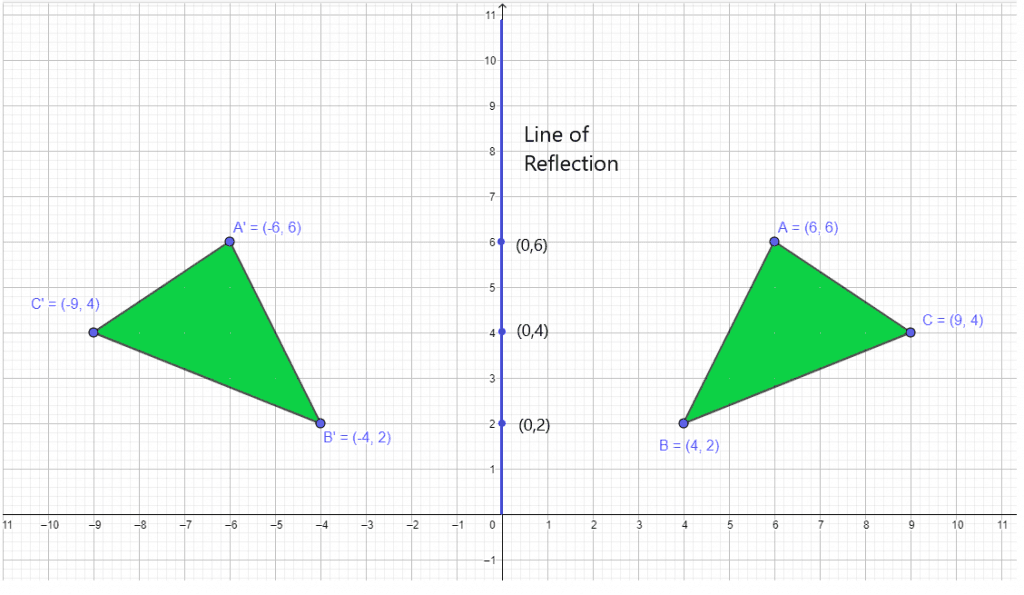
Rule for reflection across the y-axis: If point P is at (x, y), its reflection P' is at (-x, y).
Reflection Across the Origin: The Diagonal Dance
This one is a bit more of a dance! Reflecting a point across the origin (the point where the x and y axes meet, which is (0, 0)) means you're flipping the point through the center. To do this, you change the sign of both the x-coordinate and the y-coordinate. It's like doing a full 180-degree turn.

Using our point A at (3, 2) again, its reflection across the origin, let's call it A''', will have both coordinates flipped. So, 3 becomes -3, and 2 becomes -2. Thus, A''' is at (-3, -2). Notice how this is like reflecting across the x-axis first, and then reflecting that result across the y-axis (or vice-versa)!
Rule for reflection across the origin: If point P is at (x, y), its reflection P' is at (-x, -y).
Finding reflections is a fantastic way to explore symmetry and understand how shapes behave. It’s a fundamental concept that opens doors to more advanced geometry and has a surprising number of real-world applications. So next time you’re doodling or playing a game, remember the power of the mirror – and go find some reflections!