
How To Find The Charge Of A Transition Metal

Ever looked at a shiny metal object – maybe your car keys, a fancy watch, or even that suspiciously blue stain on your favorite shirt (don't ask) – and wondered, "What's the deal with this metal, man?" Well, buckle up, because we're about to dive into the wild, wonderful world of transition metals and figure out their charge. And trust me, it's less intimidating than it sounds. Think of it like trying to figure out how many socks your washing machine actually eats – there's a method to the madness, and once you get it, you'll feel like a tiny chemistry superhero.
You see, transition metals, those cool cats in the middle of the periodic table (you know, the ones that look like they're having a party between the "normal" elements and the "super heavy" ones), are a bit like teenagers. They can be a little moody, they can have multiple personalities, and they're always trying to figure out their place in the world. In chemistry terms, this "moodiness" translates to having different possible charges, or oxidation states, as the fancy folks call it. It's like they can't quite commit to being just one thing. And that, my friends, is where the fun begins!
Decoding the Metal's Mood Swings
So, how do we, mere mortals, figure out what charge a transition metal is rocking at any given moment? It's not like they've got little charge labels stuck on them. Nope. We have to do a little detective work. Think of yourself as Sherlock Holmes, but instead of a magnifying glass, you've got a chemical formula.
The most common way to suss out a transition metal's charge is by looking at the company it keeps. What other elements are hanging out with our metal friend in a compound? These companions are like the friends who influence your behavior. If they're generally a bit bossy (meaning they have a strong pull for electrons), they can dictate how our transition metal behaves, and thus, its charge.
Let's take a classic example. You've probably encountered copper. Copper can be a bit of a chameleon. Sometimes it's copper(I), and sometimes it's copper(II). How do we tell the difference? We look at what it's bonded to. If copper is hanging out with oxygen, for instance, we've got copper oxides. If you see something like CuO, that's copper(II) oxide. Why? Because oxygen is usually a grumpy old soul that likes to be a -2. To make the whole thing neutral (because most compounds want to be chill and not have an overall charge), our copper buddy has to step up and be a +2. Makes sense, right? It's like a seesaw – if one side is really heavy, the other has to compensate to keep things balanced.
But then, you might see Cu₂O. This is copper(I) oxide. Here, oxygen is still being its usual -2 self. But now we have two copper atoms. To keep the seesaw balanced with a single -2 on the oxygen side, each copper atom has to be a +1. So, 2 times +1 equals +2, which cancels out the -2 from oxygen. See? The partners matter!
The "Everything Else" Rule: Your Go-To Cheat Sheet
Now, here's where we bring in our trusty cheat sheet, the "Everything Else" rule. Most elements you'll see partnered with transition metals have pretty predictable charges. Learn these, and you're halfway there. It's like memorizing the basic rules of Go Fish – once you know them, you can play the game.
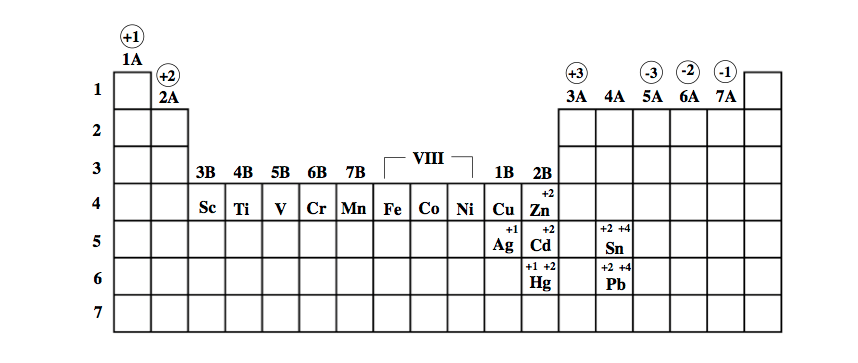
We've already mentioned oxygen. That grumpy one usually likes to be a -2. Then there are the halogens – fluorine (F), chlorine (Cl), bromine (Br), iodine (I). These guys are the "clingy" friends, always wanting to be a -1. They're like that one friend who always needs a ride home; they're predictable in their neediness.
And what about hydrogen? Usually, when hydrogen is with a metal, it's acting like a -1 (a hydride ion). But when it's with a non-metal, it's the usual +1. It's a bit of a Jekyll and Hyde situation, but usually, you're dealing with the +1 version in most everyday compounds you'll encounter.
The key is that compounds as a whole are neutral. This is our biggest clue. Think of a compound like a perfectly balanced scale. If one side has a weight, the other side must have an equal and opposite weight to keep it from tipping over. The charges of the individual atoms must add up to zero.
Let's Get Our Hands Dirty (Figuratively, of Course!)
Let's try another one. Iron. Ah, iron! The stuff of swords, skyscrapers, and that annoying reddish-brown dust that appears on anything left outside for too long. Iron is another one of our multi-talented transition metals. It can be iron(II) or iron(III). How do we know which one we're dealing with?

Consider iron(III) oxide, the stuff that makes rust. Its formula is Fe₂O₃. We know oxygen is -2. So, we have three oxygens, giving us a total negative charge of 3 * (-2) = -6. To balance this out, our two iron atoms must provide a total positive charge of +6. That means each iron atom must be +3 (+6 / 2 = +3). So, it's iron(III).
Now, what if we have iron(II) oxide? The formula is FeO. Oxygen is still -2. To balance this out, our single iron atom needs to be +2. Simple as that! It's like ordering pizza: if you're sharing with one friend and they're only having one slice, you might have to have two. But if you're sharing with two friends and they both have two slices, you might have to have three.
The Polyatomic Ion Twist: When Things Get a Little Complicated
Okay, sometimes it's not just simple elements hanging out with our transition metal. You might see something like a polyatomic ion. These are groups of atoms that stick together and have their own overall charge. Think of them as a little gang that acts as one unit.
The most common culprits are things like sulfate (SO₄²⁻), nitrate (NO₃⁻), carbonate (CO₃²⁻), and phosphate (PO₄³⁻). Notice the little negative numbers at the end? Those are their charges. They're like the group leader's badge.
Let's take iron(III) sulfate. The formula might look a bit intimidating: Fe₂(SO₄)₃. Woah, double woah! But fear not. We know sulfate (SO₄²⁻) has a charge of -2. We have three of these sulfate ions, so the total negative charge from the sulfates is 3 * (-2) = -6. Our iron atoms have to cancel this out. There are two iron atoms, so they must contribute a total of +6 charge. Therefore, each iron atom is +3. Yep, still iron(III).

What about iron(II) sulfate? That would be FeSO₄. Here, we have one sulfate ion (SO₄²⁻) with a -2 charge. To balance this, our single iron atom needs to be +2. See? It's all about balance, like a poorly constructed Jenga tower – everything has to be just right to prevent collapse.
The trick with polyatomic ions is to treat them as a single unit. You know their charge, so just plug it into your balancing equation. It's like knowing your friend's karaoke skills: you know they're going to be off-key, so you factor that into your overall party atmosphere assessment.
The Exceptions: Because Life Isn't Always Fair
Now, are there exceptions? Of course there are! This is chemistry, after all. Some transition metals have a favorite charge they tend to stick with. For example, zinc (Zn) is almost always +2. Silver (Ag) is almost always +1. These guys are the reliable ones, the "always bring dessert" friends of the periodic table. You can usually count on them.
But then you have the real rebels. Manganese (Mn) can be all over the place – +2, +3, +4, +6, +7! It's like that friend who shows up to every party in a different costume. You just never know what you're going to get.
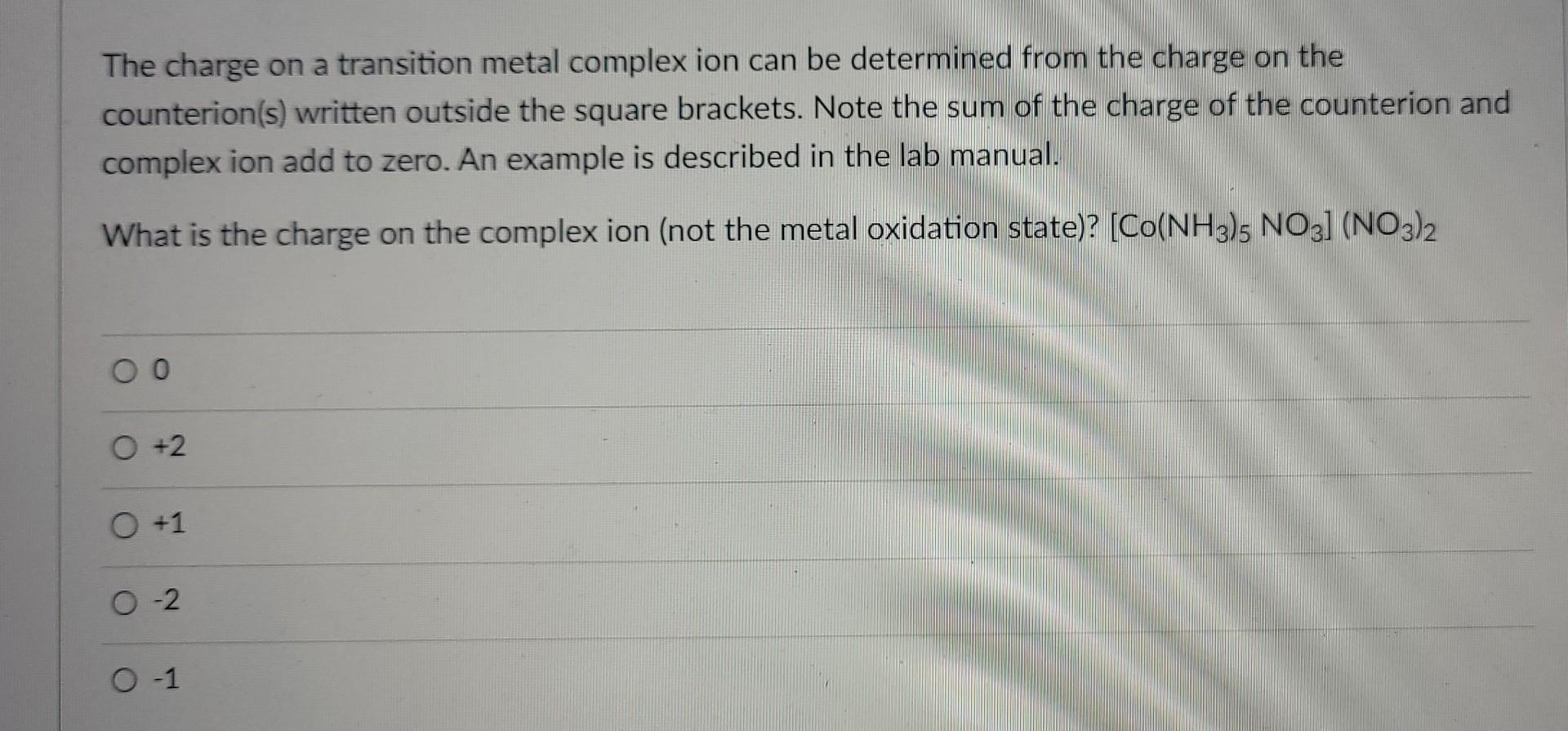
The key takeaway is that for most transition metals, you'll see them with common charges like +1, +2, or +3. If you're unsure, and you're presented with a compound, your first instinct should be to check the charge of the other elements. If they're predictable (like oxygen or halogens), use that to deduce your transition metal's charge.
And remember, the Roman numerals in the names of compounds (like iron(III) oxide) are your best friends. They're literally telling you the charge of the transition metal! It's like a spoiler alert for the metal's identity. If you see copper(I), the Roman numeral is your clue.
Putting It All Together: Your Mental Toolbox
So, to recap, finding the charge of a transition metal is like being a detective:
- Identify the compound: What elements are involved?
- Know your "usual suspects": Oxygen is -2, halogens are -1.
- Polyatomic ions are your gang: Know their charges.
- The whole thing needs to be neutral: The charges must add up to zero.
- The Roman numerals are your cheat sheet: They tell you the charge directly!
It might feel a little overwhelming at first, like trying to assemble IKEA furniture without the instructions. But with a little practice, it becomes second nature. You'll start to recognize patterns, and you'll be able to look at a chemical formula and just know what the transition metal is up to. It’s like learning to ride a bike – wobbly at first, but then you’re cruising!
So next time you see a shiny metal object, take a moment to appreciate its potential for chemical intrigue. It’s not just a boring metal; it’s a complex character with a variable mood, and you, my friend, are now equipped to understand its inner workings. Go forth and decipher those charges! You've got this!