
How To Find The Inverse Of 3x3 Matrix
Alright, gather ‘round, my caffeinated comrades and spreadsheet wranglers! Have you ever stared at a 3x3 matrix and felt a sudden, existential dread? Like you’re about to wrestle a particularly stubborn octopus in a tuxedo? Well, fear not, for today we’re embarking on a grand quest: the noble, the slightly terrifying, the utterly achievable art of finding the inverse of a 3x3 matrix.
Now, I know what you’re thinking. “Inverse? Sounds like something the villain in a sci-fi movie would demand!” And to be fair, it kind of is. Think of your original matrix as a secret code. Its inverse is the decoder ring that unlocks the message. Or, in less dramatic terms, if your matrix does something cool, like transforming your sofa into a flock of pigeons (don't ask how), its inverse would transform those pigeons back into your comfy couch. Magic, right? Almost as magical as finding a parking spot on a Saturday night.
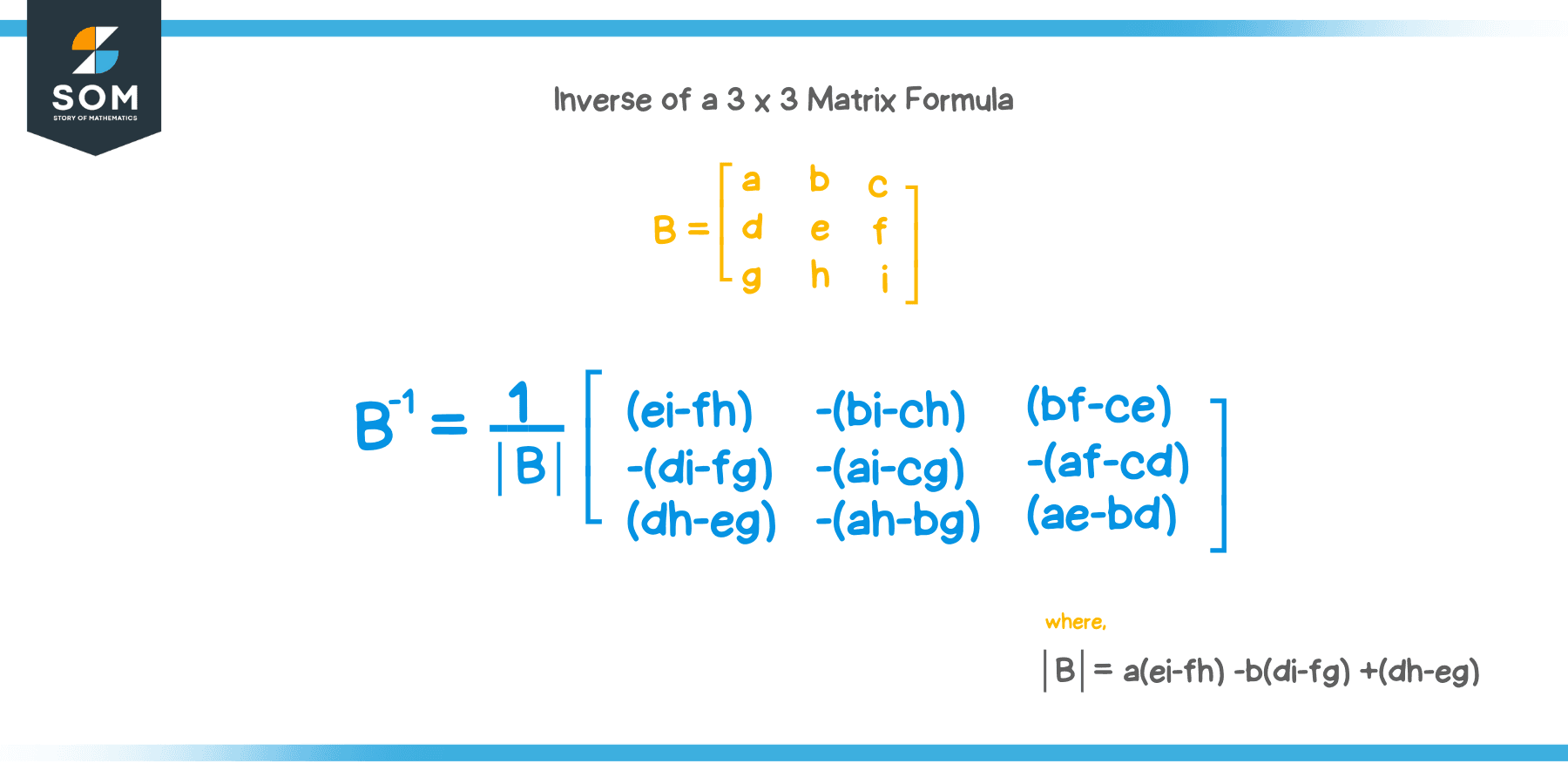
Before we dive headfirst into the numerical abyss, let’s set the stage. A 3x3 matrix is basically a square grid of nine numbers. We’re talking three rows, three columns. Think of it as a tiny, mathematical tic-tac-toe board, but instead of Xs and Os, we’ve got integers, fractions, and maybe even a rogue Greek letter if you’re feeling fancy. So, our victim today looks something like this:
[ a b c ]
[ d e f ]
[ g h i ]
Our mission, should we choose to accept it (and we have, because we’re brave souls), is to find another matrix, let’s call it A-1, such that when you multiply our original matrix A by A-1 (or vice versa, because matrix multiplication can be a bit of a diva), you get the identity matrix. The identity matrix is the superhero of matrices – it’s all ones on the diagonal and zeros everywhere else. It’s like multiplying by one in regular math, but with more pizzazz. It looks like this:
[ 1 0 0 ]
[ 0 1 0 ]
[ 0 0 1 ]
So, how do we achieve this matrix metamorphosis? Well, there are a couple of ways, but the most celebrated, and arguably the most dramatic, involves something called the adjoint matrix and the determinant. Don’t let those fancy words scare you. The determinant is just a single number that tells us a lot about our matrix. It's like the matrix's personality score. If this score is zero, it means our matrix is singular, which is a polite way of saying it’s useless and has no inverse. It's like trying to unlock a door with a key that's just a bent paperclip. No dice.

Step 1: The Grand Determinant Unveiling!
First things first, we need to calculate this determinant. For a 3x3 matrix, it’s a bit of a dance. We use a method called the "rule of Sarrus" (named after a guy who probably had a very interesting handlebar mustache). It involves drawing diagonal lines and doing some addition and subtraction. It’s like a mathematical treasure map! You take the top-left to bottom-right diagonals, multiply the numbers along them, and add them up. Then, you take the other set of diagonals (bottom-left to top-right), multiply those numbers, and subtract that sum from the first one. It's a brain-tickler, but totally doable.
For our matrix:
[ a b c ]
[ d e f ]
[ g h i ]
The determinant (det(A)) is:

det(A) = a(ei - fh) - b(di - fg) + c(dh - eg)
See? It’s just a string of multiplications and subtractions. Think of it as a complex cocktail recipe. Get one ingredient wrong, and the whole thing might taste like regret. Crucially, if det(A) = 0, stop right here. You can’t find an inverse. Go have a biscuit. You’ve earned it.
Step 2: The Cofactor Cascade! (Or, Building the Adjoint’s Building Blocks)
If your determinant is happily non-zero, it’s time to get really cozy with your matrix. We need to find the cofactor matrix. Don’t freak out; this is just a matrix of "cofactors." Each cofactor is associated with an element in the original matrix. To find the cofactor of an element, say ‘a’, you:
- Ignore the row and column that ‘a’ is in. This leaves you with a 2x2 matrix.
- Calculate the determinant of that tiny 2x2 matrix.
- Multiply that determinant by a "sign" based on the element's position. Think of it like a checkerboard pattern of plus and minus signs: +, -, +, -, +, -, +, -, +.
So, for element ‘a’ in the top-left, its cofactor C11 would be +1 * det([e f; h i]), which is +(ei - fh). For element ‘b’ (top-middle), its cofactor C12 would be -1 * det([d f; g i]), which is -(di - fg). And so on, for all nine elements.

This process, while a bit tedious, is like building the individual bricks for our final structure. You’re systematically deconstructing and reconstructing, ensuring each part is accounted for. It’s like a very organized demolition project, but with a constructive outcome!
Step 3: The Adjoint Ascendancy!
Now, you have a matrix filled with these cofactors. This is almost the adjoint matrix. The adjoint matrix is simply the transpose of the cofactor matrix. What’s a transpose, you ask? It’s like flipping your matrix over a diagonal mirror. Rows become columns, and columns become rows. So, the first row of your cofactor matrix becomes the first column of your adjoint matrix, and so on. Imagine your matrix doing a graceful pirouette!
This adjoint matrix is a crucial step. It’s like the secret ingredient that, when combined with the determinant, unlocks the inverse.
Step 4: The Grand Finale - Dividing by the Determinant!
We’re almost there, folks! The moment of truth. To get your inverse matrix, A-1, you simply take the adjoint matrix and divide every single element by the determinant you calculated way back in Step 1. Yes, every single number.
So, A-1 = (1 / det(A)) * Adjoint(A).
This is where that non-zero determinant is your best friend. If it was zero, you'd be trying to divide by nothing, which is a recipe for mathematical disaster. It's like trying to pour a pint of your favorite ale from an empty glass. Tragic.
And there you have it! You’ve successfully navigated the treacherous waters of 3x3 matrix inversion. You’ve stared into the numerical abyss and emerged victorious. Now you can transform pigeons back into sofas, solve complex systems of equations (which, let's be honest, is the real superpower), and impress your friends at parties. Just don’t be surprised if they ask you to calculate the inverse of their grocery bill. Some people just don’t appreciate the finer things in life, like a well-inverted matrix.
Remember, practice makes perfect. The more matrices you invert, the less terrifying they become. Soon, you’ll be whipping out determinants and adjoints faster than you can say "matrix inversion is not a spectator sport." So, grab your calculators, your finest pens, and a strong cup of coffee. The world of linear algebra awaits!