
How To Know Charges Of Transition Metals
Alright, chemistry adventurers! Have you ever looked at a colorful gemstone or a shiny piece of jewelry and wondered what makes it so special? Chances are, you're staring at a magnificent transition metal, and they've got a little secret: they're masters of disguise when it comes to their electrical charge!
Think of transition metals like those super popular friends who can pull off any outfit. They can be a little bit of this, a little bit of that, and honestly, it keeps things exciting! Unlike their more predictable neighbors on the periodic table, these guys are like chameleons, constantly changing their electrical "look."
The Mystery of the Shifting Charge
So, how do we crack the code of these electrifying personalities? It's not some ancient wizardry; it's actually a pretty straightforward concept once you get the hang of it. We're going to dive into the world of ions, which are basically atoms that have either gained or lost electrons, giving them a positive or negative charge.
Imagine electrons are like little bouncy balls. Some atoms are happy to share, some are clingy and hold on tight, and some are generous and give them away. Transition metals? They're the ones who are always rearranging their bouncy ball collections!
Unlocking the Clues
The biggest clue to a transition metal's charge is almost always found in the compound it's hanging out with. Compounds are like little families where different atoms bond together. And just like in any family, there are rules and expectations, especially about who's contributing what.
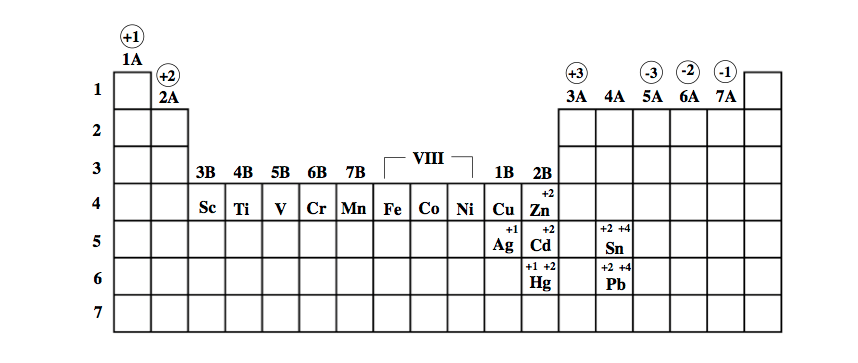
For instance, you'll often see transition metals paired up with elements that are super good at taking electrons, like oxygen or chlorine. These electron-loving elements usually have a very predictable charge. Oxygen, for example, is almost always a "-2," and chlorine is typically a "-1."
Think of oxygen as the ultimate electron vacuum cleaner! It loves to suck up those extra electrons.
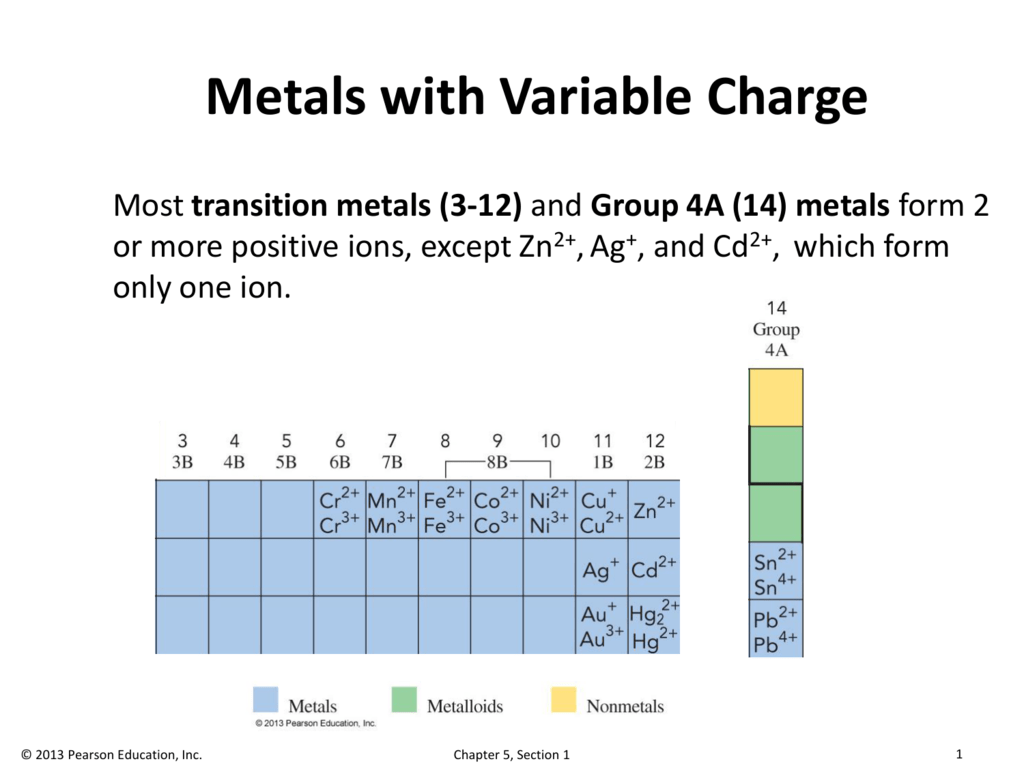
So, if you see a compound like iron oxide, and you know oxygen is a "-2," you can start to piece together iron's charge. Iron is famously known for its multiple personalities, often showing up as +2 or +3.
Let's say the formula is FeO. If there's one oxygen with its trusty "-2" charge, and the whole compound is neutral (meaning the total charges add up to zero, like a perfectly balanced seesaw), then the iron must be contributing a "+2" charge to make everything even. See? It's like a cosmic math problem!
Now, what if you saw Fe₂O₃? This is where it gets a little more interesting. We still have our electron-hoarding oxygen, and we have three of them, so that's a total negative charge of 3 x (-2) = -6. Since the entire compound is neutral, the two iron atoms together must have a total positive charge of +6.
To get a +6 from two iron atoms, each iron atom must be carrying a "+3" charge. Ta-da! Our chameleon, iron, has switched outfits from a "+2" to a "+3."
The Roman Numeral Sidekick
Chemists, being the clever folks they are, have a special way to tell you exactly which charge a transition metal is rocking. They use these neat little things called Roman numerals! When you see a Roman numeral in parentheses right after the metal's name, that's your direct answer.
So, instead of "iron oxide," you might see iron(II) oxide or iron(III) oxide. That little "(II)" is telling you the iron has a +2 charge, and the "(III)" is screaming, "This iron is rocking a +3!" It's like a secret decoder ring for element charges.

Roman numerals are the superhero capes of chemical naming conventions!
This is super helpful because, as we've seen, transition metals like iron, copper, manganese, and cobalt can be positively flirtatious with multiple charges. They're not stuck in one mode like some of the other elements.
Consider copper. It's another popular guy who often shows up as either +1 or +2. If you see copper(I) chloride, the copper is +1. If it's copper(II) chloride, the copper is +2. It’s that simple, and it’s that important!
Practice Makes Perfect (and Fun!)
The more you play with these concepts, the more you'll start to recognize the patterns. It's like learning to identify different types of birds by their songs; soon, you'll be able to spot a transition metal's charge from a mile away.
Don't be intimidated if it feels a bit like a puzzle at first. Every chemist started right where you are, squinting at formulas and wondering, "What's that metal up to now?"
Think of it as a treasure hunt! You're given a compound, and your mission, should you choose to accept it, is to discover the hidden charge of the awesome transition metal within. You've got the clues: the predictable charges of other elements and the helpful (or sometimes absent!) Roman numerals.
So next time you're admiring a beautiful blue sapphire (which often gets its color from cobalt!) or a striking ruby (sometimes colored by chromium!), you'll know that those vibrant hues are thanks to the dynamic, charge-shifting magic of transition metals. They're the rock stars of the periodic table, and understanding their charges is just the first step in appreciating their incredible versatility! Keep exploring, keep questioning, and most importantly, keep having fun with chemistry!