
How To Know The Charge Of Transition Metals

So, you've been scrolling through those glossy home décor magazines, admiring those brushed metal accents, or maybe you're a budding chef eyeing that shiny copper cookware. Ever wonder what makes these metals so… well, transitional? It's not just about their position on the periodic table; it's about their incredible ability to change their "moods," or in science talk, their oxidation states. Think of it like your favourite playlist – sometimes it's chill lo-fi, other times it's upbeat pop. Transition metals are the chameleons of the chemistry world, and understanding their charge is key to appreciating their magic.
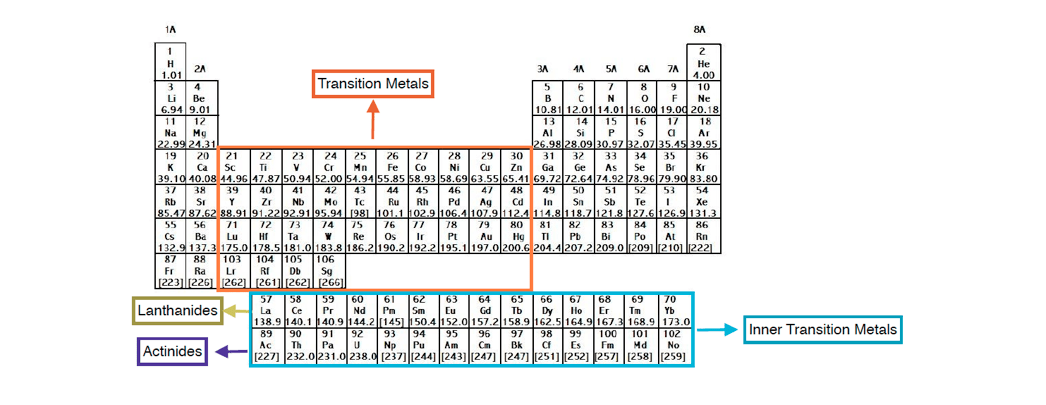
We’re talking about the elements in the middle block of the periodic table, from Scandium (Sc) all the way to Zinc (Zn). They're the backbone of so much in our world, from the vibrant pigments in your makeup to the catalytic converters in your car that keep our air cleaner. But here's the juicy secret: they don't just stick to one charge like a stubborn teenager to their phone. They're flexible, adaptable, and often have multiple personalities.
The "Usual Suspects" and Their Quirky Habits
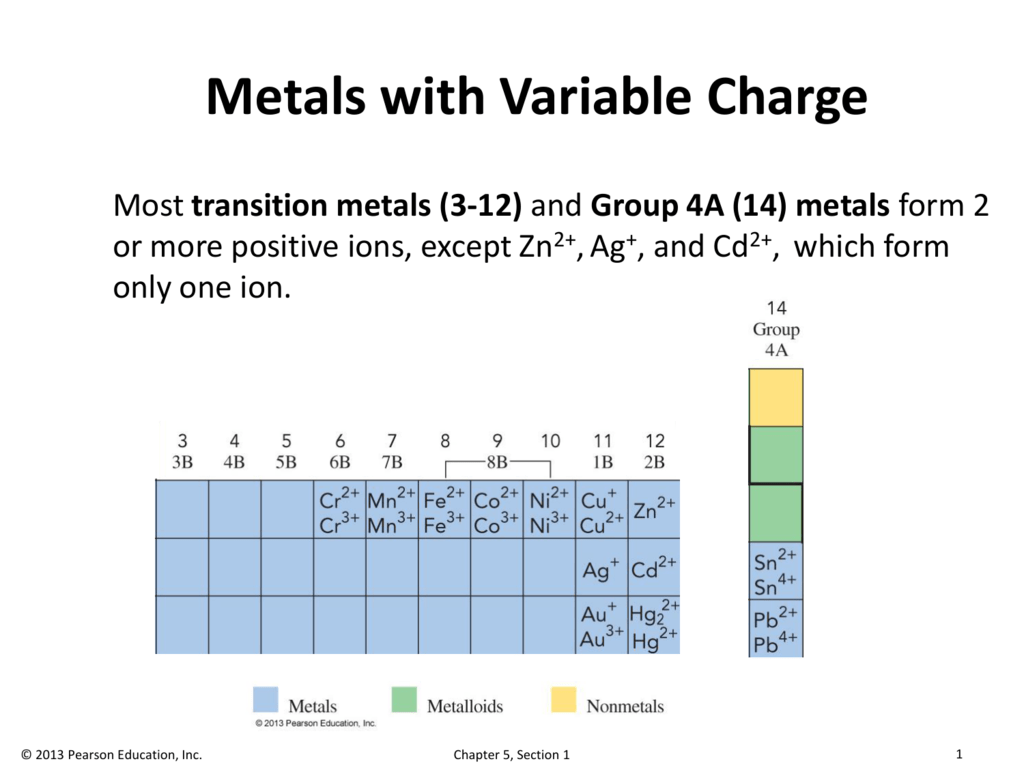
Now, not all transition metals are created equal when it comes to their charges. Some are a bit more predictable, like the "usual suspects" you might encounter. For instance, Zinc (Zn) and Cadmium (Cd) are pretty chill. They almost always rock a +2 charge. It’s like they’ve found their perfect vibe and stuck with it. Easy peasy.
Then you have Silver (Ag). This radiant metal usually hangs out with a +1 charge. Think of it as its signature look, like a classic little black dress. Effortlessly elegant and always in style.
But here's where the fun really begins. Many transition metals are like those friends who can pull off any outfit. They can exist happily with different charges. This is where the term oxidation state comes in. It’s essentially the electrical charge an atom possesses when it forms a chemical bond. For transition metals, these charges can range from +1, +2, +3, all the way up to +7, and even higher in some extreme cases! It’s like having a whole wardrobe of charges to choose from.
Why So Many Charges? The Inner Dance
So, what gives these elements their chameleon-like abilities? It’s all about their electron configuration. Remember those electron shells we learned about in school? Transition metals have electrons in their d orbitals, which are a bit more… well, flexible. Unlike the electrons in the outer shells (which are typically involved in bonding), these inner d electrons can be more easily lost or shared.
Think of it like this: your outer shell electrons are like the clothes you wear to a formal event – very structured. Your d electrons are more like your comfy loungewear or your workout gear – you can mix and match them more readily. This allows transition metals to participate in bonding in a variety of ways, leading to those different oxidation states.

This ability to adopt different charges is what makes them so useful. It’s how they can catalyze reactions, form colourful compounds, and even transport oxygen in our blood (hello, Iron!). It’s the hidden superpower that makes the world go 'round.
Navigating the Charge Game: Tips and Tricks
Alright, so how do you actually know what charge a transition metal is rocking in a particular situation? It’s not always about memorizing a massive list. Here are a few practical tips:
1. The "Balance the Books" Rule (Ionic Compounds):
When a transition metal is part of an ionic compound, the charge is often dictated by the other elements present. The overall compound needs to be electrically neutral. This is like a meticulously balanced budget – everything has to add up to zero.
For example, in Copper(I) Chloride (CuCl), Chlorine (Cl) typically has a -1 charge. To make the compound neutral, Copper (Cu) must have a +1 charge. See? Copper is rocking its +1 vibe here.
Now, in Copper(II) Chloride (CuCl₂), you still have two Chlorines, each with a -1 charge, for a total of -2. To balance this out, Copper (Cu) needs to have a +2 charge. It’s like Copper is saying, "Okay, if you need two negative ones, I can provide two positive ones!"
2. Look for the Roman Numerals (The Cheat Sheet):
In chemical names, those handy Roman numerals in parentheses are your absolute best friends. When you see something like Iron(II) sulfate or Iron(III) chloride, the Roman numeral directly tells you the oxidation state of the iron. It’s like a label on a designer handbag – it tells you exactly what you’re getting!
This is the easiest way to identify the charge. So, Iron(II) means Fe²⁺, and Iron(III) means Fe³⁺. Simple, right?
3. The "Common Charges" List (Your Go-To Guide):
While transition metals are flexible, they do have their favourite charges. There are certain oxidation states they tend to favour. It’s worth having a general idea of these common charges for the most frequent offenders. Here’s a quick rundown of some popular players:

- Iron (Fe): Usually +2 or +3. Think of it as its classic duo.
- Copper (Cu): Frequently +1 or +2. Sometimes it’s the understated +1, other times the bolder +2.
- Manganese (Mn): This one is a bit of a rockstar, often seen in +2, +4, or +7 states. Especially when you see it in colourful permanganate compounds (MnO₄⁻), it's rocking a +7!
- Chromium (Cr): Often +2, +3, or +6. The +6 state, like in chromates, is known for its vibrant yellow and orange colours.
Memorizing these common charges will make identifying them in various compounds much quicker. It's like knowing your favourite band's most popular songs – you can usually guess what they'll play.
4. Context is Key: Look at the Ligands (For the Adventurous):
In coordination complexes (those fancy structures where a central metal ion is surrounded by other molecules or ions called ligands), the charge of the metal ion is influenced by the charges of the ligands. Ligands can be neutral (like water, H₂O, or ammonia, NH₃) or charged (like chloride, Cl⁻, or cyanide, CN⁻).
For example, in the complex [Cu(NH₃)₄]²⁺, ammonia (NH₃) is a neutral ligand. Since the overall charge of the complex is +2, the copper (Cu) must also have a +2 charge. It's like a puzzle where you figure out the missing piece.
If you encounter something like [Fe(CN)₆]³⁻, cyanide (CN⁻) has a -1 charge. With six of them, you have a total of -6 from the ligands. To get an overall charge of -3 for the complex, the iron (Fe) must have a +3 charge. This is a bit more advanced, but it’s like being a detective, piecing together clues.
Fun Facts and Cultural Glances
Did you know that the vibrant colours of many transition metal compounds are directly related to their oxidation states? The famous red of rust is due to Iron being in its +3 state. The beautiful blue of lapis lazuli? That's often attributed to sulfur atoms interacting with iron and copper ions, whose specific charges contribute to the colour.
Think about ancient civilizations and their use of metals. The Egyptians used copper compounds for eye makeup, and the Romans used lead for plumbing (not the best idea in hindsight!). Their understanding of these metals, while not scientific in our modern sense, was deeply practical and often involved observing their properties, which are intrinsically linked to their chemical behaviour and thus, their charges.
Even in modern art and technology, transition metals are indispensable. The bright, stable pigments used in paints and inks often rely on transition metal oxides and salts, with their specific charges influencing the hue and intensity. And in our electronics, from the circuitry in our phones to the plating on our jewellery, these metals play crucial roles, all thanks to their versatile chemistry.
A Daily Dose of Transition Metal Appreciation
So, the next time you admire that shimmering stainless steel appliance, sip from a sturdy copper mug, or even just see the deep red of a brick wall, take a moment to appreciate the incredible, adaptable nature of transition metals. Their ability to switch "charges" is not just a fascinating chemical phenomenon; it's what makes so much of our modern life possible.
It’s a subtle reminder that change, and the ability to adapt, isn’t just a scientific concept; it’s a fundamental aspect of how things work, whether it's a metallic element on the periodic table or us navigating the ever-shifting landscape of our own lives. Sometimes, embracing a different "charge" or a new "state" is exactly what’s needed to create something beautiful, strong, and enduring.