
How To Measure Fluorescent Tube Length
Hey there, fellow curious cats and DIY dabblers! Ever stared at a flickering fluorescent tube overhead and wondered, "You know, how long is that thing, really?" It might sound like a super simple question, right? Like, just grab a ruler and go for it. But oh, if it were only that easy! Measuring fluorescent tubes is a little bit like solving a tiny, illuminating mystery. And trust me, it’s more interesting than you might think!
Why would you even care about measuring a fluorescent tube? Well, let's say your trusty light decides to give up the ghost, and you're off to the store for a replacement. You could just eyeball it, but that’s a recipe for disaster, isn't it? You’ll end up with a tube that’s either too short and looks a bit sad and lost in its fixture, or too long and refuses to even consider going in. Total bummer. Knowing the exact length is your golden ticket to a perfectly fitting, beautifully lit space. Think of it as giving your light fixture a custom-tailored suit!
So, how do we get to the bottom of this luminous length conundrum? There are a couple of main ways to go about it, and they’re both pretty straightforward. Let’s break them down, shall we?
The Direct Approach: The Good Ol' Measuring Tape
This is the most intuitive method, the one that probably popped into your head immediately. And hey, sometimes the simplest solutions are the best! But here’s where the fluorescent tube throws us a curveball. You can't just measure the glass part. Nope, that would be too easy. We need to measure the overall length of the tube, and that includes the little metal pins on either end.
Imagine the tube is a tiny, glowing caterpillar. You’re not just measuring its body; you’re measuring from its nose to its tail, pins and all! So, what you’ll need is your trusty measuring tape or ruler. The kind that’s flexible and doesn't mind a little curving is ideal, but a rigid one works too. You just have to be a bit more strategic.
The best way to do this is to lay the tube down on a flat surface. Make sure you’re in a well-lit area – maybe even turn on a different light if you need to! With your measuring tape, start at the very tip of one metal pin. Then, gently stretch the tape all the way along the tube until you reach the very tip of the other metal pin. And there you have it! That’s your measurement. Easy peasy, right?

Now, you might be thinking, "What if the tube is still in the fixture?" Ah, a valid question! In that case, you can still use your measuring tape, but you’ll want to measure from the edge of one socket to the edge of the other socket where the pins would sit. It's essentially the same measurement, just done in situ. Just be careful not to bump or jiggle the tube too much if it's still connected!
Here's a little pro-tip for you: fluorescent tubes come in standard sizes. You’ll often see them referred to by their length in inches, like 2-foot, 4-foot, or 8-foot tubes. But it’s not exactly 24, 48, or 96 inches. That’s where the whole "overall length" thing comes in. A 4-foot tube, for instance, is typically around 48 inches in total length, but it’s crucial to measure to be sure. It’s like ordering a pizza – you want to make sure you get the size you asked for, not just a general idea!
The "What If I Can't Take It Out?" Scenario
Sometimes, you’re just not in a position to remove the tube. Maybe you’re renting, or you’re just not feeling the whole "hands-on electrical stuff" vibe. No worries! We’ve got a workaround.

This is where it gets a tiny bit more abstract, but still totally doable. You’ll still need your measuring tape. What you’re going to do is measure the distance between the center of the pins on each end of the tube. Think of it like drawing an invisible line straight through the middle of each metal contact point and measuring the space between those lines.
Alternatively, you can measure from the inside edge of one socket to the inside edge of the other socket when the tube is installed. This is essentially measuring the gap the tube needs to fill. It’s a little less precise than measuring the whole tube, but it often gives you enough information to find the right replacement. It’s like guessing someone's height by looking at them compared to a doorway – not perfect, but usually good enough to know if they'll fit!
Why the Length Matters (Beyond Just Fitting)
Okay, so we’ve established how to measure. But why is it such a big deal? Well, it's not just about the physical fit. The length of a fluorescent tube is directly related to its wattage and light output (measured in lumens). A longer tube generally means more power and more brightness.

Imagine trying to light up a huge ballroom with a tiny desk lamp. It just wouldn't work, right? Similarly, putting a short, low-wattage tube in a fixture designed for a long, high-wattage one will result in a dim, sad glow. You might end up with shadows where there should be light, and that’s just no fun.
On the flip side, trying to cram a super-long tube into a fixture meant for a shorter one is a recipe for broken glass and potential electrical hazards. Safety first, always!
The Naming Game: Decoding the Codes
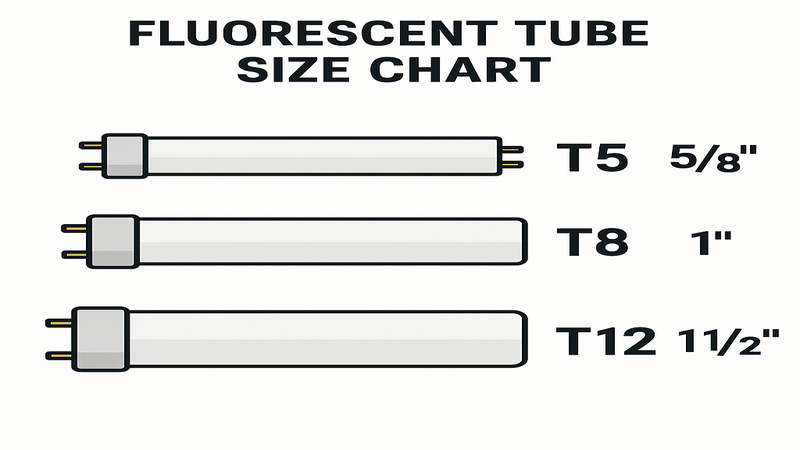
Sometimes, you’ll see numbers on the tube itself, or on the packaging. These aren't just random digits; they often give you clues. For example, a common type is the T8 fluorescent tube. The 'T' stands for 'tubular', and the '8' refers to the diameter of the tube in eighths of an inch. So, a T8 is 8/8ths of an inch, or 1 inch in diameter. Other common types are T12 (1.5 inches in diameter) and T5 (5/8ths of an inch in diameter).

While the diameter is important for compatibility with fixtures (especially older ones), the length is the primary factor for replacement. So, even if you know it’s a T8, you still need to know if it’s a 2-foot T8, a 4-foot T8, or an 8-foot T8.
Think of it like ordering shoes. You need to know your size (like the T8 designation), but you also need to know if you need a regular width or a wide width (like the length). Both are crucial for a perfect fit!
So, the next time you’re faced with a dim or deceased fluorescent light, don’t just shrug and hope for the best. Grab that measuring tape, embrace your inner detective, and get the right length. Your future self, enjoying perfectly lit spaces, will thank you for it. Happy measuring, and may your lights always shine bright!