
How To Name Ionic Compounds With Transition Metals

Ah, the wonderful world of chemistry! Where we get to play with tiny building blocks and make all sorts of cool stuff. Sometimes, though, these building blocks have rather… complicated names. Especially when we start talking about those flashy elements in the middle of the periodic table: the transition metals. Honestly, it’s like they’re trying to make things difficult on purpose.
You know, the ones that look all sparkly and often have pretty colors? Think of iron, copper, and gold. They’re the rockstars of the periodic table, really. But when they decide to team up with other elements to form compounds, things can get a little… hairy.
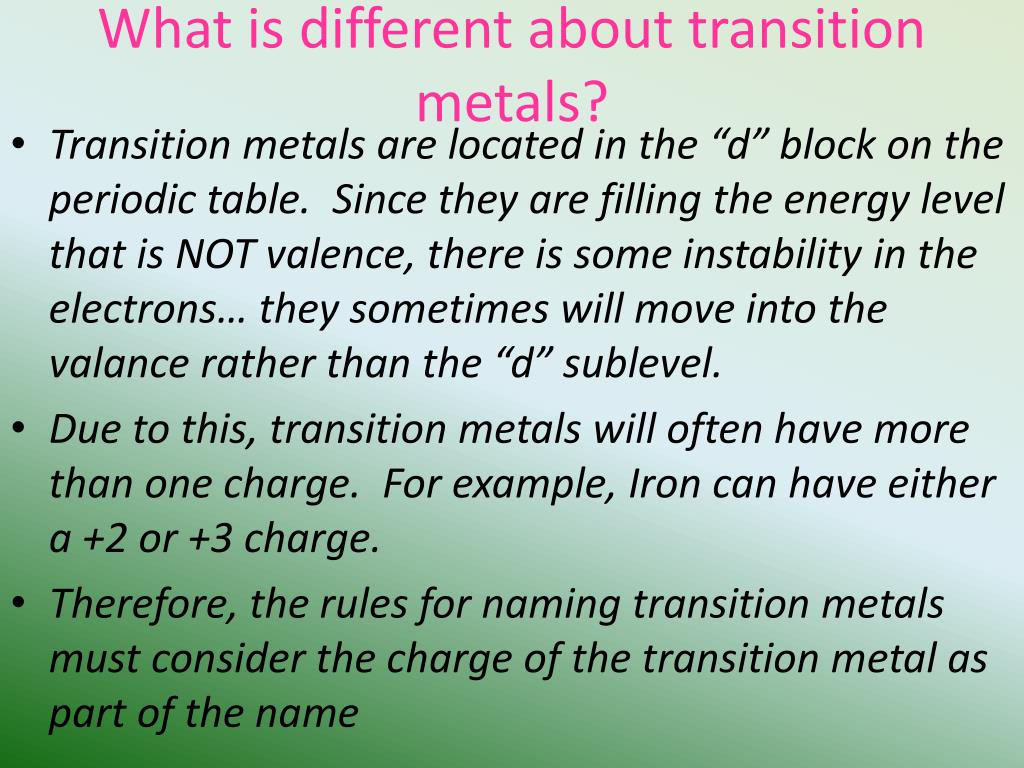
Let's say you have iron. It’s a fairly common element. We see it in nails, cars, and even our blood (though that's a bit more complicated, so let's stick to the simpler stuff for now). But iron, bless its metallic heart, can’t make up its mind. It can be a bit of a Jekyll and Hyde, or perhaps a Loki and Thor.
Sometimes, iron is feeling rather mild-mannered. Other times, it’s a bit more… enthusiastic. This means it can form different types of bonds, and for us naming these compounds, it’s a bit of a headache. It's like trying to pick out a favorite outfit, but then realizing you have several versions of the same outfit, all slightly different.
So, how do we tell these different versions of iron apart when they’re paired up with, say, oxygen? We need a system, of course. And the system, my friends, involves a little something we call Roman numerals. Yep, those handy little symbols that remind us of ancient history class. We're talking about I, II, III, IV, and so on.
These Roman numerals are our secret code. They tell us which version of the transition metal we’re dealing with. Think of them as little badges of honor, or perhaps little “charge” stickers, letting us know the metal’s mood for the day.
Let’s take iron again. It can be iron(II) or iron(III). It’s like having two identical twins, but one is always wearing a blue shirt and the other a red shirt. You need those shirt colors to tell them apart, right?
When iron is in its (II) mood, it forms a compound with, let’s say, chlorine. The chlorine atoms are pretty straightforward. They’re always happy to gain one electron. So, if we have two chlorine atoms to balance out our iron(II), we get… wait for it… iron(II) chloride.

See? Simple. You say the name of the metal, then the name of the other element (with its ending changed to "-ide," like chlorine becomes chloride), and then you pop in those Roman numerals in parentheses right after the metal's name.
Now, what happens when iron is in its more energetic (III) mood? It can bond with three chlorine atoms. And the name for that compound? You guessed it: iron(III) chloride. The only difference is that little number in the parentheses.
It’s a bit like naming a band. You have “The Smiths” and then you have “The Smiths featuring Morrissey.” The core is the same, but the additional detail makes it distinct. In our case, the additional detail is the Roman numeral.
This applies to a whole bunch of other transition metals too. Take copper. Oh, copper! It’s another one that likes to play dress-up with its electron count. It can be copper(I) or copper(II).
If copper is feeling a bit shy and forms a compound with, say, oxygen, it might be copper(I) oxide. If it’s feeling a bit bolder and pairs up with two oxygen atoms, it becomes copper(II) oxide.

It’s honestly one of those things that seems a bit extra at first. Why can’t these metals just pick one way of being? But then you realize, it’s what makes them so versatile. It’s why we have so many different types of materials and technologies based on these elements.
And the naming? Well, it’s just a way of keeping track of all these different personalities. Imagine a party with a bunch of people named John. It would get confusing pretty fast, wouldn’t it? You’d need nicknames, or at least to know their last names. The Roman numerals are our chemical nicknames.
Let’s consider another common culprit: lead. Yes, that trusty metal. It can exist as lead(II) or lead(IV). So, if it’s hanging out with sulfur, which usually likes to grab two electrons, we could have lead(II) sulfide or, if lead is feeling particularly generous with its electrons, lead(IV) sulfide.
And sometimes, they throw in a curveball. Some transition metals, like zinc and silver, are a bit more predictable. They tend to stick to one “charge” or one way of behaving. So, you’ll often see compounds like zinc chloride or silver oxide without any Roman numerals.
It's like having a friend who is always on time and another friend who is always fashionably late. You learn to expect it from them. Similarly, chemists learn to expect certain behaviors from certain transition metals.
But for the ones that are a bit more… capricious, the Roman numerals are our trusty guides. They are the little whispers of information that prevent us from mixing up, say, a tasty compound with a not-so-tasty one. Though I suppose in the lab, neither is truly tasty. Let's stick to the safety goggles.
So, the next time you encounter a chemical name with a number in parentheses after a transition metal, don’t panic. It’s not a secret code meant only for super-geniuses. It’s just a way of saying, “Hey, this metal is doing its thing in a specific way right now!”
It’s a bit like being a detective, trying to figure out the identity of a chemical compound. The "-ide" ending tells you what elements are involved, and the Roman numeral tells you the specific “personality” of the transition metal.
And honestly, while it might seem a bit clunky at first, there’s a certain charm to it. It’s the little details that make chemistry so fascinating. It’s the fact that a single number can completely change the properties of a substance.
So, embrace the Roman numerals! They are your friends in the sometimes-confusing, but always exciting, world of transition metal chemistry. They are the unsung heroes of accurate chemical nomenclature. Go forth and name with confidence, my fellow explorers of the elemental!
Think of it as learning a new language. At first, the grammar rules seem arbitrary, but soon they become second nature. And before you know it, you’ll be fluent in the language of molecules, confidently naming compounds like iron(II) sulfate or copper(I) iodide.
It’s a small step for a chemist, but a giant leap for understanding. And who knows, maybe one day you’ll be the one discovering new compounds and giving them their own unique, Roman-numeral-adorned names.
So, the next time you see that little number in parentheses, give it a nod. It’s just the transition metal letting you know its current mood. And you, my friend, are smart enough to understand.
I think the Roman numerals are actually rather elegant. They're like little footnotes that tell a crucial story about the metal's identity. It's a testament to how much information can be packed into a few simple symbols.
It’s all part of the grand puzzle. And the more pieces you put together, the more you appreciate the intricate beauty of it all. So, don't be intimidated. Be curious. Be amused. And most importantly, be ready to name those transition metal compounds with a smile.