
How To Say The Year In Japanese

So, you're thinking about diving into the wonderful world of Japanese, huh? Maybe you're planning a trip to the Land of the Rising Sun, or perhaps you just love geeking out on new languages. Whatever your reason, knowing how to say the year is a surprisingly handy skill. Think of it like this: it's your passport to understanding when things happened, or when they will happen, in a whole new culture.
It might seem a little daunting at first, but trust me, it's not as complicated as trying to fold a fitted sheet. We'll break it down, nice and easy, so you'll be sounding like a seasoned Japanophile in no time. Plus, who doesn't love impressing their friends with a little bit of linguistic flair? "Oh, that anime? It came out in ni-sen-juu-roku-nen," you'll casually drop, and watch their jaws hit the floor.
Why Bother With Japanese Years? It's Not Just For Time Travelers!
Okay, I get it. You're probably thinking, "Why do I need to know how to say the year in Japanese when my phone already tells me?" Fair question! But learning this isn't just about reciting numbers. It's about connecting with a culture on a deeper level. Imagine reading a historical manga, watching an old samurai film, or even just looking at a beautiful piece of traditional art. Knowing the year it was made, or when the story is set, adds so much context. It’s like suddenly seeing a black-and-white photo pop into vibrant color!
And let's not forget about travel. When you're browsing a quaint little antique shop in Kyoto, or trying to figure out when a festival is happening, understanding the Japanese year system can be a real game-changer. It's not just about dates; it's about understanding the flow of time in Japan. Plus, it’s a really cool party trick. Seriously. Next time someone asks you when something happened, just hit them with the Japanese year. They'll be impressed, guaranteed.
Let's Get Down To Business: The Basics
So, how do they do it? In Japanese, you say the year by combining the numbers with the word for year, which is nen (年). Easy peasy, right? It's a lot like how we say "twenty-twenty-four" – we have the number, then we have the word for the unit.
The tricky part, as with many things in Japanese, is the pronunciation. But don't sweat it! We'll tackle it step-by-step. Think of it like learning to ride a bike. A few wobbles at first, but before you know it, you’re cruising.
Breaking Down Those Numbers
We'll start with the numbers themselves. You probably know some of them already!
- Ichi (一) - One
- Ni (二) - Two
- San (三) - Three
- Shi / Yon (四) - Four (Yes, there are two ways! We'll get to that.)
- Go (五) - Five
- Roku (六) - Six
- Shichi / Nana (七) - Seven (Another one with two options!)
- Hachi (八) - Eight
- Kyuu / Ku (九) - Nine (You guessed it, more options!)
- Juu (十) - Ten
Now, for the slightly bigger numbers:
- Hyaku (百) - Hundred
- Sen (千) - Thousand
- Man (万) - Ten Thousand
See? Not so scary. It’s like building with LEGOs. You start with the small bricks and build up.
Putting It All Together: The Magic of Nen
Now, let’s add the magical word: nen (年), meaning year.
Let's take a super recent year, like 2023.
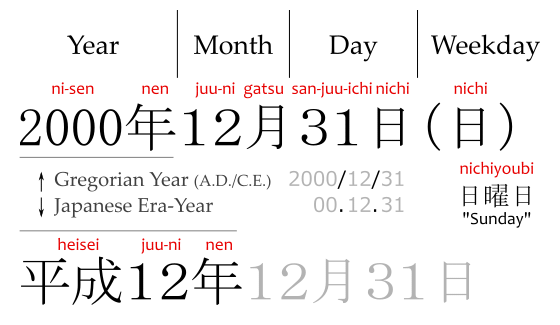
We say "two thousand" as ni sen (二千).
Then we say "twenty" as ni juu (二十).
And finally, "three" as san (三).
So, putting it all together, 2023 becomes ni-sen-ni-juu-san-nen (二千二十三年).
Think of it like saying "two-thousand-twenty-three-year." It’s a direct translation of how the numbers combine.
Let’s try 2024.
We have ni sen (二千) for two thousand.
Then ni juu (二十) for twenty.

And yon (四) for four. Remember, we usually use yon for counting things like years to avoid confusion with shi, which can sound like death.
So, 2024 is ni-sen-ni-juu-yon-nen (二千二十四年).
See the pattern? You break it down from the biggest chunk (thousands) to the smallest (ones).
A Little Story: The Year of the Ramen
Imagine you’re a massive fan of a certain ramen shop. Let’s say your absolute favorite ramen place opened its doors in the year 2011.
How would you say that in Japanese?
We have sen (千) for one thousand.
Then kyuu-hyaku (九百) for nine hundred.
Followed by juu (十) for ten.

And finally, ichi (一) for one.
So, 2011 would be sen-kyuu-hyaku-juu-ichi-nen (二〇一一).
You could tell your friend, "This amazing ramen shop opened in sen-kyuu-hyaku-juu-ichi-nen! It's been serving up deliciousness ever since!" It sounds so much more authentic, doesn't it?
The Curious Case of 4 and 7
You might have noticed those pesky double numbers for four and seven. Why the drama? Well, in Japanese, some number pronunciations sound like unlucky words.
Shi (四) sounds like shi (死), meaning death. So, to avoid bad vibes, people often use yon (四) when counting things, especially years.
Similarly, shichi (七) sounds a bit like shichi (失), meaning loss. So, nana (七) is often preferred for seven.
It’s like how in English we have superstitions about walking under ladders or breaking mirrors. The Japanese language has its own little quirks!
So, for years, you’ll almost always hear yon instead of shi, and nana instead of shichi. It’s a small detail, but it makes a big difference in sounding natural.
Let's Practice!
Ready for a quick quiz? How would you say:
- 1995? (Hint: Sen-kyuu-hyaku-kyuu-juu-go-nen)
- 2005? (Hint: Ni-sen-go-nen)
- 1989? (Hint: Sen-kyuu-hyaku-hachi-juu-kyuu-nen)
Don't worry if you stumble a bit. The key is repetition and practice. Say them out loud. Record yourself. Sing them in the shower! Whatever works for you.
Beyond the Gregorian Calendar: Eras!
Now, here’s where it gets really interesting. Japan also uses a system of eras, called gengō (元号). These eras are tied to the reign of the Emperor.
For example, we are currently in the Reiwa (令和) era. If you hear someone talking about something happening in "Reiwa 5," they mean the 5th year of the Reiwa era, which is 2023.
Each new Emperor ushers in a new era name. This system is still very much alive and well in Japan, especially for official documents and historical contexts. It’s like having different historical periods named after monarchs in Western history, but it’s an active system!
So, when you encounter a Japanese year, it might be given in the Western (Gregorian) calendar format we’ve been practicing, or it could be in the era system.
For example, a date might be written as 令和五年 (Reiwa go-nen) which is 2023.
Why This Matters (Even If You're Just Watching Anime)
Learning to say the year in Japanese isn't just about memorizing numbers. It's about unlocking a deeper appreciation for Japanese culture. It allows you to:
- Understand historical context: When you're reading about the Edo period or watching a drama set in the Meiji era, knowing the years will bring the narrative to life.
- Connect with locals: If you're lucky enough to visit Japan, being able to understand and even use these terms will undoubtedly be a fun and memorable experience.
- Appreciate art and media: From classic films to modern manga, understanding the publication or setting year adds a layer of richness to your enjoyment.
- Impress your friends! (We already covered this, but it bears repeating!)
So, there you have it! The Japanese year system, broken down into bite-sized, easy-to-digest pieces. It’s a journey, not a race. Keep practicing, have fun with it, and before you know it, you'll be confidently navigating Japanese years like a pro. Ganbatte! (Good luck!)