
How To Solve Quadratic Equations By Using Square Roots
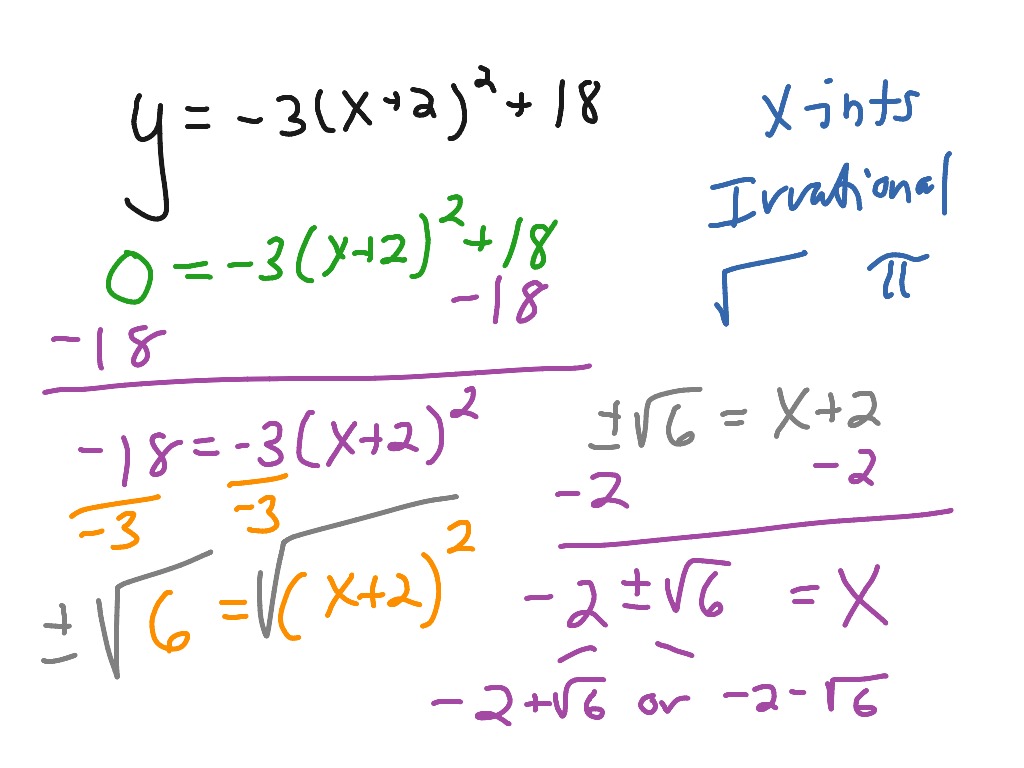
Have you ever stumbled upon a math problem that looks a bit like a puzzle, with a squared term and a constant, and wondered if there's a neat, direct way to crack it? Well, there is! Today, we're going to explore a wonderfully straightforward method for solving a specific type of quadratic equation: the square root method. It's not just for mathematicians in dusty libraries; understanding this can actually be quite satisfying and surprisingly useful.
So, what exactly is a quadratic equation? In its simplest form, it's an equation where the highest power of the variable is two (think x²). While there are several ways to tackle these beasts, the square root method is often the quickest and most elegant when the equation is missing its linear term (the one with just x). Its primary purpose is to isolate that squared variable and then, as the name suggests, take the square root to find the values of x that make the equation true. The main benefit? Simplicity and speed for a particular kind of problem.
Where might you see this in action? In education, it's a foundational step in learning algebra, building a bridge to more complex quadratic solving techniques. Think about geometry problems involving areas. If you're trying to find the side length of a square given its area, you're essentially dealing with a quadratic equation where the side length squared equals the area. For example, if a square garden has an area of 25 square meters, you'd solve s² = 25, and the square root method tells you the side length (s) is 5 meters. In physics, concepts like projectile motion can, in simplified scenarios, lead to equations solvable by this method. Imagine calculating how long it takes for an object to fall from a certain height; the formula might involve a squared time term.
Let's dive into a simple example. Suppose you have the equation x² - 9 = 0. The goal is to get x² by itself. So, we add 9 to both sides, giving us x² = 9. Now comes the fun part! We take the square root of both sides. Remember, a number has two square roots: a positive one and a negative one. So, the square root of 9 is both 3 and -3. Therefore, our solutions are x = 3 and x = -3. See? Relatively painless!
Another example: 2x² = 32. First, divide both sides by 2 to get x² = 16. Then, take the square root of both sides. The square roots of 16 are 4 and -4. So, x = 4 and x = -4 are our solutions.
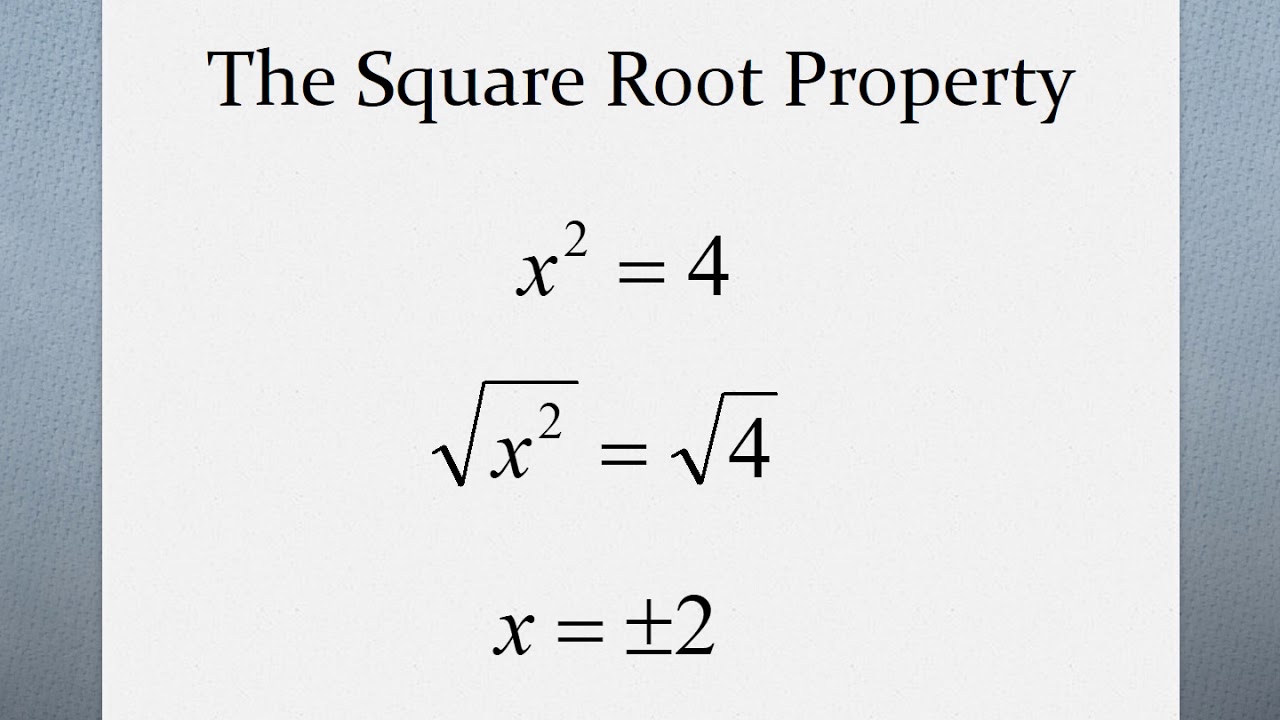
How can you explore this further without feeling overwhelmed? Start with equations where the x term is absent. Practice isolating the x² term and then finding the square roots. Online math resources and even many graphing calculators can help you check your work. You can even try creating your own simple problems. Think of a number, square it, and then create an equation. For instance, pick 5, square it to get 25, and then form the equation x² - 25 = 0. Then, try solving it using the square root method!
The square root method is a powerful tool in your mathematical arsenal, offering a clear and direct path to solutions for certain quadratic equations. It's a great way to build confidence and appreciate the elegance of algebraic manipulation.