
How To Solve The 6x6 Rubik's Cube

So, you've mastered the 3x3, huh? Feeling pretty smug, are we? Well, buckle up, buttercup, because we're about to dive into the wonderfully bewildering world of the 6x6 Rubik's Cube. Yeah, that's right. Six by six. It looks like a regular Rubik's Cube had a very large family and they all decided to get into a massive, colorful argument.
Seriously, when you first lay eyes on this beast, your brain might do a little jig of confusion. It's a mosaic of tiny squares. It’s like a stained-glass window exploded. And you think, "How in the name of all that is twisty do I even begin to tackle this?"
The answer, my friend, is with a healthy dose of caffeine, a sprinkle of patience, and a whole lot of knowing that it's not actually magic. It’s just math. Fancy, complicated, colorful math. And the best part? Once you get it, you get this incredible, brain-tingling rush. It's like you’ve unlocked a secret level in the game of life.
Why Bother with a 6x6?
Good question! The 3x3 is classic, right? It fits in your pocket, it’s iconic. But the 6x6? It's an event. It's the heavyweight champion of the standard cube world. It’s the kind of puzzle that makes people stop and stare. "Whoa, what is that?" they'll ask. And you, with a nonchalant shrug and a glint in your eye, will say, "Oh, just a little something I whip out on Tuesdays."
Plus, let's be honest, the satisfaction of solving something this complex is, well, chef's kiss. It's a mental workout. It's a party for your brain cells. And hey, if you're looking to impress your friends, or just yourself, this is your golden ticket.
The "Oh Crap, It's a Lot" Factor
Okay, so the first thing you'll notice is the sheer number of little squares. On a 3x3, you have centers, edges, and corners. Simple enough. On a 6x6? You've got layers of centers, and edges that are split into multiple pieces. It's a whole new ball game. You can't just look at a blue piece and know where it goes immediately. You have to group things.
Think of it like this: the 3x3 is a solo act. The 6x6 is a symphony orchestra. You have sections to build before you can get to the grand finale. Don't let it scare you. It just means we need a slightly different approach.

The Grand Strategy: Building Blocks
The secret sauce to solving bigger cubes like the 6x6 is all about breaking it down. We’re going to turn this chaotic mess into something manageable. The main strategy is called "Reduction." We reduce the big cube down to something that resembles a 3x3. Once we're there, we can use our trusty 3x3 solving skills.
Here's the breakdown of the reduction phase:
Step 1: Building Centers - The Colorful Patchwork
This is where we start. Remember how a 3x3 has one center piece per side? Well, on a 6x6, each center area is actually made up of 4 smaller center pieces. Your first mission? Get all those four pieces of the same color together. So, you'll have a solid 2x2 block of blue, a solid 2x2 block of red, and so on.
This is where you can get a little creative. You'll be nudging pieces around, forming those little 2x2 squares. Don't worry if it looks messy at first. It's like putting together a really, really big jigsaw puzzle where the pieces keep trying to escape. The key is to be methodical. Find two pieces of the same color, put them together. Find another two, put them together. Then, bring those pairs together.
Pro tip: Try to build centers on opposite sides first. It can sometimes make things a little easier to keep track of. Imagine you’re painting a masterpiece, one color block at a time.

Step 2: Pairing Edges - The Edge Familiess
Now for the edges. On a 6x6, each edge is actually made up of two pieces that belong together. Think of them as lost twins. Your job is to reunite them. You’ll have a blue-red edge, but it's in two separate spots. You need to find both pieces and then use some clever twists to bring them side-by-side.
This is often the most time-consuming part of the reduction phase. You’ll be scanning the cube, looking for these lone edge twins. Once you find a pair, you’ll maneuver the cube so they’re next to each other on the same layer. Then, with a little algorithm, you’ll "pair" them up, effectively making them one unit.
Don’t be surprised if you mess up a center while doing this. It happens! Just go back to Step 1 and rebuild that center. It’s part of the process. Embrace the chaos, then bring order.
The "Oh, I Know This!" Phase: 3x3 Mode Activated
Once all your centers are solid 2x2 blocks and all your edges are paired up, congratulations! You've essentially transformed your 6x6 into a slightly larger, more complex-looking 3x3. The centers act as single center pieces, and the paired edges act as single edge pieces. You've done the heavy lifting!
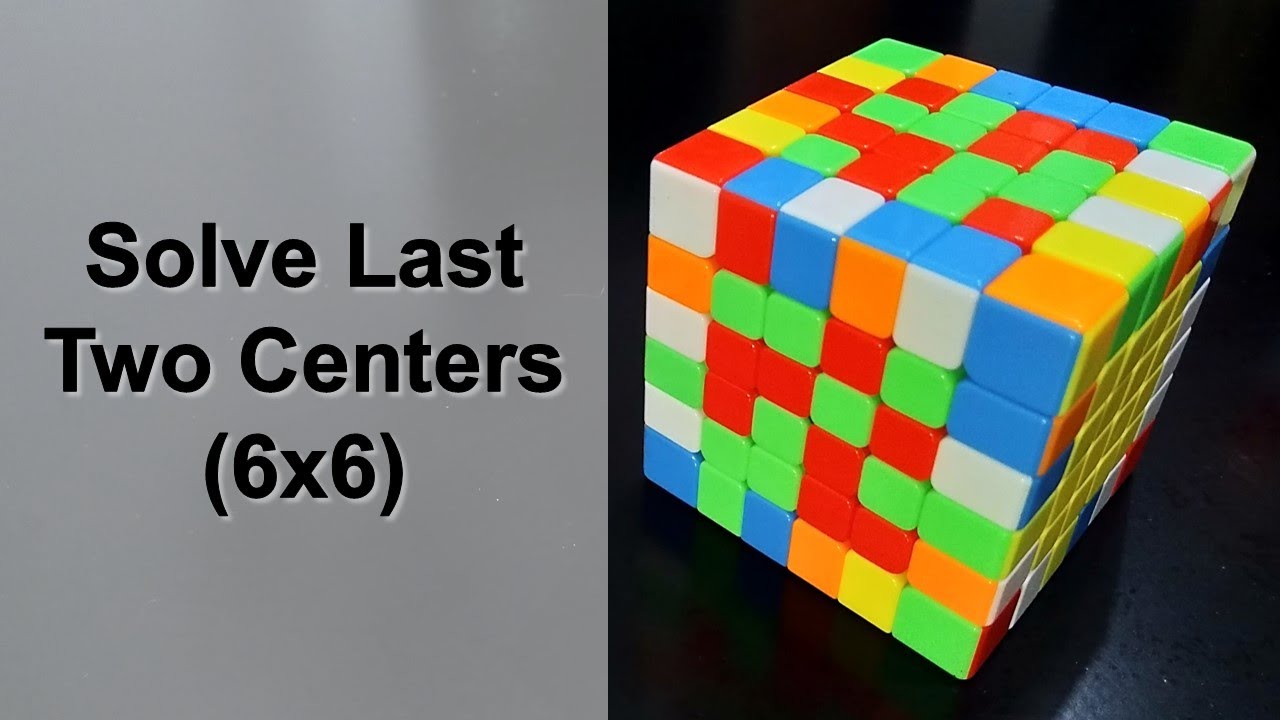
Now, you’ll solve it just like you would a 3x3:
Step 3: Solving the First Layer (Cross and Corners)
Same old, same old. Build your white cross (or whatever color you choose) by aligning the paired edge pieces with the correct center. Then, solve the corners, putting them in their rightful spots. Your paired edge pieces are now acting like single edges, and your 2x2 centers are acting like single centers. Easy peasy, right?
Step 4: Solving the Middle Layer (Edge Pairs)
Again, this is just like a 3x3. You’ll use your standard middle-layer algorithms to place the remaining paired edge pieces. Your paired edges will behave just like regular 3x3 edge pieces.
The "Almost There!" Moment: Parity Issues
Here's where things get a tiny bit funky. Because the 6x6 has an even number of layers, you can sometimes run into something called "parity errors." Don't panic! It's just a mathematical quirk. It means that sometimes, the cube can get into a state where a 3x3 solve algorithm would normally work, but it just doesn't quite happen.
The most common parity error you'll encounter is when you have two edges that need to be swapped, or when you have two edges that need to be flipped, and your 3x3 algorithms just won't fix it. There are specific algorithms for these parity errors. Think of them as special cheat codes for the 6x6.
![How to Solve 6x6 Rubik’s Cube [Easiest Tutorial] - YouTube](https://i.ytimg.com/vi/_OMD3CjXpNo/maxresdefault.jpg)
Don't try to memorize them all at once. Just know they exist. When you get to a point where you should be able to solve it like a 3x3 but something is stubbornly wrong, it's probably parity. A quick search for "6x6 parity algorithms" will give you the exact moves you need.
Step 5: Solving the Last Layer (OLL and PLL)
After you've dealt with any parity issues, the rest is just your standard 3x3 last-layer solving. You'll do your OLL (Orienting the Last Layer) to get the yellow cross and then orient all the yellow pieces. Then you’ll do your PLL (Permuting the Last Layer) to put all the pieces in their final positions.
And then… BAM! You've done it. You've conquered the 6x6. Take a moment. Admire your handiwork. You’ve stared into the abyss of tiny squares and emerged victorious.
The Fun Part: Why We Love These Puzzles
Beyond the bragging rights, solving these larger cubes is incredibly rewarding. It teaches you to think in layers, to break down complex problems, and to persevere. It’s a testament to human ingenuity and the joy of a good challenge. Plus, the satisfying click and whirr of all those little pieces moving? Pure ASMR for the puzzle lover.
So, if you're looking for your next mental adventure, if you want to expand your cubing horizons, grab a 6x6. It might look intimidating, but it's a journey that's totally worth taking. And who knows, maybe you’ll even start eyeing up the 7x7 next!