
How To Write A Linear Equation Word Problem

Hey there, coffee buddy! So, you're staring down the barrel of a linear equation word problem and feeling a little… intimidated? Like you’ve walked into a math museum and suddenly everything’s behind velvet ropes? Don't sweat it! We’ve all been there. It’s like trying to assemble IKEA furniture without the pictograms, right? Pure chaos.
But guess what? They're not that scary. Think of them as little puzzles, hidden messages waiting for you to crack. And the secret weapon? Understanding the story. That’s it! No magic spells, no ancient runes. Just figuring out what’s actually going on.
So, grab another sip of your latte (or whatever your caffeinated beverage of choice is), and let's dive into this. We’re going to break down how to turn those confusing sentences into neat, tidy math equations. Ready?
The Big Picture: What’s a Linear Equation Word Problem, Anyway?
Okay, first things first. What are we even talking about here? A linear equation word problem is basically a story that can be described using a straight line. Think about it. When things go up at a steady rate, or down at a steady rate, that’s linear. Like your phone bill when you don’t buy any extra data. Or how quickly your dog eats his treats when you’re not paying attention. (Seriously, where do they go? It's a mystery!).
The "equation" part? That's just a way to represent that steady change mathematically. You know, with numbers and letters. Those letters are usually x and y, the usual suspects. One represents what you're trying to find (the unknown!), and the other represents, well, the other thing that’s changing.
So, we have a story, and we want to translate that story into a mathematical sentence that looks something like y = mx + b. You remember that old friend, right? Or maybe it’s just showing up now, like an unexpected guest at your party. Either way, we’ll get acquainted.
Step 1: Read It Like You Mean It (But Like, Slowly)
This is the most crucial step, and I cannot stress this enough. Do NOT skim. Do NOT just glance at the numbers. You need to read the problem carefully, maybe even twice. Imagine you’re a detective trying to uncover a clue. What are the key pieces of information? What’s the goal?
Let’s say you have this gem: "Sarah is saving up to buy a new bike that costs $300. She already has $50 saved and plans to save $25 each week from her allowance."
Okay, first read: "Sarah bike $300, $50 saved, $25 week." Got it. Sort of. But what does it mean?
Second read: "Sarah wants a bike. It’s gonna cost her $300. She’s already partway there with $50. She’s gonna add $25 to her savings every single week. How many weeks will it take her to get the whole $300?"
See? The second read, the one where you actually process it, is where the magic starts. You're not just seeing words; you're seeing a situation. You're empathizing with Sarah's bike-buying journey. We've all been there, right? That longing for a shiny new set of wheels.
Step 2: Identify the Unknowns (The "X" and "Y" Hunt!)
Now that you’ve got a grip on the story, it's time to play "find the unknowns." What is the problem asking you to figure out? This is usually your dependent variable, the thing that depends on something else. In our Sarah example, what’s she trying to find? Yep, you guessed it: the number of weeks she needs to save.
So, let's assign a letter to that. w for weeks? x for weeks? Whatever floats your boat! Let’s go with w for clarity. So, w = the number of weeks.
What’s the other variable involved? What does w affect? In this case, it’s the total amount of money Sarah has saved. That amount changes depending on how many weeks go by. So, that’s our other variable. Let’s call it m for money (or y if you're feeling traditional). Let's stick with m for now. So, m = the total amount of money Sarah has saved.
Sometimes, the problem might give you the dependent variable and ask for the independent one. It's like a detective switching roles – now you’re the one being investigated! But the principle is the same: find what you're looking for, and find the thing it relates to.
Step 3: Hunt for the "Rate" and the "Starting Point" (The Slope and Y-Intercept!)
This is where the linear part really shines. Linear equations have two special components: a rate of change (the slope, often called m in the equation y = mx + b, confusingly, but let’s just call it the “rate” for now) and a starting value (the y-intercept, often called b, or the “initial amount”).
Think about our Sarah example again. What is happening at a steady rate? Sarah is saving $25 each week. That "each" is a huge clue! It means every week, the amount of money goes up by the same amount. That’s your rate!
So, the rate of change is $25 per week. This is the number that will be multiplied by our "weeks" variable.
Now, what about the starting point? Did Sarah start with zero money for the bike? Nope! She already has $50 saved. That's the amount she starts with, before any new weeks of saving begin. This is your initial amount, your y-intercept!
So, the starting amount is $50. This is the number that will be added (or subtracted) to the rate part.
Step 4: Put it All Together: Building the Equation!
Alright, detective! You’ve identified your unknowns, your rate, and your starting point. Now, let’s build the equation! Remember our general form? Total Amount = (Rate of Change * Number of Time Periods) + Starting Amount.
Let's plug in our Sarah variables:
- Total Amount: m (money saved)
- Rate of Change: $25 per week
- Number of Time Periods: w (weeks)
- Starting Amount: $50
So, the equation becomes: m = 25w + 50.
Ta-da! You’ve just built a linear equation from a story. It’s like speaking in code, but a code that makes perfect sense. And the best part? You can now use this to answer all sorts of questions!
Step 5: Answering the Question (The Grand Finale!)
The problem usually asks you to find something specific. In Sarah’s case, it’s how many weeks it will take her to save the total cost of the bike, which is $300.

So, we know the total amount of money Sarah needs is $300. That means m = 300. We plug this into our equation:
300 = 25w + 50
Now, it’s just a matter of solving for w. This is where your basic algebra skills come into play. You want to get w all by itself.
- Subtract 50 from both sides:
- Divide both sides by 25:
300 - 50 = 25w + 50 - 50
250 = 25w
250 / 25 = 25w / 25
10 = w
So, it will take Sarah 10 weeks to save enough money for her bike. Amazing! You just solved a word problem. Give yourself a high-five. Or a cookie. Cookies are good.
Let’s Try Another One (Because Practice Makes Perfect-ish)
Okay, let’s say your friend, Mark, is a marathon runner. He's training for a race. He runs 5 miles every day.
First read: Mark runs 5 miles daily. Training.
Second read: Mark runs the same distance, 5 miles, every single day as part of his marathon training. He’s been at it for a while.

Wait a sec. This one’s a bit different. Is there a starting point? Not really mentioned in terms of total distance run. Is there an unknown total distance to reach? Not explicitly. What’s the question likely to be? Probably something about how far he'll run over a certain period.
Let’s assume the question is: "If Mark runs 5 miles each day, how many miles will he run in 30 days?"
Unknowns:
- Total miles run: Let's call it d (for distance).
- Number of days: This is given as 30, but we can also think of it as our variable, let's call it x.
Rate of Change: 5 miles per day. This is our rate.
Starting Amount: In this scenario, since the problem is asking for the total distance over 30 days, and we’re not given any prior running distance to add, we can consider the starting amount to be 0. He hasn't run yet for this 30-day period.
Equation:
Total Miles = (Miles per day * Number of days) + Starting Miles
d = 5x + 0
Which simplifies to: d = 5x
Answering the Question:
We want to find the total miles run in 30 days. So, x = 30.
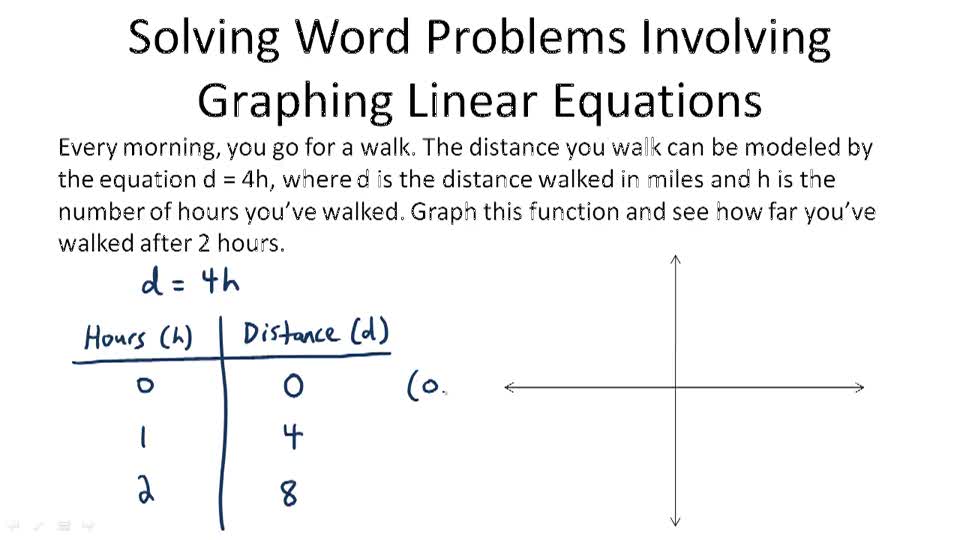
d = 5 * 30
d = 150
Mark will run 150 miles in 30 days. See? It’s all about the context!
Common Pitfalls and How to Avoid Them (The Sneaky Traps!)
Sometimes, word problems try to trick you. They're like those little pamphlets that come with furniture asking for donations to a starving artist – you’re not quite sure what they’re asking for, are you?
1. Confusing Units: What if one part is in hours and another is in minutes? Or dollars and cents? Always, always, always make sure your units match. If you’re calculating miles per hour, your time needs to be in hours. If you’re dealing with money, make sure it’s all in dollars or all in cents. It’s like trying to add apples and oranges. Messy!
2. “Per” is Your Best Friend: That little word "per" is a giant flashing neon sign pointing to your rate of change. "Miles per hour," "dollars per day," "students per class." If you see it, flag it! It's your slope!
3. The "Already" Clue: Words like "already," "started with," "initially" are dead giveaways for your y-intercept (your starting amount). It's the stuff you have before the action described by the rate begins.
4. What Are They Really Asking?: Sometimes the problem gives you extra information you don’t need. It's like getting a free appetizer with your meal, but then you realize you can’t finish the main course because you’re too full. Focus on what the question specifically asks you to find. Sometimes it's the total, sometimes it's the time, sometimes it's the rate itself!
The Takeaway: You’ve Got This!
So, there you have it. Linear equation word problems aren’t some mythical beast. They’re just stories dressed up in numbers. With a bit of careful reading, a hunt for those key pieces of information – the unknowns, the rate, and the starting point – you can crack them all.
Remember to read slowly, identify what you’re looking for, spot that steady change, and then put it all together. You’re not just doing math; you’re translating stories into a language of logic. And that, my friend, is pretty darn cool.
Now, go forth and conquer those word problems! And maybe treat yourself to another coffee. You’ve earned it.