
In What Direction Is Matter Displaced In A Compressional Wave
Have you ever wondered what happens to all the stuff, the actual matter, when a wave zooms through? We’re talking about those rippling disturbances that travel, like a cool effect in a movie. Think about a slinky, that fun coiled toy. When you give it a push, you see a wave travel all the way to the other end. But what’s happening to the metal coils themselves?
It’s a bit of a mind-bender, but for a special kind of wave – a compressional wave – the matter doesn’t actually go on a big journey. Nope! It’s more like a very enthusiastic game of "pass the parcel" happening with the particles. Imagine a bunch of friends standing in a line. You give the first friend a gentle nudge. They bump into the next friend, who bumps into the next, and so on. The nudge travels down the line, right? That’s the wave moving.
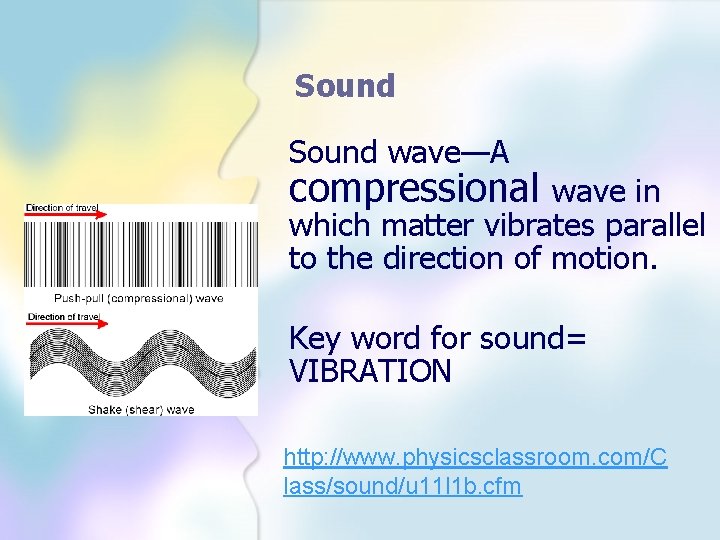
But here's the super cool, and dare we say, slightly mischievous part: each friend in the line only moves a little bit forward and then back to their original spot. They don't get up and run down the whole line, waving goodbye. They just get a little squished, then they relax back. This is the heart of a compressional wave!
So, in a compressional wave, the displacement of matter is back and forth, in the same direction that the wave is traveling. If the wave is moving from left to right, the little bits of matter, like our friends in the line, are also jostling forward and then springing back, all along that left-to-right axis.
It's like a really well-choreographed dance. Everyone has their spot, and they do their little shuffle forward and backward, and that shuffle is what propels the whole dance move down the stage. The energy is what travels, not the individual dancers moving to the very end.
"It’s not about the particles migrating, it’s about them being momentarily pushed and pulled, creating a ripple effect of motion."
Think about sound. Sound is a fantastic example of a compressional wave. When you speak, your vocal cords vibrate. These vibrations push and pull the air molecules around them. These air molecules then bump into their neighbors, and this chain reaction of bumping and jostling travels through the air to our ears. The air molecules themselves don't travel from your mouth to your ear; they just wiggle back and forth in place, letting the sound wave do all the traveling.
Isn't that neat? It’s like a magic trick happening all around us, all the time. The air, the ground, even some materials in our bodies – they all participate in these subtle, yet powerful, compressional waves.
Why is this so entertaining? Because it plays with our expectations! We often think of movement as things going from point A to point B. But in compressional waves, it's the disturbance that travels, not the material itself in a significant, long-distance way. It’s a subtle but profound difference. It’s the difference between a person running a marathon and a wave in a stadium crowd. The marathon runner moves from start to finish. The stadium wave moves around the stadium, but each person just stands up and sits down.
This "local shuffle" is what makes compressional waves so special. They are efficient. They transfer energy without requiring the bulk movement of the medium. This is crucial for so many natural phenomena. Without this back-and-forth dance of matter, we wouldn't be able to hear music, feel the rumble of thunder, or even understand how certain tools like sonar work.
Let’s dive a little deeper into this playful jostling. Imagine you're at a concert. The music is loud! Those sound waves are compressional waves. The air molecules in front of the speaker are being pushed together (compressed) and then spread apart (rarefied). This compression and rarefaction travels outwards. The molecules themselves are just doing a little jig, a tiny hop forward and a hop backward, all in sync with the rhythm of the sound. They are displaced in the direction of wave propagation.

It’s like a silent, invisible parade of little nudges. One particle nudges its neighbor, which nudges its neighbor, and this nudging travels. The energy of the sound is carried by these nudges, this series of compressions and expansions in the medium. The matter is simply being temporarily squeezed and then released. It’s a very polite way to transmit energy, really. No one is pushed too far out of their comfort zone!
This is what makes compressional waves, like sound waves, so fundamental. They are the carriers of so much information and energy in our universe. And the understanding of this directional displacement – that the matter moves back and forth in the same line as the wave – is key to appreciating the elegance of physics.

So, the next time you hear a sound, think about those tiny air molecules, doing their little back-and-forth dance. They are not going on a grand adventure; they are simply contributing to the ripple of energy. This intimate, local movement is what creates the grand phenomenon of sound. It's a beautiful reminder that sometimes, the most significant journeys are made not by moving far, but by moving just enough, right where you are.
This concept is so intriguing because it challenges our everyday intuition. We see things move, and we assume they travel. But with compressional waves, it’s the impulse, the energy, that makes the long trip, while the matter stays relatively put. It’s a subtle but powerful idea, and once you grasp it, the world of waves opens up in a whole new, exciting way. It's like discovering a secret handshake that all the particles in the universe know!
It's these kinds of fascinating, almost quirky, behaviors of the physical world that make science so captivating. The universe is full of these unexpected movements and displacements. And compressional waves? They’re just one more reason to be curious and to perhaps peek behind the curtain of how things really work. So next time you hear a bang, a whisper, or even your own heartbeat through bone conduction, remember the tiny, energetic shuffles happening all around you!