
Meade Ds 60 Telescope Parts

Have you ever looked up at the night sky, brimming with a million twinkling lights, and felt a powerful urge to get a closer look? That’s where the magic of a telescope comes in, and for many budding astronomers, the Meade DS-60 telescope is a fantastic entry point into the cosmos. It might seem a bit technical at first, but diving into the parts of a Meade DS-60 telescope is actually a fun adventure. Think of it like getting to know the different pieces of a puzzle that, when assembled, unlock breathtaking views of planets, moons, and even distant galaxies!
Understanding the components of your Meade DS-60 isn't just about knowing what's what; it's about empowering yourself to use it effectively and make the most of your stargazing journeys. Each part plays a crucial role in gathering light, focusing it, and delivering a clear, magnified image to your eye. It’s like a team of tiny cosmic assistants working together to bring the universe closer to home.
The Eyes of the Telescope: The Optics
At the heart of any telescope are its optics – the lenses and mirrors that bend and focus light. For the Meade DS-60, you'll primarily be dealing with lenses, as it's a refractor telescope. This means it uses a large objective lens at the front to gather light.
- Objective Lens: This is the big, crucial lens at the front of the telescope tube. The DS-60 typically features a 60mm aperture, meaning this lens is 60 millimeters in diameter. A larger aperture gathers more light, allowing you to see fainter objects and more detail. It's the primary light collector, the “eye” that captures photons from distant celestial bodies.
- Eyepiece: This is the smaller lens you look through. The Meade DS-60 usually comes with a couple of different eyepieces, often a 10mm and a 25mm. These determine the magnification. A shorter focal length eyepiece (like the 10mm) gives you higher magnification, good for looking at the Moon or planets. A longer focal length eyepiece (like the 25mm) provides lower magnification but a wider field of view, which is great for scanning star clusters or larger nebulae. Think of them as different zoom levels on a camera!
- Focuser: This is the mechanism that moves the eyepiece in and out to bring the image into sharp focus. On the DS-60, it’s usually a simple rack-and-pinion system. You’ll turn a knob, and the eyepiece holder will slide smoothly until everything is crystal clear. A crisp focus is the difference between a fuzzy blob and a recognizable celestial feature.
The Backbone of the Operation: The Mount
While the optics do the heavy lifting of seeing, the mount is what holds the telescope steady and allows you to point it at different parts of the sky. For the Meade DS-60, you'll often find it on a manual alt-azimuth mount. This type of mount moves up and down (altitude) and left and right (azimuth), mimicking how you’d naturally move your head to scan the sky. It’s straightforward and easy to learn.
- Tripod: This is the stable base that supports everything. A good tripod minimizes vibrations, which is essential for clear viewing, especially at higher magnifications. The DS-60 typically has a sturdy tripod that can be adjusted for height, making it comfortable for stargazers of all ages.
- Mount Head: This is the part that attaches to the tripod and holds the telescope tube. It’s designed to allow smooth motion in the altitude and azimuth directions. Some mounts also have slow-motion controls, which are small knobs that allow for very fine adjustments, helping you precisely track a planet or moon as it moves across the sky.
- Tube Rings or Dovetail Clamp: These are the pieces that physically connect the telescope tube to the mount head. They ensure the tube is securely held and balanced.
Tip: Keeping your mount and tripod stable is key! Make sure all the legs are firmly planted and any locking mechanisms are secure before you start observing.
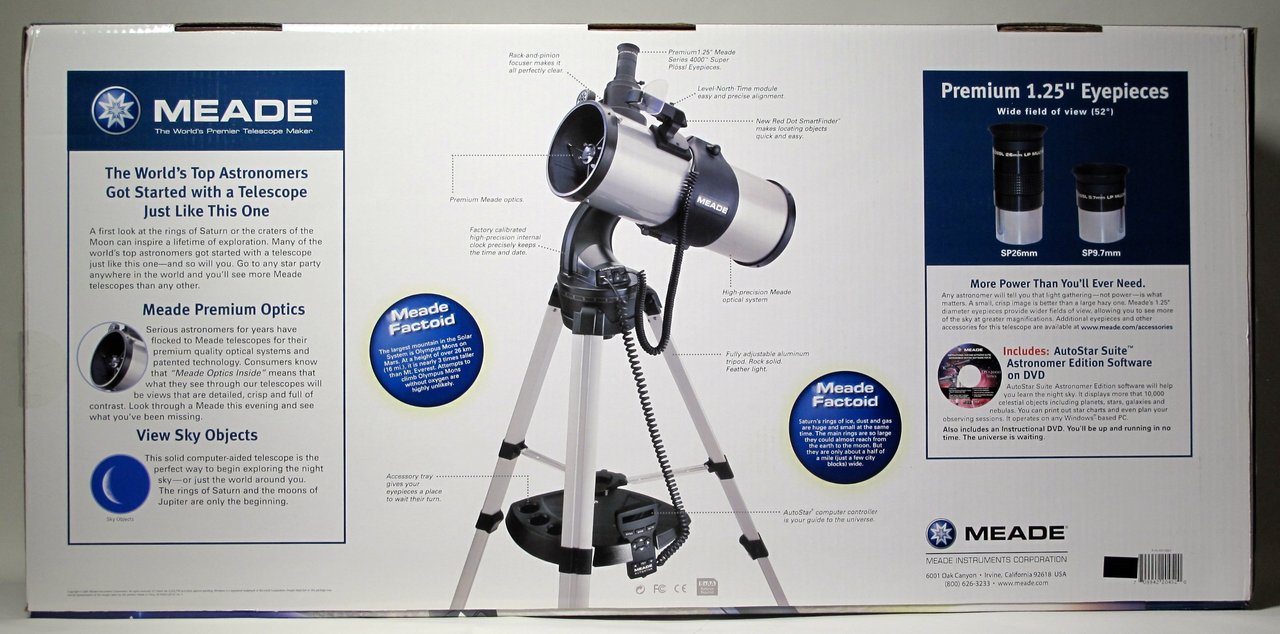
MEADE DS-2130ATS-LNT Telescope - www.trenesymas.com
Connecting it All: Accessories and Other Bits
Beyond the core optics and mount, the Meade DS-60 often comes with or can be enhanced by a few other useful parts:
- Finderscope: This is a small, low-power telescope mounted on the side of the main telescope tube. Its purpose is to help you locate objects. You look through the finderscope to aim your main telescope. It’s like using a laser pointer to guide a big spotlight! The DS-60 might come with a simple red-dot finder or a small optical finder.
- Diagonal: For refractor telescopes like the DS-60, a diagonal prism is often included. It fits between the focuser and the eyepiece and redirects the light path at a 90-degree angle. This makes observing more comfortable, especially when looking at objects high overhead, as you don't have to crane your neck as much.
- Barlow Lens: While not always standard, a Barlow lens is a fantastic accessory. It’s placed between the eyepiece and the focuser and effectively doubles or triples the magnification of any eyepiece you use with it. It’s a great way to get more power without buying a whole new set of eyepieces.
- Dust Caps: Don't forget these! Dust caps protect the objective lens and the eyepiece from dust and scratches when the telescope isn't in use. Keeping your optics clean is vital for maintaining image quality.
Exploring the parts of your Meade DS-60 is an exciting part of the stargazing hobby. Each component is designed to work in harmony, bringing the wonders of the universe within reach. So, next time you set up your telescope, take a moment to appreciate the ingenious design and the journey these parts take you on – from your backyard to the vast expanse of space!