
Meade Lightbridge 16 Truss Tube Dobsonian Telescope
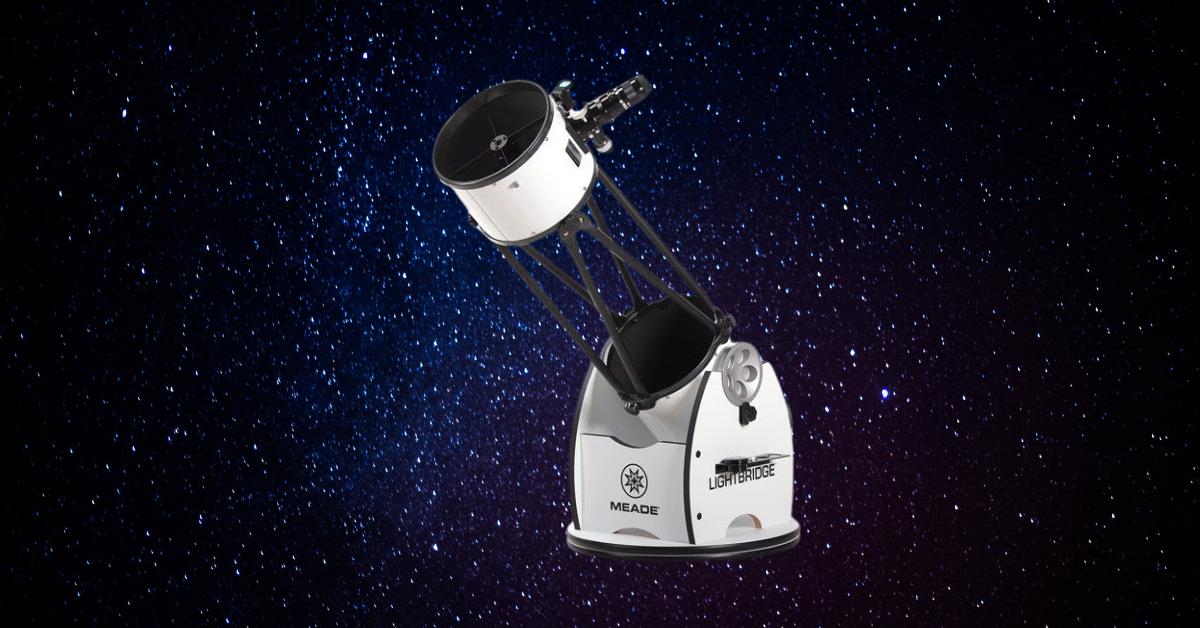
Remember those starry nights as a kid? The ones where you’d lie on your back, pointing out constellations that looked suspiciously like a dog or a queen? We've all been there, a primal connection to the cosmos that feels both ancient and incredibly personal. But what if you could ditch the blurry images in your mind and see actual galaxies, nebulae, and planets with a clarity that makes your jaw drop? Enter the Meade Lightbridge 16 Truss Tube Dobsonian Telescope. It's not just a telescope; it's your personal portal to the universe, and trust me, it’s surprisingly easy to fall in love with.
Now, before you imagine some complicated, super-scientific contraption that requires a PhD to operate, let's get one thing straight: the Lightbridge 16 is designed with you, the enthusiastic stargazer, in mind. Think of it as the ultimate weekend warrior's tool for exploring the night sky. It’s the kind of instrument that bridges the gap between casual curiosity and a genuine passion for astronomy, all without making you feel like you're back in physics class.
Unboxing the Universe
The first thing that strikes you about the Meade Lightbridge 16 is its sheer presence. It’s big, bold, and undeniably impressive. But don't let its size intimidate you. The truss tube design is a game-changer. Unlike traditional solid tube telescopes, the Lightbridge 16 breaks down into manageable pieces, making it significantly easier to transport and set up than you might expect. Imagine this: you’re heading to a dark sky site, a camping trip, or even just your backyard away from the city lights. Instead of wrestling with a behemoth, you’re assembling a sophisticated piece of engineering that, with a little practice, becomes almost second nature.
This isn't a "set it and forget it" kind of telescope, but the assembly process itself becomes part of the ritual. It's a moment to disconnect from the digital noise and reconnect with something tangible, something real. It’s like building your own personal observatory, piece by piece, under the darkening sky. And the payoff? Absolutely breathtaking.
The Magic of the Dobsonian Mount
At the heart of the Lightbridge 16's user-friendliness is its Dobsonian mount. This is the classic, no-frills mount that’s been a favorite among amateur astronomers for decades. It’s essentially a sturdy base that allows the telescope to move smoothly up and down (altitude) and side to side (azimuth). No complex motors, no confusing controls – just pure, intuitive pointing. Think of it like steering a well-balanced ship; a gentle nudge is all it takes to find your target. This simplicity is key. It means more time spent looking and less time fiddling.
This ease of use is a huge draw for anyone who wants to jump into deep-sky observing without a steep learning curve. You can point it at Jupiter and almost instantly be greeted by its famous Great Red Spot, or swing it towards the Orion Nebula and see swirling clouds of gas and dust that are, frankly, mind-blowing. It’s the kind of experience that makes you feel like you’ve stepped into a science fiction movie.

The Lightbridge 16: More Than Just Size
So, why the "Lightbridge 16"? The "16" refers to the aperture, the diameter of the main mirror. In the world of telescopes, aperture is king. The larger the aperture, the more light the telescope can gather, and the fainter, more distant, and more detailed objects you can see. A 16-inch aperture is a serious piece of optical equipment. We're talking about gathering enough light to reveal details in galaxies that are millions of light-years away. You can practically see the structure in the Andromeda Galaxy, not just a faint smudge. It’s like upgrading from a blurry black-and-white TV to a 4K IMAX screen, but for the cosmos.
This isn't just about looking at pretty dots. It's about observing cosmic landscapes that have existed for billions of years. You’re not just seeing the moon; you’re seeing craters with a clarity that makes you feel like you could reach out and touch them. You’re not just seeing Saturn; you’re seeing its rings with an astonishing sharpness, perhaps even the Cassini Division, that famous gap in the rings. It’s a level of detail that truly connects you to the vastness of space.
Truss Tube Advantage: Portability Meets Power
The truss tube design deserves another mention because it’s where the Lightbridge 16 really shines in terms of practicality. Traditional solid tube Dobsonians, especially at this aperture, can be incredibly cumbersome. Transporting them often requires a van or a dedicated trailer. The Lightbridge 16, on the other hand, with its open truss structure, breaks down into a surprisingly manageable package. The optical tube essentially disassembles into several long rods and the mirror box, which then nest together. This makes it far easier to load into a car and take to your favorite dark sky location, away from the light pollution of the city.

This portability is a crucial factor for anyone who doesn’t have a permanent observatory or who wants the flexibility to chase clear skies. It means that the universe isn't confined to your backyard; it's accessible wherever you can find a dark spot. Imagine a road trip where your destination isn’t just a scenic viewpoint, but a portal to the stars. The Lightbridge 16 makes that kind of adventure a reality.
Making the Most of Your Lightbridge 16
So, you've got this incredible instrument. Now what? The beauty of a telescope like the Lightbridge 16 is its versatility. While it excels at deep-sky observing (seeing galaxies, nebulae, and star clusters), it's also a fantastic planetary observer. Because of its large aperture, it can gather a lot of light, allowing you to see incredible detail on planets like Jupiter, Saturn, and Mars when they're well-positioned.
Tip 1: Find your dark sky. Light pollution is the enemy of astronomical observation. Even a moderate reduction in light pollution can dramatically improve what you see. Look for local parks, rural areas, or designated dark sky preserves. Websites like the International Dark-Sky Association can be a great resource for finding dark sky locations near you.
Tip 2: Invest in good eyepieces. The telescope comes with eyepieces, but to truly unlock the Lightbridge 16’s potential, consider adding a few high-quality eyepieces. Different focal lengths will give you varying magnifications, allowing you to zoom in on planets or get a wider view of star fields. Think of them as different lenses for your cosmic camera.

Tip 3: Learn to collimate. With any Newtonian reflector telescope, collimation – aligning the mirrors – is crucial for sharp images. Don't let this sound intimidating! It’s a straightforward process, and there are plenty of tutorials online. A well-collimated telescope delivers significantly sharper and more enjoyable views. It's like tuning a guitar; a little adjustment makes all the difference.
Fun Fact: Did you know that some of the most stunning astrophotography images you see are actually captured through telescopes with apertures similar to, or even smaller than, the Lightbridge 16? While the Lightbridge is primarily an observing telescope, its large aperture can certainly be adapted for astrophotography with the right equipment and techniques.
The Social Aspect: Stargazing Together
One of the unexpected joys of owning a powerful telescope like the Lightbridge 16 is the social aspect. You’ll find yourself wanting to share the view. Imagine setting it up at a local park or community event. The gasps of awe as people see the rings of Saturn for the first time, or the wonder in a child’s eyes as they glimpse Jupiter’s moons, are incredibly rewarding. It’s a way to spark curiosity and wonder in others, to remind them of the incredible universe we inhabit.

Think of it as the ultimate icebreaker. "Have you ever seen the craters on the moon through a telescope this big?" is a much more interesting conversation starter than most. You'll likely find yourself connecting with other enthusiasts, sharing tips, and discovering new observing spots. It’s a community built around a shared fascination for the celestial.
When the Sky’s Not the Limit
The Meade Lightbridge 16 Truss Tube Dobsonian Telescope is more than just an optical instrument; it's an invitation. It's an invitation to explore, to learn, and to connect with something far grander than ourselves. It’s for the curious souls who look up at night and wonder what else is out there. It’s for those who appreciate the blend of sophisticated engineering and simple, intuitive design.
It’s about experiencing the universe in a way that feels both profoundly personal and universally shared. It's about transforming those childhood memories of pointing at the sky into tangible, awe-inspiring realities. It's about realizing that the wonders of the cosmos are not just for scientists in observatories, but for anyone willing to take a moment, look up, and embrace the extraordinary.
A Little Reflection
In our fast-paced, often terrestrial-bound lives, it's easy to forget that we're living on a tiny planet hurtling through an unimaginably vast expanse. The Lightbridge 16 is a constant, gentle reminder of this. Setting it up, the cool night air on your face, the quiet anticipation as you scan the heavens – these are moments of profound grounding. They put things in perspective. That frustrating email, that minor daily inconvenience, it all seems a little smaller when you're gazing at a nebula that’s hundreds of light-years across. It’s an opportunity to marvel, to feel a sense of awe, and to remember that there’s so much more to our existence than the everyday hustle. It’s a lifestyle choice, really, one that adds a touch of the sublime to the ordinary.