
Metal Nonmetal And Metalloid Periodic Table

Ever wondered what makes your phone buzz, your bicycle frame strong, or even the salt on your fries so… salty? The answer lies in the incredible world of elements, and the Periodic Table of Elements is our ultimate guide to these fundamental building blocks of everything around us. Think of it as a giant, super-organized family tree for atoms, and within this family, elements are grouped into three distinct, and frankly, pretty cool, categories: metals, nonmetals, and metalloids. Understanding these groups isn't just for chemists in lab coats; it’s like unlocking a secret code to how the world works, and honestly, it’s surprisingly fun!
So, why should you care about this elemental showdown? Well, knowing the difference between a metal, a nonmetal, and a metalloid is like knowing the difference between a superhero, a sidekick, and a character who can do a bit of both! Each group has its own set of superpowers, and these properties dictate how they interact, what they can create, and why they’re indispensable in our everyday lives. From the dazzling shine of gold to the airy breath we take, and the semiconductors that power our technology, these categories are the key to understanding their unique talents.
The Shinies and the Strong Ones: Meet the Metals!
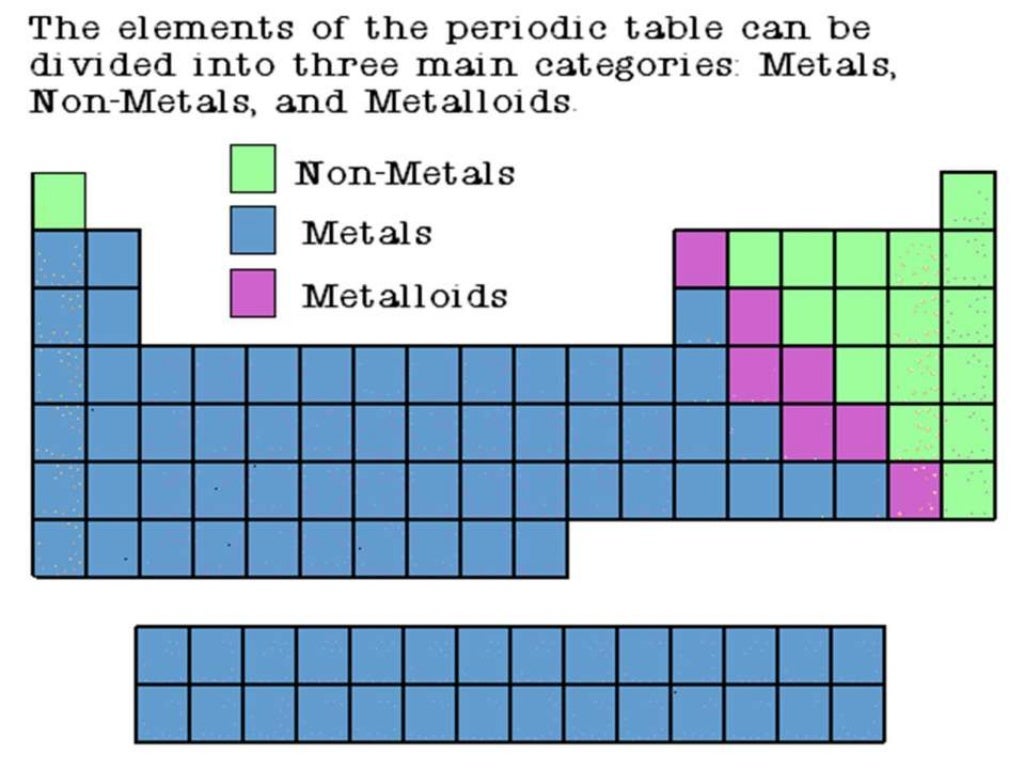
Let's kick things off with the crowd-pleasers: the metals. These are the celebrities of the Periodic Table, and for good reason! Most of the elements you’ll find on the left and in the middle of the table are metals. What makes them so special? Well, first off, they’re known for their fantastic luster – that’s a fancy word for shininess. Think of polished silver or gleaming copper; these guys love to reflect light!
But their good looks aren't their only trick. Metals are also excellent conductors, meaning they’re brilliant at letting heat and electricity flow through them. This is why copper wires are used in all our electronics and why pots and pans are made of metal – they heat up quickly and efficiently! Another key characteristic is their malleability and ductility. This means they can be hammered into thin sheets (malleable) without breaking and drawn out into wires (ductile). Imagine taking a lump of iron and shaping it into a car part or stretching it into a wire – that’s the magic of metals!
You'll find a vast array of metals, from the incredibly light lithium in your phone battery to the strong and versatile iron in buildings and cars, and the precious gold and silver used in jewelry and currency. They’re the backbone of industry and the sparkle in our lives!
The Air We Breathe and the Stuff We Don't See: Hello, Nonmetals!
Now, let's turn our attention to the more enigmatic characters: the nonmetals. These elements tend to hang out on the right side of the Periodic Table, with a few exceptions popping up in other spots. Unlike their metallic cousins, nonmetals are generally poor conductors of heat and electricity. They’re often dull in appearance and can exist in solid, liquid, or gaseous states at room temperature.
Don't let their less flashy nature fool you, though; nonmetals are absolutely vital! Take oxygen, the gas we breathe to survive. Or nitrogen, which makes up the majority of our atmosphere and is crucial for plant growth. Then there's carbon, the fundamental element of life itself, found in everything from diamonds to our own bodies. Sulfur, known for its distinct smell, plays a role in many biological processes and industrial applications.
Halogens, a group of nonmetals like chlorine and fluorine, are highly reactive and have important uses in everything from disinfectants to toothpaste. And let's not forget the noble gases like helium, which makes balloons float and is used in scientific research.

While metals are often about strength and conductivity, nonmetals are about building blocks, energy transfer (in a different way!), and the very essence of life.
The Best of Both Worlds: Introducing the Metalloids!
Finally, we have the fascinating middle-grounders: the metalloids. These elements have properties that are a bit of a mix between metals and nonmetals. They’re the diplomatic members of the elemental family, able to act like metals in some situations and like nonmetals in others. They’re often found along the "staircase" line that separates metals from nonmetals on the Periodic Table.
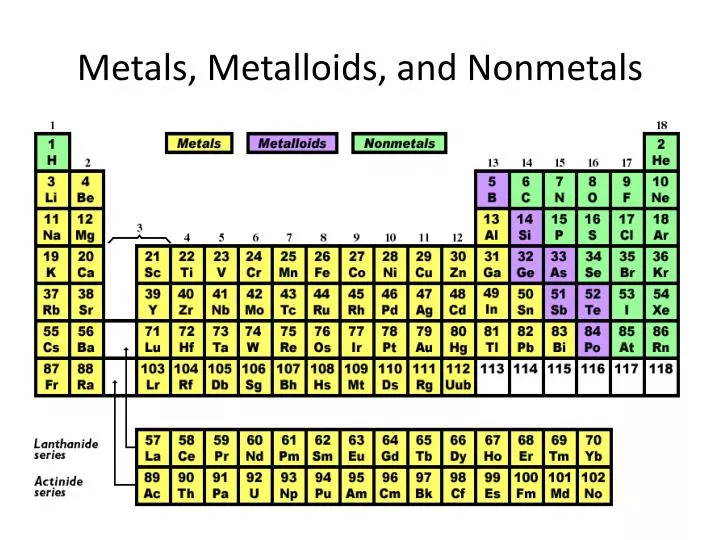
One of the most famous metalloids is silicon. You might have heard of silicon chips or silicon wafers; these are the backbone of almost all our modern electronics! Silicon can conduct electricity, but not as well as a metal, and its conductivity can be precisely controlled. This makes it perfect for transistors and semiconductors, the tiny switches that power our computers, smartphones, and pretty much every gadget you own. Without metalloids, the digital revolution would simply not have happened!
Other notable metalloids include germanium, which also has semiconductor properties, and arsenic, which, despite its toxic reputation, has some important industrial and medicinal uses. Boron, another metalloid, is used in everything from detergents to bulletproof vests.
So, the next time you look at a Periodic Table, remember it’s not just a chart of elements. It’s a roadmap to the materials that shape our world, a guide to the building blocks of life, and a testament to the incredible diversity and usefulness of metals, nonmetals, and their intriguing cousins, the metalloids!