
Metals And Non Metals Bond

Ever wondered what makes things stick together? We're not just talking about glue or tape here. We're diving into the amazing world of how tiny little bits of stuff, called atoms, decide to hold hands. And guess what? Some of the coolest partnerships happen when a metal decides to bond with a nonmetal. It's like a cosmic matchmaking service, and the results are seriously spectacular!
Think about it. You've got your shiny, often quite zingy metals. They're like the life of the party, always ready to share. Then you have your more reserved, sometimes a bit clingy nonmetals. They're not as flashy, but they've got a real knack for grabbing things. When these two meet, it's not just a casual handshake; it's a full-on, energetic embrace. This is what we call an ionic bond, and it's a big deal in the universe of chemistry.
So, what's the secret sauce? Well, metals are like generous souls. They have these outer electrons, little energy packets, that they're just itching to get rid of. They're like, "Here, take it! I've got plenty!" Nonmetals, on the other hand, are often looking for just that. They're a bit greedy, in the nicest way possible, and they're always on the hunt for extra electrons to make themselves feel complete and stable. It's like a perfectly balanced exchange, a chemical giving and receiving that creates something entirely new and often quite wonderful.
Imagine a tiny bit of sodium, that common metal you find in table salt. It's got one extra electron it's just dying to donate. Now, picture a tiny bit of chlorine, the nonmetal that makes up a big part of that same table salt. Chlorine is looking for exactly one electron to feel perfectly happy. When sodium and chlorine get together, it's instant chemistry! The sodium happily gives its electron to the chlorine. Poof! They're no longer just sodium and chlorine; they've become sodium chloride – or as we know it, salt!
This electron transfer is the star of the show. It creates these charged particles, called ions. The metal, having lost an electron, becomes a positive ion (because electrons are negative, so losing one makes you more positive). The nonmetal, having gained an electron, becomes a negative ion. And what happens when you have positive and negative charges hanging around? They stick together! It's like tiny magnets, but on a molecular level. This powerful attraction between oppositely charged ions is the ionic bond.

And the results of these electrifying partnerships? They're everywhere! Think about the stuff you use every day. That sparkly diamond you might admire? It's actually a network of carbon atoms, a nonmetal, all bonded together, but the principle of atoms holding hands is fundamental. But let's get back to metals and nonmetals. When they form these ionic bonds, they often create substances with some seriously cool properties. They can be hard, they can be brittle, and they often have very high melting points. This means you need a lot of energy, a lot of heat, to get them to change from a solid to a liquid.
Consider the glow of a light bulb. Inside some older bulbs, you might find tungsten, a strong metal, bonded with oxygen, a nonmetal. This compound helps the filament glow without burning out too quickly. Or think about the vibrant colors in some paints and pigments. Many of these get their hues from metal oxides, where a metal atom has teamed up with oxygen. It's a whole spectrum of visual delight, all thanks to these elemental alliances.
What makes this whole process so entertaining is the sheer variety of outcomes. It’s not a one-size-fits-all situation. Different metals and different nonmetals combine in countless ways, each creating a unique compound with its own set of characteristics. It’s like a chef experimenting with ingredients; the possibilities are almost endless. You can have strong, rigid materials, or you can have substances that dissolve easily in water. It all comes down to which metal is partnering with which nonmetal and how they decide to share their electrons.
"It's the unexpected partnerships that often lead to the most exciting discoveries."
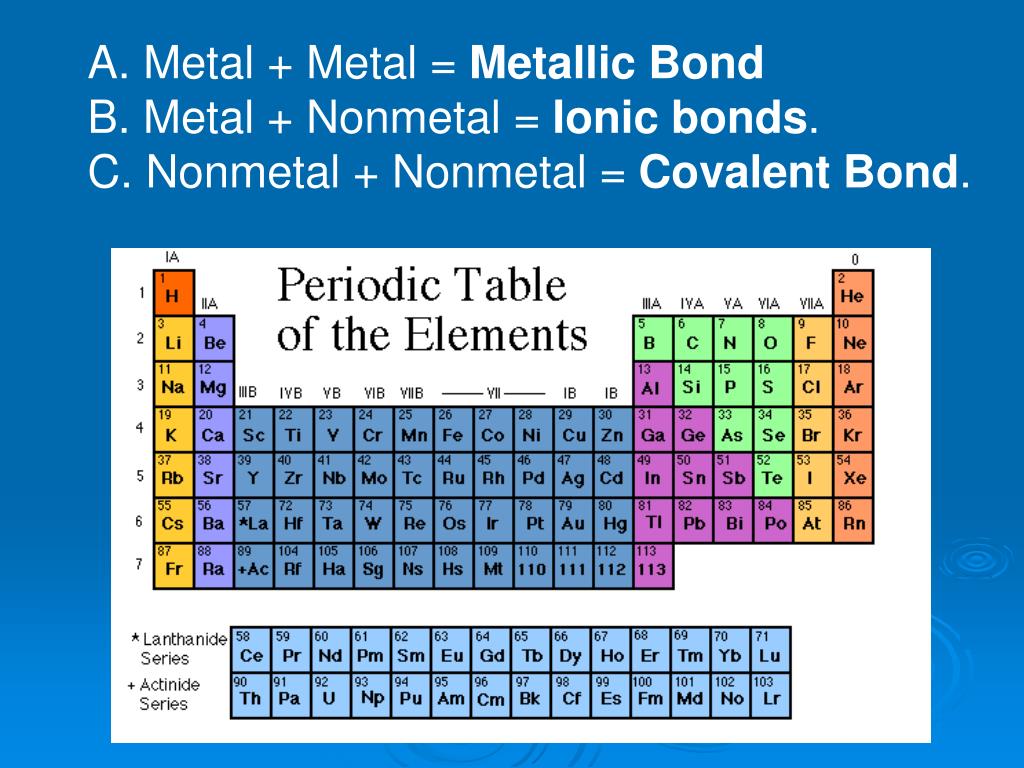
And the beauty of it is that we can actually predict a lot of this! Scientists have figured out the rules of engagement for these atomic relationships. By looking at where elements sit on the periodic table, they can get a pretty good idea of whether a metal and a nonmetal will get along and how they'll bond. It's like having a cheat sheet for the universe's building blocks.
So, the next time you look at something made of metal, or something that's not, take a moment to appreciate the invisible dance of electrons that holds it all together. The bonding between metals and nonmetals is a fundamental force, creating the very fabric of our world. It's a story of attraction, of giving and taking, and of creating something stronger and more stable than the individual parts. It’s a testament to the fact that sometimes, the most interesting things happen when very different personalities decide to come together and form a lasting connection. It’s truly fascinating, and a little bit magical, if you ask me. Go on, get curious!