
Metals Non Metals Metalloids Periodic Table

Hey there, science enthusiast (or soon-to-be science enthusiast)! Ever wondered what makes your phone so zippy, or why a balloon floats? It's all thanks to tiny little building blocks. And guess what? We're about to dive into a world that's way cooler than you might think. We're talking about metals, nonmetals, and those sneaky little guys called metalloids. And where do they all hang out? In a super organized, totally awesome chart called the Periodic Table. Get ready for some fun!
So, what's the big deal with these elements? Think of them as the ultimate ingredients for everything around you. Your jewelry? Mostly metals. The air you breathe? Mostly nonmetals. That super-hard ceramic mug? Probably a bit of both, plus some metalloids playing their part.
Metals: The Rockstars of the Element World
Let's start with the divas: the metals. These guys are usually shiny, like, really shiny. Think of your favorite gold necklace or that cool silver watch. They also love to conduct electricity. That's why they're all over your electronics, making sure everything flows smoothly. Plus, most metals are excellent at conducting heat. That's why your trusty frying pan is probably made of metal – it gets nice and toasty!
But here's a funny quirk: some metals are super reactive. Like, really jumpy. Take sodium, for example. Drop it in water, and it goes nuts! Poof! It's a little fiery show. You definitely don't want to be playing with pure sodium. Stick to salt, which is sodium and chlorine having a chill-out session.
And then there's mercury. It's a metal, but it's a liquid at room temperature! How weird is that? It’s the only metal that behaves like that. It’s a bit of a rebel, don’t you think? You used to find it in old thermometers, but it’s best admired from a distance these days.
We've got heavy hitters like iron, which builds our skyscrapers. We've got lightweights like aluminum, which makes our soda cans. And we've got precious ones like gold and platinum, which make us feel fancy. Metals are everywhere, doing important (and sometimes flashy) jobs.
Nonmetals: The Understated Heroes
Now, let's chat about nonmetals. These guys are the opposite of metals in many ways. They’re usually not shiny. Think of charcoal or sulfur. They're also pretty bad at conducting heat and electricity. They're more like insulators, keeping things in their place.

But don't underestimate them! Nonmetals are absolutely essential for life. Oxygen? That's a nonmetal. You need it to breathe, duh! Carbon? Another nonmetal, the backbone of all organic life. If you've ever eaten food, you've eaten carbon. It’s the ultimate party starter in the chemical world.
And what about nitrogen? It makes up a HUGE chunk of the air we breathe, but we can't use it directly. It's like having a giant buffet and being unable to eat most of it. Plants, however, are great at grabbing it. That's why fertilizer is so important!
Some nonmetals are gases, like the helium that makes your voice sound funny in balloons. Others are solids, like the phosphorus in your matches that helps them light up. And then there's bromine, a liquid nonmetal that's a bit of a scary one, but very interesting in its own right.
Nonmetals might not be as flashy as metals, but they're the quiet achievers. They're the foundation for so much that matters. Pretty cool, right?
Metalloids: The Bridge Builders
Okay, these are the really interesting ones. Metalloids, also called semimetals, are the kids who can play with both the metal and nonmetal groups. They're like the peacekeepers of the element world.
They have properties that are somewhere in between metals and nonmetals. Sometimes they act like metals, and sometimes they act like nonmetals. It all depends on the situation. Sneaky, right?
Silicon is the most famous metalloid. It’s a key player in your computer and smartphone. That's right, the tech that connects us all is built on a metalloid! Without silicon, your Netflix binge would be a lot less enjoyable.
Another one is arsenic. Now, arsenic has a bit of a villainous reputation in history, often associated with…well, let’s just say unfortunate endings. But in small, controlled amounts, it’s used in things like semiconductors. It’s a good reminder that even the most notorious elements have their useful sides.

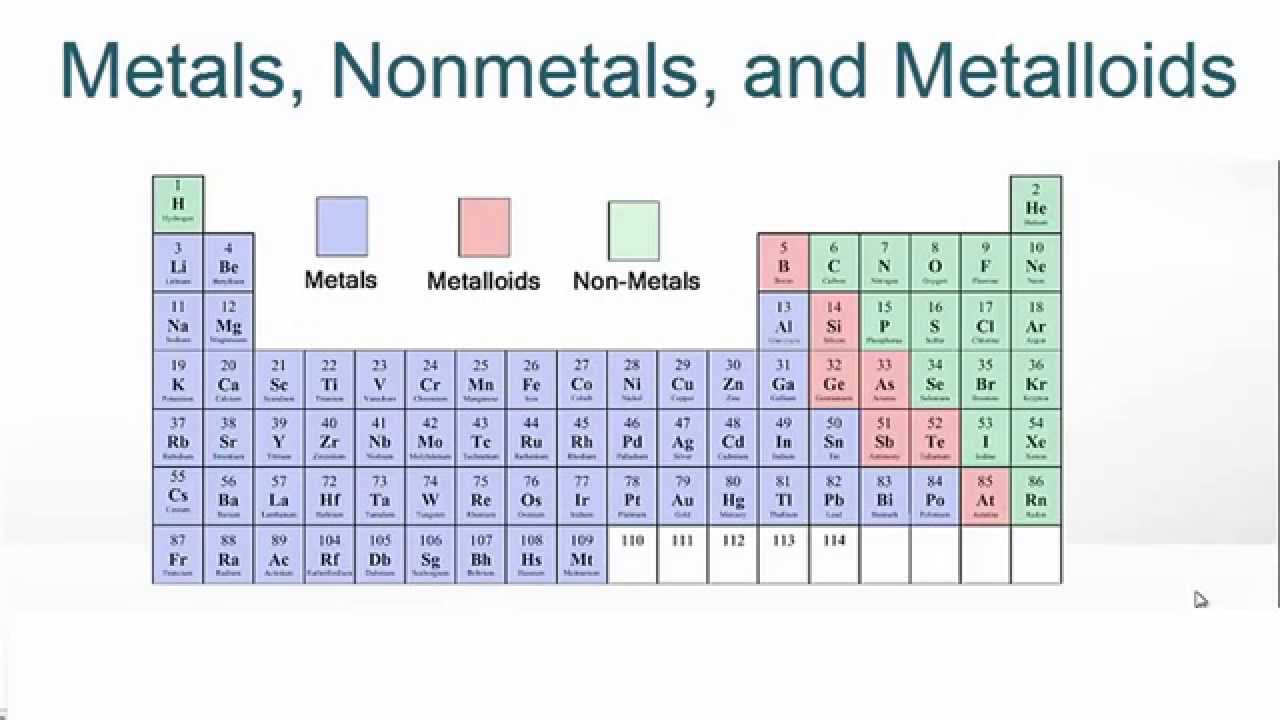
There are only a handful of metalloids: boron, silicon, germanium, arsenic, antimony, tellurium, and polonium. They might be few in number, but their impact is huge. They’re the essential bridges that make complex chemistry possible.
The Periodic Table: The Ultimate Element Playlist
So, where do all these elements live? They have their own super-organized house called the Periodic Table of Elements. Imagine a giant, colorful poster in every science classroom. That's the place!
It's not just a random list. It's arranged in a clever way. Elements are lined up in rows and columns based on their atomic number (how many protons they have – think of it as their unique ID number) and their recurring chemical properties.
The columns, called groups, have elements with similar behaviors. So, all the alkali metals (a very reactive group of metals) are in the same column. The rows are called periods, and they tell you about the energy levels of the electrons. It's like a perfectly curated playlist of everything in the universe.
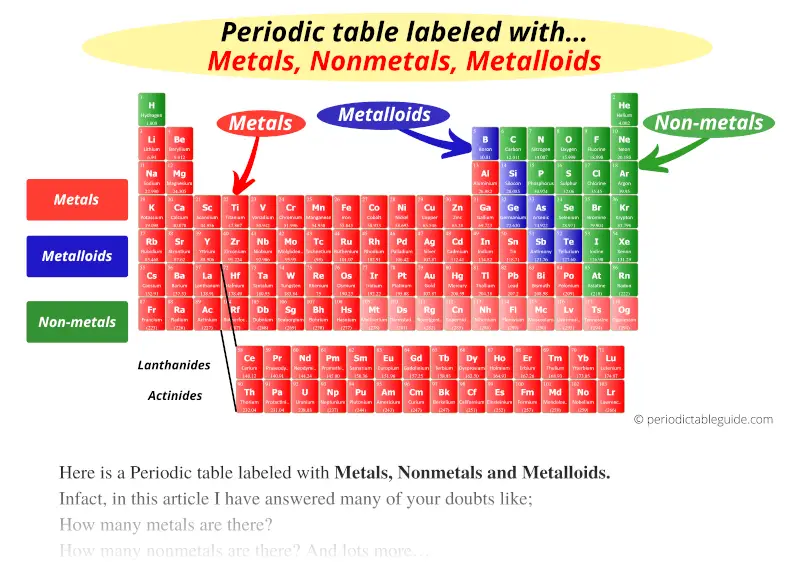
It's organized by atomic number, which is basically how many protons an atom has. So, Hydrogen is number 1, Helium is number 2, and it goes on and on. It's like a cosmic filing system!
And the best part? This table is like a crystal ball. Scientists can look at the position of an element and predict a lot about its behavior. It’s a roadmap to the universe’s building blocks.
Looking at the table can be fun too. You see all the symbols, like H for Hydrogen, O for Oxygen, Fe for Iron (why Fe? Because it’s Latin for ferrum – cool, right?). You’ll see colorful blocks representing metals, nonmetals, and metalloids. It's a visual feast!
So next time you see a Periodic Table, don't just see a bunch of squares and symbols. See a world of possibilities. See the shiny metals, the life-giving nonmetals, and the clever metalloids, all perfectly arranged. It's the ultimate guide to understanding what makes everything, well, everything. And that's pretty darn fun, don't you think?