
Metals Nonmetals And Semimetals On The Periodic Table
Okay, so picture this: I’m at my nephew Leo’s birthday party, right? Chaos, glitter, way too much cake. He’s opening presents, and he gets this ridiculously cool, ginormous set of building blocks. But they’re not just any blocks; they’re all these different colors and textures. Some are smooth and shiny, others are a bit rough and matte. Some feel heavy, others surprisingly light.
Leo, being the tiny engineer he is, immediately starts sorting them. He’s got a pile of the really shiny, metallic-looking ones, then a separate pile of the dull, almost chalky ones, and then a few that are… well, they’re a bit of a mix. “These ones are strong,” he declares, holding up a big silver block. “And these ones,” he points to a black, powdery-looking one, “they’re good for drawing.” Then he picks up a bronze-colored one. “And these ones… they’re kinda in the middle. They can be strong and good for drawing!”
And honestly, watching this little dude, I had this sudden epiphany. It’s kind of like the periodic table, isn’t it? All these elements, all these different properties, and they’re not just randomly scattered. They’ve got their own cliques, their own personalities. And at the heart of it, it all boils down to these three big groups: metals, nonmetals, and the ever-so-intriguing semimetals.
So, What’s the Deal with Metals?
Think of your jewelry, your pots and pans, the frame of your bike. What do they all have in common? They’re probably made of metals, or at least contain a good chunk of them. These guys are the rockstars of the periodic table. They’re the ones that often grab the spotlight with their flashy properties. Generally speaking, metals are known for being:
- Shiny: Like a disco ball on element duty. Think gold, silver, polished aluminum.
- Conductive: This is a biggie. They’re fantastic at letting heat and electricity zip through them. That’s why your toaster gets hot and your phone actually works.
- Malleable and Ductile: This is where the building block analogy comes in. Malleable means you can hammer them into thin sheets (like aluminum foil for your lunch). Ductile means you can draw them out into wires (like the copper wiring in your walls). They don’t just shatter; they bend and shape. Pretty handy, right?
- Solid (mostly): At room temperature, most metals are solid. The exception that proves the rule? Mercury. This silvery liquid metal is found in old thermometers and is a bit of a rebel.
- High Melting Points: Generally, it takes a lot of heat to turn these guys into liquid.
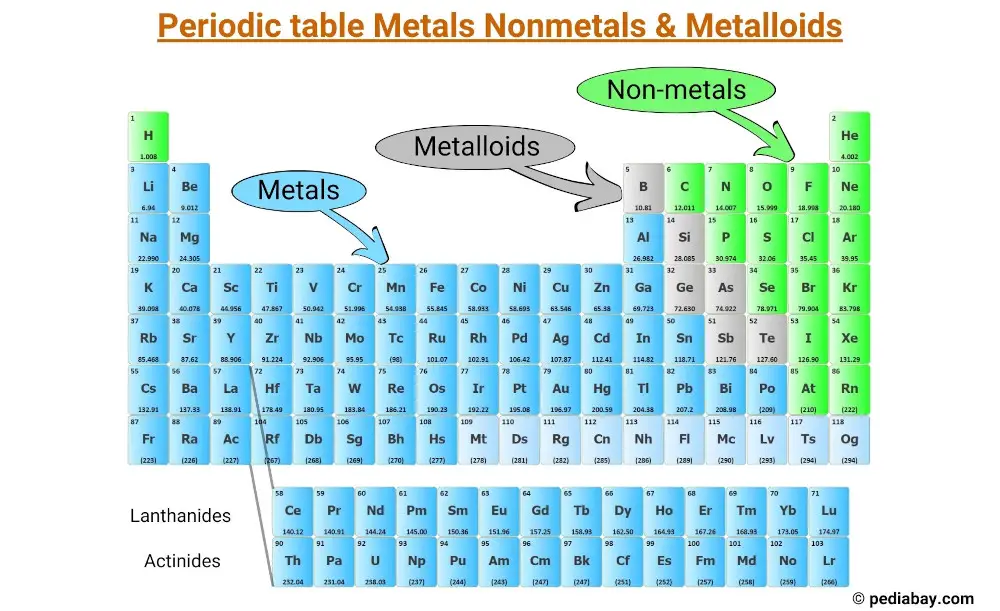
On the periodic table, metals are the undisputed majority. They occupy a huge chunk of the left side and the middle. You’ve got your alkali metals (Group 1, super reactive, don’t try to play with those!), your alkaline earth metals (Group 2, also reactive but a bit less dramatic), the transition metals (the big block in the middle, like iron, copper, gold – the bling and the building materials!), and then the lanthanides and actinides at the bottom, which are a whole other fascinating can of worms (but let’s save that for another day, shall we?).
The reason they’re so good at conducting electricity and heat is all down to their electrons. They have these outer electrons that are not super tightly held. They’re pretty free to roam around, forming this “sea of electrons” that allows for easy movement of charge and energy. It's like a bustling highway system for electrons!
Imagine trying to build a house out of chalk. It wouldn’t work, right? You need something strong, something that can be shaped. That’s where metals shine. They’re the backbone of so much of our modern world, from the skyscrapers we live in to the tiny circuits in our computers.
And Then There Are the Nonmetals: The Quirky Counterparts
If metals are the flashy, robust performers, then nonmetals are the… well, the rest. They’re a much smaller group, found mostly on the upper right side of the periodic table, plus hydrogen hanging out all by its lonesome on the left (which is a whole other story of elemental identity crisis). Nonmetals are generally the opposite of metals in many ways:
- Dull: Forget the shine. Most nonmetals are matte, powdery, or even gaseous. Think of sulfur, carbon (in its charcoal form), or the oxygen you’re breathing right now.
- Poor Conductors: They’re insulators, basically. They don’t let heat or electricity pass through easily. That’s why they’re used in things like rubber (made from carbon-based polymers) or glass (mostly silicon dioxide).
- Brittle: If you try to hammer a nonmetal, it’s more likely to shatter into pieces than bend. Think of a piece of coal breaking.
- Varied States: Nonmetals can be solids (like carbon, sulfur), liquids (like bromine – a reddish-brown, fuming liquid, pretty gnarly stuff!), or gases (like oxygen, nitrogen, chlorine).
- Low Melting and Boiling Points: Compared to metals, many nonmetals will melt or boil at much lower temperatures.
This diverse group includes familiar faces like oxygen (crucial for life!), nitrogen (makes up most of the air), carbon (the basis of all organic life and also the stuff of diamonds and pencils), sulfur (that eggy smell!), and the halogens (like chlorine and fluorine, which can be quite reactive and useful in cleaning products, but also dangerous!).
The electrons in nonmetals are held much more tightly by their atoms. They’re not looking to share or let their electrons roam free. This tight grip is what makes them poor conductors and contributes to their brittleness. They’re more about individualistic, electron-hugging behavior.
Think about the gases in our atmosphere. They don’t conduct heat well, they’re not shiny, and you can’t hammer them into shape. They’re essential for us, but their properties are a world away from, say, a gold bar. They play different roles in the grand scheme of things.
Enter the Middle Ground: Semimetals (or Metalloids)
Now, this is where it gets really interesting. Remember Leo’s bronze block that was “kinda in the middle”? That’s our semimetal. These elements are the Switzerland of the periodic table, existing in a fascinating blend of metallic and nonmetallic properties. They’re also called metalloids, which is a pretty descriptive name, don’t you think? It literally means “metal-like.”
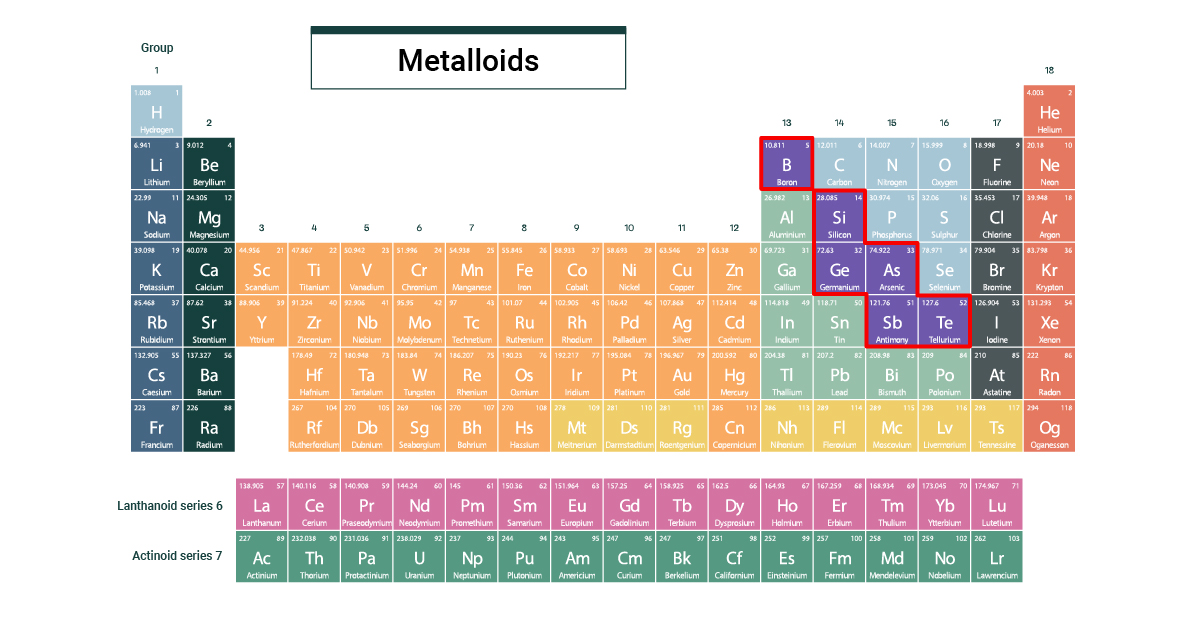
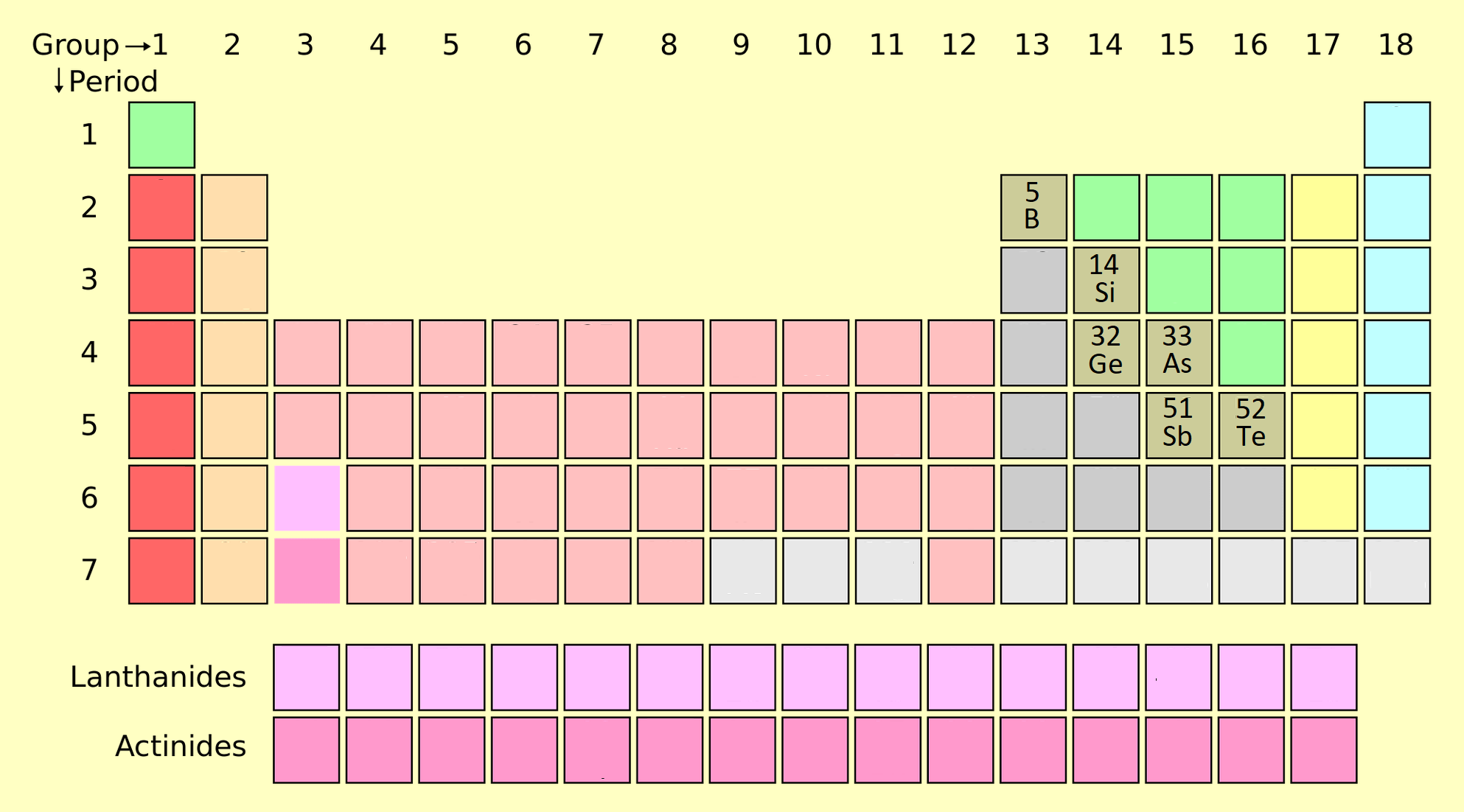
You’ll find them forming a zigzag line that separates the metals from the nonmetals on the periodic table. They’re like the border towns, picking up a little bit of culture from both sides. The common semimetals include:
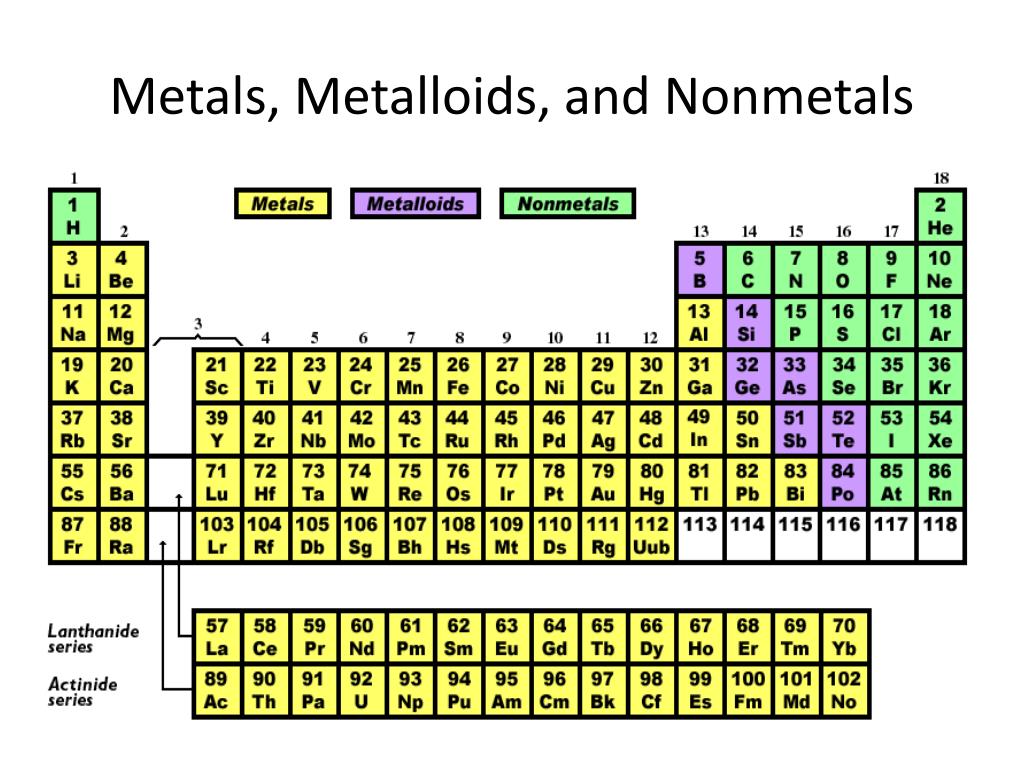
- Silicon (Si)
- Germanium (Ge)
- Arsenic (As)
- Antimony (Sb)
- Tellurium (Te)
- Polonium (Po)
- Astatine (At) – sometimes debated, but often included!
So, what makes them so special? Well, they exhibit properties that are a bit of both:
- Appearance: They can look a bit metallic, often shiny, but are usually harder and more brittle than true metals.
- Conductivity: This is their superpower! They are semiconductors. Under certain conditions, they can conduct electricity and heat, but not as well as metals. This ability to control conductivity by adding impurities (a process called doping) is absolutely revolutionary.
- Reactivity: Their chemical behavior is also a mix. They can sometimes form alloys with metals or compounds with nonmetals.
The magic of semiconductors is the reason we have computers, smartphones, and pretty much all modern electronics. Silicon, in particular, is the king of semimetals in this regard. Its ability to precisely control electrical current is the foundation of the microchip. Without silicon, your laptop would just be a very expensive paperweight.
It’s like they have the potential to be a metal, but also the potential to behave like a nonmetal. They’re adaptable. They’re the elements that allow us to fine-tune properties, to create materials that do exactly what we need them to do. They’re not just a bridge; they’re an essential component in so many advanced technologies.
Think about it: if you only had pure metals and pure nonmetals, you’d have extremes. You’d have things that conduct everything or things that block everything. Semimetals allow for that nuanced control, that perfect balance needed for intricate electronic circuits.

Why Does This Even Matter?
You might be thinking, “Okay, cool story about Leo and his blocks, but why should I care about metals, nonmetals, and semimetals?” Well, because understanding these categories is like having the cheat codes to understanding the material world around you. Everything you touch, see, and interact with is made up of elements, and their properties are largely determined by whether they fall into these three buckets.
From the sturdy steel beams of a skyscraper (metals) to the oxygen we breathe (nonmetal), to the silicon chip that powers our communication (semimetal), these classifications aren’t just abstract scientific concepts. They are the fundamental building blocks of our civilization and our very existence.
When you look at a periodic table, it’s not just a messy chart of letters and numbers. It’s a beautifully organized map of how matter behaves. The distinct regions for metals, nonmetals, and semimetals are like different neighborhoods, each with its own character and its own vital role to play.
So next time you’re admiring a shiny piece of jewelry, taking a deep breath of fresh air, or scrolling through your phone, give a little nod to the elements. Remember that their place on the periodic table, and their classification as a metal, nonmetal, or semimetal, is the reason they can do what they do. It's a pretty neat way to look at the world, don't you think? Just a bunch of elements, hanging out with their friends, and making everything happen.