
Mild Steel Strain Stress Curve
Ever had that moment when you’re trying to hang a picture, and you've got a nail that's just... a little too stubborn? You give it a tap, then a bit more force, and suddenly it feels like you’re wrestling a grumpy badger. That, my friends, is a tiny, everyday peek into the wild world of mild steel and its rather dramatic stress-strain curve.
Think of mild steel as the trusty, slightly unremarkable workhorse of the metal world. It’s not flashy like gold, nor is it super tough and brittle like some fancy alloys. It’s just… there. Like that reliable pair of jeans you wear to do yard work. It’s not going to win any fashion awards, but it gets the job done without complaining too much. And that, as we’ll see, is its secret superpower.
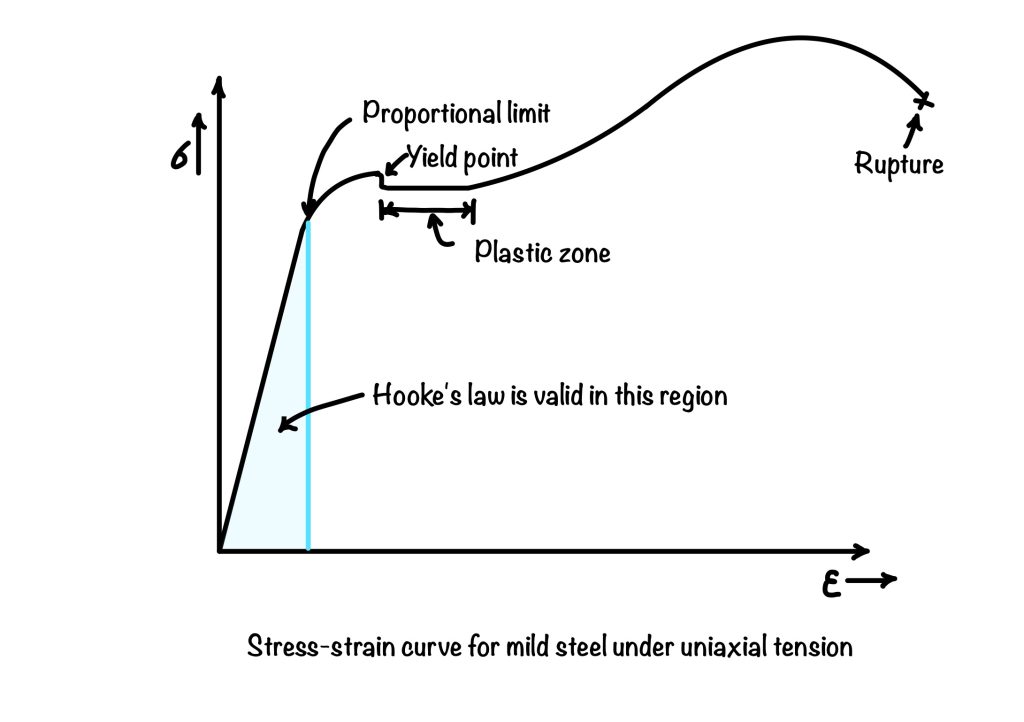
Now, let’s talk about what happens when you start stressing this poor metal out. Imagine you’re gently pulling on a rubber band. At first, it stretches easily, right? No biggie. That’s like the initial phase of our steel friend’s ordeal. We call this the elastic region. It’s like telling a joke to someone who giggles. They respond, but they snap right back to their usual self when the joke is over.
In this elastic phase, if you stop pulling, the mild steel just springs back to its original shape. It’s like you’re lightly nudging a sleeping cat – it might twitch an ear, but it’s still very much itself. The pull (the stress) is directly related to how much it stretches (the strain). It’s a nice, polite, predictable relationship. Like your first few dates – all smiles and polite conversation.
But then, you keep pulling. And pulling. You’re not being gentle anymore. You’re putting some serious elbow grease into it. This is where things get interesting. You reach a point where the steel starts to say, "Okay, dude, I'm starting to feel this." This is called the proportional limit, and then the elastic limit. Think of it as the moment before your friend rolls their eyes at your third bad pun. There's still a chance of recovery, but it's getting dicey.
After the elastic limit, if you keep applying more force, the steel starts to permanently change. It stretches, and when you let go, it doesn’t quite spring back to where it was. It’s got a bit of a permanent slouch, like that one person who always sits with their shoulders hunched a little. This is the beginning of the plastic region.
In this plastic zone, the relationship between stress and strain becomes a bit more complicated. It's not a straight line anymore. It's more like a conversation where one person starts rambling and the other is just trying to keep up. You apply more stress, and you get a lot more strain. The steel is really giving in now. It's like when you're trying to convince your teenager to clean their room. You might start with a gentle suggestion, but eventually, you have to lay down the law, and even then, you get a lot of eye-rolling and minimal effort. The room still isn't clean, but hey, you tried.

Here’s where it gets really fun: the yield point. This is a magical, almost uncanny moment. Mild steel, bless its predictable heart, reaches a point where it can stretch significantly with very little additional force. It's like reaching the summit of a really steep hill and then having a nice, flat plateau for a while. You’ve put in the hard work, and now you can just coast. Or, in steel terms, you can bend it, deform it, shape it, without it fighting back too much.
Imagine you’re trying to bend a coat hanger. You can bend it back and forth a bit, and it goes back to its shape (elastic). But then, you bend it further, and it stays bent. That bend? That’s the yield point in action. Mild steel is great for this. That’s why it’s used for car bodies, structural beams, and, yes, those slightly bendy coat hangers you can’t resist fiddling with.
This yielding behavior is super important. Engineers use this yield point as a critical number. It tells them how much load something can take before it starts to permanently deform. It’s like setting a speed limit. You want to go fast, but you don’t want to go so fast that the car starts falling apart. The yield point is that safe-ish zone before things get… interesting.
So, you’ve reached the yield point, and you’re still pulling. The steel is happily stretching, looking a bit like a deflated balloon. It’s definitely not going back to its original shape. But then, something else happens. As you continue to stretch it, the steel actually starts to get stronger again, at least in terms of how much more force it takes to stretch it further. This is called strain hardening, or sometimes work hardening. It’s like your muscles after a really good workout. You’re sore, yes, but you’re also stronger and can lift more the next time.

In this strain hardening phase, the steel’s internal structure is rearranging itself. Tiny little imperfections called dislocations are getting tangled up, making it harder for the steel to deform. It’s like trying to push through a crowd – the more people there are, the harder it is to move. You keep applying stress, and the steel keeps deforming, but the amount of stress needed to cause further deformation actually increases. It’s a weird, counter-intuitive kind of strength gain through suffering.
This leads us to the ultimate tensile strength. This is the absolute peak of the curve. It’s the moment when the steel is at its strongest, resisting your pulling with all its might. Imagine you’re trying to pull a really stubborn cat away from a sunny spot. You’re giving it everything you’ve got, and it’s resisting with surprising ferocity. This is the cat’s ultimate tensile strength (and probably yours, if you’re in a tug-of-war).
Once you pass the ultimate tensile strength, the steel starts to get weaker. Not weaker in the sense that it’s suddenly made of tissue paper, but weaker relative to that peak strength. This is because at this point, a localized narrowing starts to occur in one spot of the steel. We call this necking. It’s like when you pinch a piece of playdough really hard in one spot – it gets thinner there.
This necking is the beginning of the end. The steel is concentrating all its deformation in this one small area. It’s like a bad movie where all the drama happens in the last 10 minutes. The rest of the steel is still holding on, but this one weak point is about to give way.
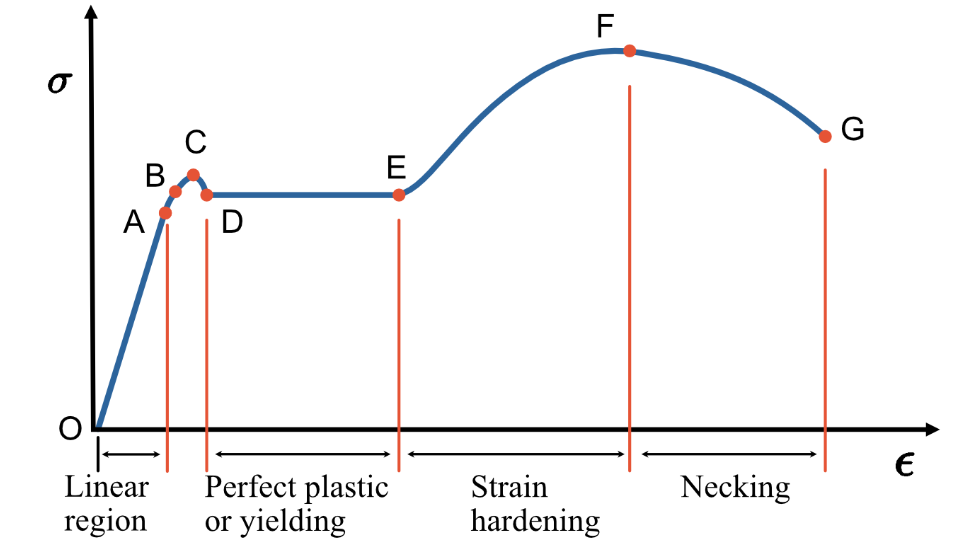
Finally, we reach the fracture point. Boom! The steel breaks. It snaps. It’s had enough. It’s like when your phone finally dies after being on 1% for an hour. It’s been hanging on by a thread, but eventually, it’s got to give up the ghost. The stress required to cause this final break is the fracture strength.
So, let’s recap this whole dramatic journey of mild steel. It starts out all polite and elastic, happily springing back. Then it hits the yield point, where it says, "Okay, I'll bend, but I won't go back." Then it gets tough and strong through strain hardening, like a seasoned athlete. It reaches its peak strength, its ultimate tensile strength, and then, in one dramatic spot, it starts to neck down before finally, with a sigh (or a loud snap), it fractures.
The beauty of mild steel's stress-strain curve is its predictability and its utility. It tells engineers exactly how much abuse this metal can take before it starts to misbehave. It’s like knowing your friend will eventually return that borrowed tool, even if it takes a few reminders. Mild steel will deform before it catastrophically fails, which is a really good thing. It gives you a heads-up, a warning, that things are getting a bit wobbly. It’s not going to go from perfectly fine to shattered in a nanosecond.
Think about bridges, buildings, cars. All these things are designed with mild steel in mind. We know its limits, its breaking points, its sweet spots of deformation. We can shape it, weld it, bend it, and rely on it to hold up our world. It’s the silent, unsung hero of our infrastructure, the material that’s tough enough for the job but flexible enough to be worked with.
It’s like that friend who’s always there for you, not always the most exciting, but incredibly dependable. You can count on them to lend an ear, or in the case of mild steel, to lend its structural integrity. It’s the stuff that makes our modern lives possible, from the nuts and bolts holding your bike together to the giant beams supporting your apartment building.
So next time you see a steel beam, or even just a bent nail, give a little nod to the mild steel strain-stress curve. It’s a testament to engineering, to understanding materials, and to the surprisingly dramatic life story of a very common, very useful metal. It’s a curve that’s as familiar to engineers as your favorite meme is to you. And just like a good meme, it tells a story that’s both informative and, in its own way, quite entertaining.
The whole process is a beautiful dance between force and deformation. It’s the metal’s way of showing us its personality. It starts off shy, gets a bit stubborn, then really lets loose before finally, well, calling it a day. And that’s precisely why we love it. It’s honest. It’s reliable. It’s mild steel, and its stress-strain curve is a story worth telling. It’s the metal equivalent of saying, "I’m tough, but I’m not that kind of tough, and I’ll let you know when I’m about to throw in the towel." And frankly, in the world of materials, that’s a pretty darn good personality trait.
We take it for granted, this ubiquitous metal. But its predictable behavior, its clear stages of response to stress, are the bedrock of countless technologies and structures. It’s the foundation upon which we build, the stuff that keeps us safe and allows us to move forward. So, hats off to mild steel, and its wonderfully revealing stress-strain curve!