
Minecraft How To Craft Flint And Steel
Hey there, fellow digital dwellers and aspiring artisans! Ever find yourself staring at a pixelated pile of wood, yearning for a crackling campfire, or perhaps a rather dramatic explosion? Well, buckle up, buttercups, because today we're diving into the wonderfully simple, yet utterly essential, art of crafting Flint and Steel in the boundless world of Minecraft.
Think of it as your personal gateway to the primal element of fire. No fancy advanced crafting table recipes here, no obscure mob drops guarded by dragons (yet). This is pure, unadulterated, early-game magic. It’s the kind of knowledge that separates the chill campers from the shivering, perpetually-cold adventurers. You know, the ones who are still trying to punch trees for warmth?
The Humble Beginnings: Gathering Your Ingredients
So, what exactly do you need to conjure this fiery enchantment? It’s surprisingly straightforward. You’ll require two very specific items:
- Flint: This is your spark-maker.
- Iron Ingot: This is your striker.
That’s it! No, seriously. Two things. It’s like the minimalist chic of the crafting world. If you’ve ever wondered how to get your hands on these goodies, fear not. Let’s break it down.
Digging for Diamonds... and Delightful Gravel
Flint, my friends, is a bit of a surprise treat. You won't find it lying around in neat little piles. No, flint is a byproduct of something else entirely: gravel. You know, those slightly annoying blocks that tend to cascade down on you when you’re not paying attention? Yeah, those.
Your best bet for finding gravel is usually underground. Start digging! But here’s the trick: when you mine gravel blocks with your pickaxe, there’s a 10% chance that instead of dropping the gravel block itself, you’ll get a lovely piece of flint. Think of it as a little lottery win from Mother Nature’s underground vault.
Pro-Tip: Gravel deposits are often found near water sources, both above and below ground. So, keep an eye out in caves, ravines, or even just beneath the surface where you see a patch of it. And a word to the wise: mining gravel can be… unstable. Be prepared for potential block-fall situations. It’s like the Jenga of the underground. Keep your wits about you, and maybe have a strategically placed block or two to catch any falling debris. Or, you know, just don't stand directly underneath it for too long.
Culturally speaking, flint has a long and storied history. For millennia, humans used it to start fires, a pivotal moment in our evolution. It’s that same satisfying ‘click’ sound you might associate with old-school lighters, but in block form. Pretty cool, right? You’re basically holding a piece of ancient technology in your digital hands.
The Gleam of Iron: From Ore to Ingot
Now, for the iron. This is slightly more involved, but still very much in the "early game" territory. You’ll need to venture into caves or mine downwards to find iron ore. These are the stone blocks with reddish-brown speckles. They’re fairly common, thankfully, so you shouldn’t have to go on a wild goose chase for too long.
Once you’ve mined your iron ore (you’ll need at least one piece for this recipe, but it’s always good to grab more!), you can’t just pop it into your inventory and expect it to be usable. Oh no, we're not that lucky. You need to smelt it.
This requires a Furnace. If you haven't crafted one of those yet, it's a simple recipe: eight cobblestone blocks arranged in a circle in your crafting grid. Cobblestone, of course, comes from mining stone. See? It’s all connected, like a beautifully intricate, blocky web of survival.

Place your iron ore into the top slot of the furnace, and fuel (like coal, charcoal, or even planks of wood) into the bottom slot. After a short wait, your furnace will churn out a shiny iron ingot. Voilà!
Pro-Tip: Iron ore can be found at pretty much any underground level, but it becomes more abundant the deeper you go. However, be mindful of venturing too deep too soon. That’s where the more dangerous mobs tend to hang out. Think of it as a risk-reward scenario. Want that sweet, sweet iron? Be prepared for potential encounters with creepers and skeletons. It's a classic Minecraft rite of passage.
The Grand Unveiling: Crafting Time!
Alright, you’ve got your flint, you’ve got your iron ingot. Now for the moment of truth. Open up your Crafting Table (that’s the 3x3 crafting grid, remember?).
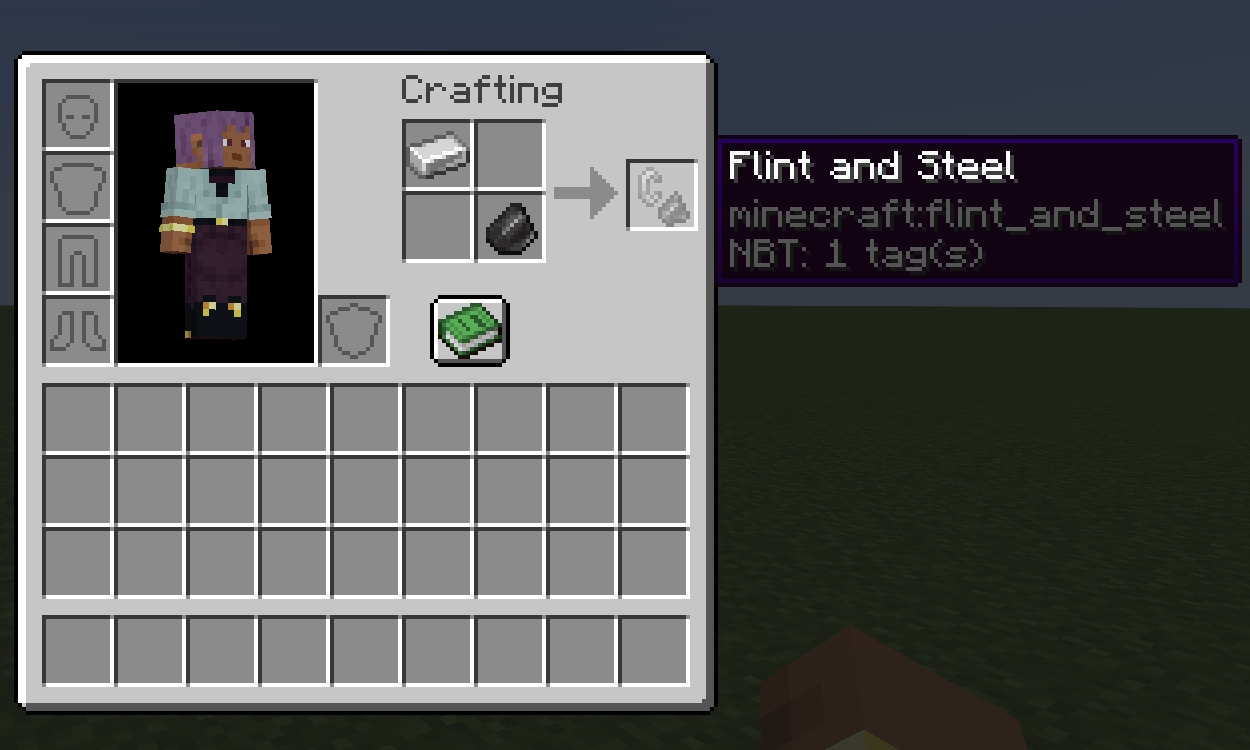
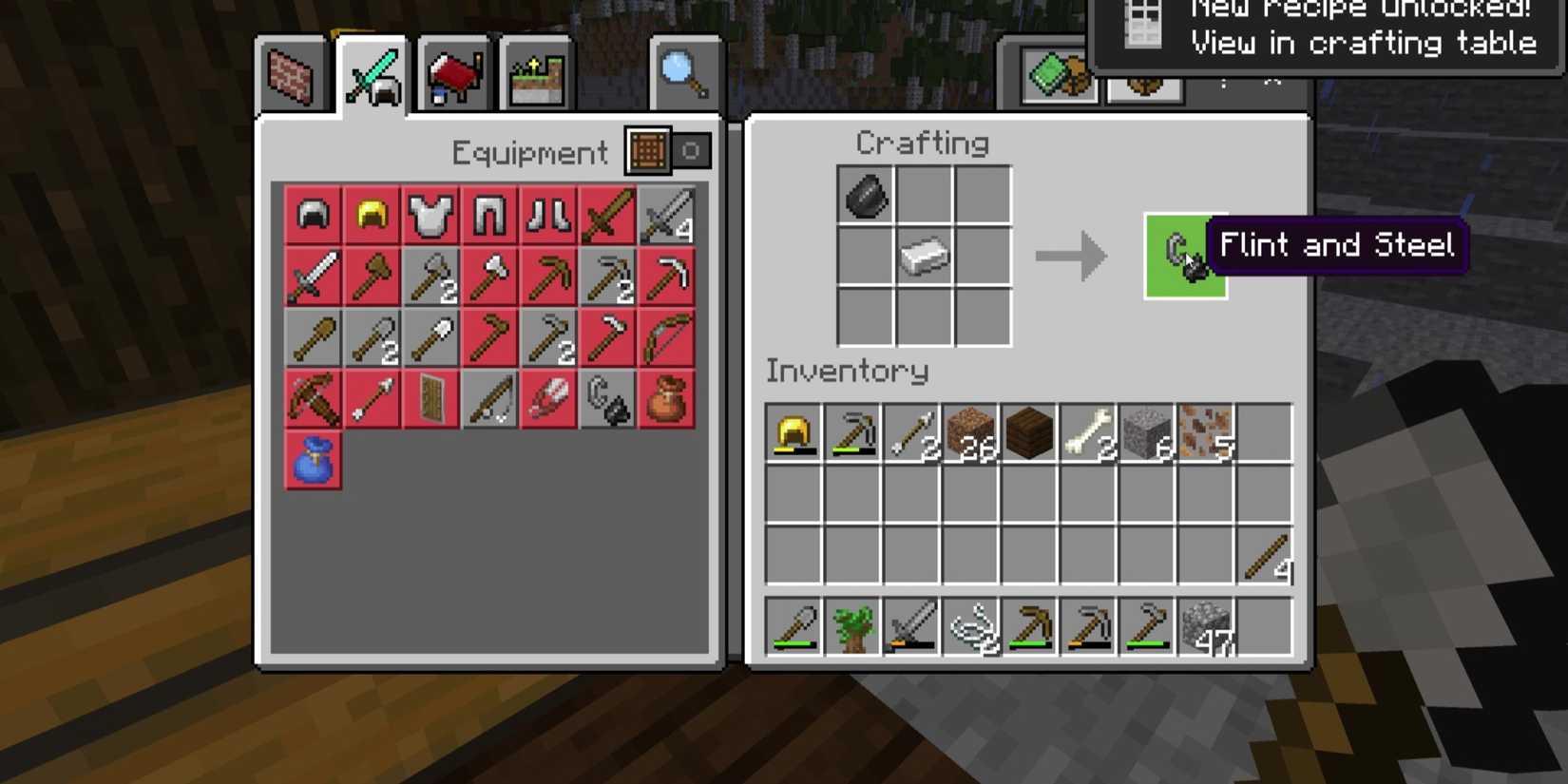
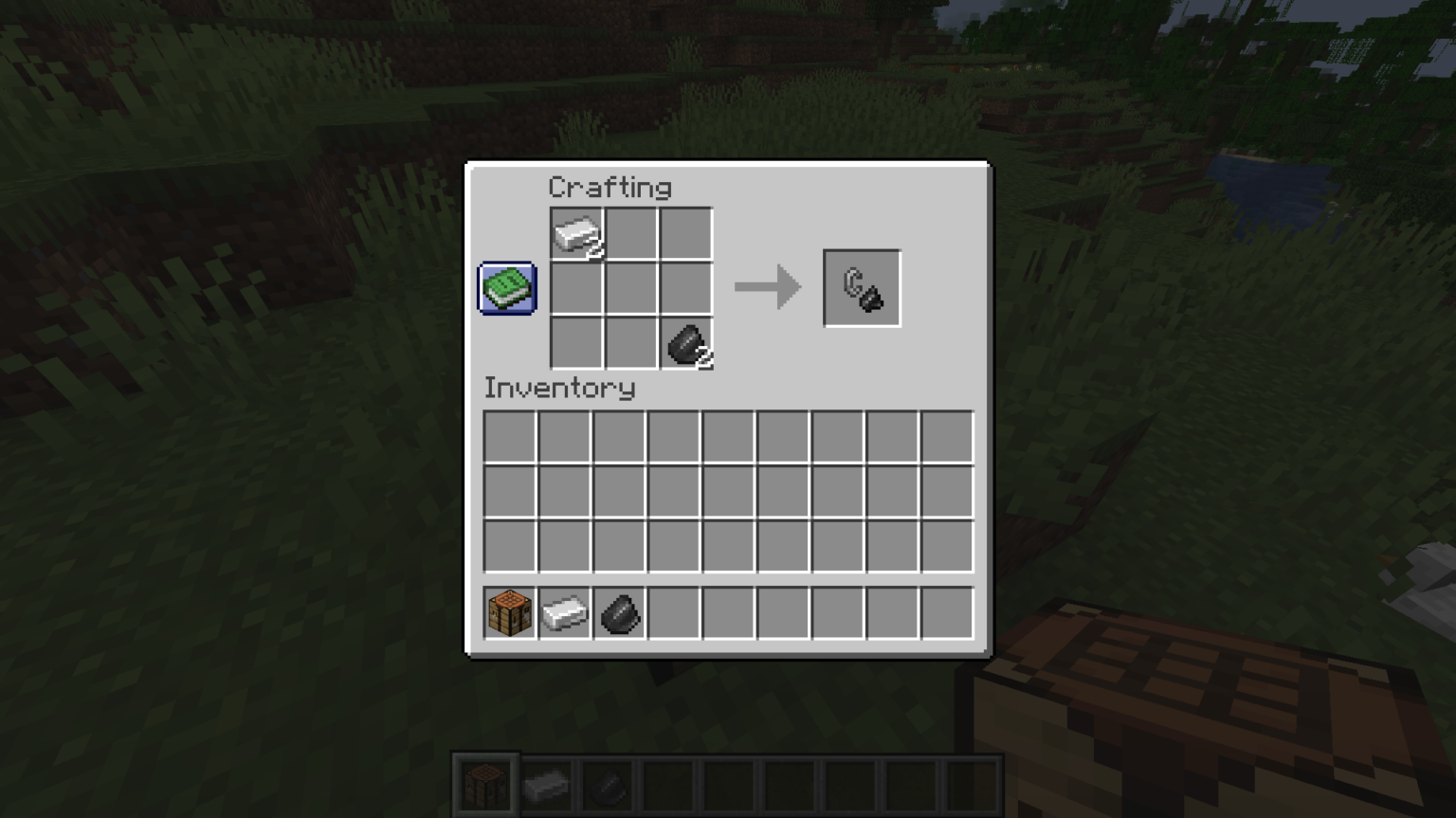
Here’s where the magic happens, and it’s ridiculously simple. Place the iron ingot in one slot, and the flint in the slot directly adjacent to it (either horizontally or vertically).
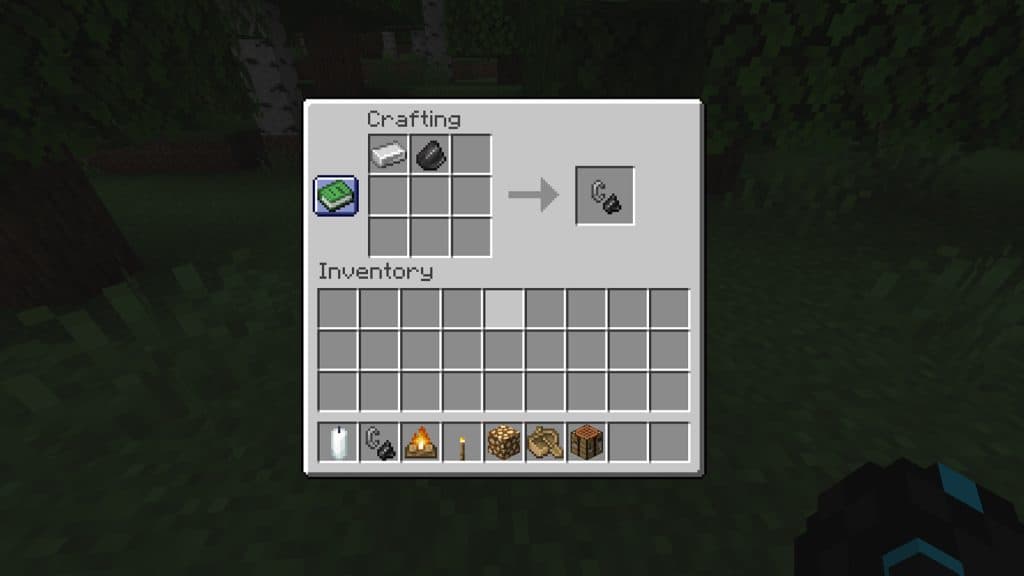
That’s it. The Flint and Steel recipe is literally just those two items next to each other. No complex patterns, no mind-bending arrangements. It’s the ultimate "bang for your buck" crafting recipe.
You’ll see the Flint and Steel icon appear in the output slot. Click on it, drag it into your inventory, and congratulations! You are now the proud owner of a brand-new tool capable of conjuring fire. It’s a feeling akin to discovering fire for the very first time in human history, albeit with fewer cave paintings and more enthusiastic pixelated cheers.
Why You Absolutely Need This Thing
Okay, so you've crafted it. But what’s the big deal? Why is this seemingly simple item so crucial? Oh, let me count the ways!
- Campfires and Light: The most obvious use, of course, is to start fires. Need to cook some food? Light up a dark cavern? Make your humble abode feel a little more… cozy? Right-click on a flammable block (like wood) and watch the flames dance. It’s your portable sun, your personal hearth.
- Nether Portal Construction: This is arguably the most important use. To travel to the fiery, dangerous, and wonderfully weird dimension known as the Nether, you need to construct a Nether Portal. This involves building a large frame out of obsidian blocks and then using your Flint and Steel to ignite the inside of the portal. Without it, you’re stuck in the Overworld, forever dreaming of ghast tears and soul sand. It’s the ultimate ticket to adventure.
- Explosive Fun (and Folly): Creepers. We all know and love (or… tolerate) them. But did you know that a Flint and Steel can actually set them on fire? This can sometimes cause them to explode prematurely, giving you a little breathing room. Also, for the more… chaotic players among us, Flint and Steel can be used to ignite TNT blocks. Prepare for some serious demolition! Just make sure you're not standing too close when the fireworks start.
- Aesthetic Appeal: Let’s be honest, a well-placed campfire under a starry Minecraft sky just looks good. It adds a touch of realism and atmosphere to your builds.
- Preventing Nighttime Woes: Ever been caught out in the dark, desperately trying to find shelter? A quick fire can provide a small circle of light and warmth, deterring some of the nastier nocturnal creatures.
Fun Fact: The texture of Flint and Steel in Minecraft is intentionally designed to look like a classic steel striker with a piece of flint, subtly nodding to its real-world inspiration. It’s the little details that make this game so charming.
A Quick Word on Durability
Like many tools in Minecraft, your trusty Flint and Steel has a limited number of uses. Each time you use it to start a fire, it loses a little bit of its durability. Don’t panic, though! The durability on Flint and Steel is actually quite generous. You’ll get a lot of fires started before it finally gives up the ghost. And when it does? Well, you know the drill: gather more flint, smelt more iron, and craft another!
It’s a constant cycle of resource gathering and crafting, which is part of what makes Minecraft so enduringly addictive. You're always working towards something, always improving your toolkit.
The Big Picture: Fire, Sparks, and Life
It’s funny, isn't it? How this simple act of combining two basic elements in a digital world can feel so… foundational. The ability to create fire is one of the earliest milestones in human development. It provided warmth, protection, a way to cook food, and a gathering point for communities.
In Minecraft, this translates to your very first steps towards establishing a stable existence. That first campfire isn’t just a light source; it’s a symbol of your growing mastery over your environment. It’s the beginning of transforming a wild, untamed world into something a little more… yours.
And perhaps, in our own daily lives, we can draw a parallel. We often encounter situations where we feel "stuck" or "in the dark." We might need to "ignite" a new idea, "spark" a conversation, or simply find the "warmth" of connection. Sometimes, all it takes is a simple combination of readily available elements – a willingness to listen, a dash of creativity, a bit of persistence – to create something that brings light, comfort, and progress. So next time you’re lighting up a campfire in your Minecraft world, take a moment to appreciate the fundamental power you’re wielding, and maybe, just maybe, think about how you can bring a little more spark into your own reality.