
Most Rarest Metal In The World

I remember rummaging through my grandpa’s old workshop. It was a treasure trove of forgotten things: rusty tools, strange-smelling oils, and jars filled with… well, I’m still not entirely sure what half of it was. But there was this one tiny, lead-lined box. It felt surprisingly heavy for its size. Inside, nestled on velvet that had seen better days, was a small, dull-looking pebble. He called it his ‘lucky charm,’ but looking back, it was probably just a piece of quartz. Still, it sparked something in me – that sense of mystery, that feeling that there might be something really special hidden away.
And that got me thinking. We hear about gold, silver, platinum, right? They’re the big players, the ones you see in jewelry stores and fancy watches. But what about the really obscure stuff? The metals that make those bling-bling rocks look like common garden gnomes? Today, we’re going on a little adventure to uncover the most rarest metal in the world. Buckle up, it’s going to be a wild ride through the periodic table.
Now, defining ‘rarest’ can be a bit tricky, can’t it? Are we talking about the total amount that exists on Earth? Or the amount we can actually find and extract? Or maybe it’s about how difficult and expensive it is to get our hands on it? For our purposes today, let’s consider a combination of natural abundance and practical scarcity. It’s got to be super, super low in the Earth’s crust, and even then, if it’s ridiculously easy to pull out, it’s not quite the elusive unicorn we’re looking for.
So, who’s the contender for the crown of the rarest metal? Drumroll, please… it’s a tough one, and there are a few strong contenders, but one element consistently pops up at the absolute top of the ‘good luck finding this’ list: Francium. Yep, sounds a bit like a fancy French cheese, doesn’t it? But trust me, this stuff is far more volatile than brie.
The Reign of Francium: A Fleeting Existence
Francium, with the atomic number 87, is an alkali metal. That means it’s in the same family as lithium, sodium, and potassium – the ones you find in batteries and, well, table salt. But Francium is the black sheep of that family, the one that’s always looking over its shoulder, knowing its time is limited. And I mean really limited.
Here’s the kicker: Francium is extremely radioactive. Like, ‘blink and you’ll miss it’ radioactive. Its most stable isotope, Francium-223, has a half-life of just 22 minutes. Twenty. Two. Minutes. Imagine trying to host a party for Francium. By the time you’ve sent out the invitations, the guest of honor would have decayed into something else. It’s the ultimate party pooper of the metallic world.
What does a half-life of 22 minutes even mean? It means that after 22 minutes, half of the Francium atoms present will have transformed into another element, usually Astatine. And then another 22 minutes pass, and half of that remaining Francium is gone. It’s a race against time, a constant state of disintegration.
So, naturally, if it’s decaying that quickly, there can’t be much of it hanging around, can there? Exactly! Scientists estimate that at any given moment, there is less than 30 grams of Francium on the entire Earth’s crust. Thirty grams! That’s less than a standard chocolate bar. And considering how quickly it disappears, it’s more like a fleeting whisper than a solid presence.
Where Does This Elusive Element Come From?
You won’t find Francium lying around in veins of rock like gold or copper. It doesn’t form stable deposits. Instead, it’s a byproduct of a natural radioactive decay process. Specifically, it’s formed when Actinium, another radioactive element, decays.
Think of it like a very, very long and complicated chain reaction. Uranium decays into Thorium, which decays into Protactinium, and so on, and so on, until eventually, after a multitude of steps, some of it can turn into Actinium, and then, bam, a tiny bit of Francium is born. It’s like finding a rare coin dropped by a collector who then immediately lost it again.
Because it’s so short-lived and doesn’t accumulate, extracting Francium is a monumental task. It’s not like mining. It’s more like trying to catch a handful of mist. Researchers can only produce it in tiny quantities in laboratories using powerful particle accelerators.

The process involves bombarding Thorium targets with accelerated Oxygen ions. It’s incredibly complex, energy-intensive, and yields only a minuscule amount of Francium. For every few days of running these sophisticated machines, scientists might be able to produce enough Francium to observe for a few minutes before it’s gone.
The Cost: More Than Your House, More Than Your Country
Given its extreme rarity and the difficulty in producing it, you might be wondering about the price tag. Well, let’s just say if you wanted to buy a gram of Francium, you’d probably need to sell a small country. Or maybe a large moon.
Estimates vary, and honestly, it’s hard to put a definitive price on something that effectively doesn’t exist in a usable form for very long. However, some sources suggest that the cost of producing Francium could be upwards of $10 million per gram. Maybe even more.
That’s a lot of zeros, isn’t it? For perspective, gold, which we consider incredibly valuable, hovers around $60-$70 per gram. Platinum is a bit higher, maybe $40-$50 per gram. Even rare earths, which are crucial for our modern technology, don’t touch this kind of astronomical figure.
So, why bother? Why do scientists go through all this trouble to create something so fleeting and expensive?
The Scientific Pursuit of the Unknown
The primary reason is pure scientific curiosity and the advancement of knowledge. Studying Francium, even in its minuscule and ephemeral existence, helps us understand fundamental principles of physics and chemistry. It’s about pushing the boundaries of what we know about matter and the universe.
For example, Francium’s radioactive properties are of interest in nuclear physics. Understanding its decay patterns and its interactions with other elements can provide insights into nuclear structure and stability. It’s like trying to solve a complex puzzle piece by piece, even if the pieces disappear as soon as you put them down.
There have also been speculative medical applications, particularly in cancer treatment. Because it decays so rapidly and emits alpha particles, some researchers have explored its potential for targeted radiation therapy. The idea is that if you could deliver Francium directly to cancerous cells, its intense radiation would destroy them while the short half-life would minimize damage to surrounding healthy tissues.
However, the practical challenges are immense. The instability of Francium makes it incredibly difficult and dangerous to handle, even for the most skilled scientists. So, while the potential is there, it remains largely theoretical for now.
Honorable Mentions: Other Extremely Rare Metals
While Francium often takes the gold (or, should I say, the imaginary Francium medal?), it's not the only game in town when it comes to ultra-rare elements. Here are a few other contenders that make you appreciate the sheer abundance of, say, iron in your frying pan:
- Astatine: Another radioactive element, often considered even rarer than Francium in terms of natural occurrence. It's also incredibly unstable, with its longest-lived isotope having a half-life of about 8 hours. So, practically speaking, it's gone almost as soon as it appears. It’s the metallic equivalent of a shooting star.
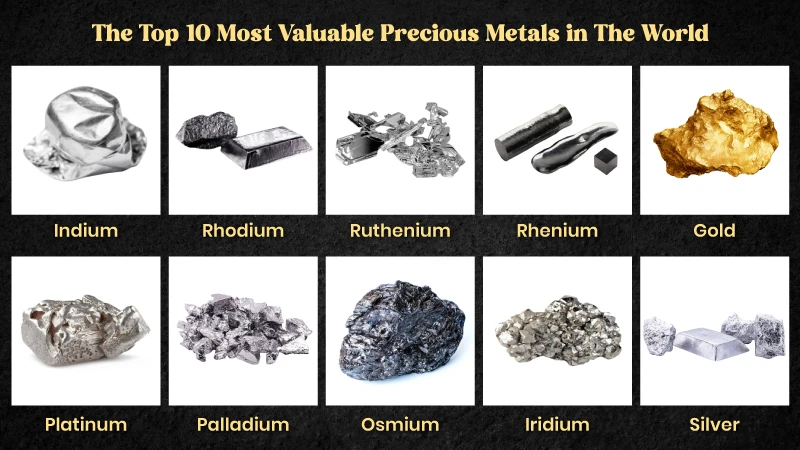
- Ruthenium, Rhodium, Palladium, Osmium, Iridium, Platinum (The Platinum Group Metals - PGMs): These six elements are often found together in the Earth’s crust and are known for their incredible rarity and resistance to corrosion. Platinum itself is prized for its beauty and durability, but its cousins are often even harder to come by and have even more specialized industrial uses. Think catalytic converters for cars – they rely heavily on these guys!
- Rhenium: This is a super-dense and incredibly heat-resistant metal. It’s so rare that it’s often considered a byproduct of copper and molybdenum mining. It’s essential for high-performance jet engines and other extreme-temperature applications. Imagine needing something that can withstand the fiery guts of a rocket – that’s Rhenium for you.
- Tellurium: This is a metalloid, meaning it has properties of both metals and nonmetals. It’s used in solar panels and as an alloying agent for metals like copper and stainless steel. It’s not as rare as Francium, but it’s still not something you’re going to stumble upon in your backyard.
It’s fascinating to think that these elements, with their extreme scarcity and unique properties, exist right under our feet, even if we can only produce or detect them in fleeting moments.
The Rarity of Rarity
The concept of ‘rarest’ is really a fascinating one. It highlights the incredible diversity of matter in our universe and the fact that some elements are just far, far less common than others. It’s a testament to the complex processes that shaped our planet over billions of years.
When you think about it, the metals we interact with daily – aluminum in our cans, copper in our wires, iron in our buildings – are incredibly abundant. They’re the workhorses of our civilization. The truly rare elements, on the other hand, are the specialists, the ones with extraordinary properties that we only need in tiny amounts for highly specific, often high-tech, applications.
And then there’s Francium, the king of ephemeral metals. It’s a reminder that the universe is full of wonders, some of which are so fleeting they barely leave a trace. It makes you wonder what else is out there, waiting to be discovered or understood, even if it’s just for a few precious minutes.
So, the next time you’re admiring a piece of jewelry or holding a piece of technology, spare a thought for the elements that didn’t make the cut for everyday use. Think about the Francium, existing and disappearing in a radioactive blink, a true testament to the rarity of rarity itself. And maybe, just maybe, you'll feel a little bit closer to understanding the incredible, invisible ballet of atoms that makes up our world.