
Periodic Table Of Metals Metalloids And Nonmetals

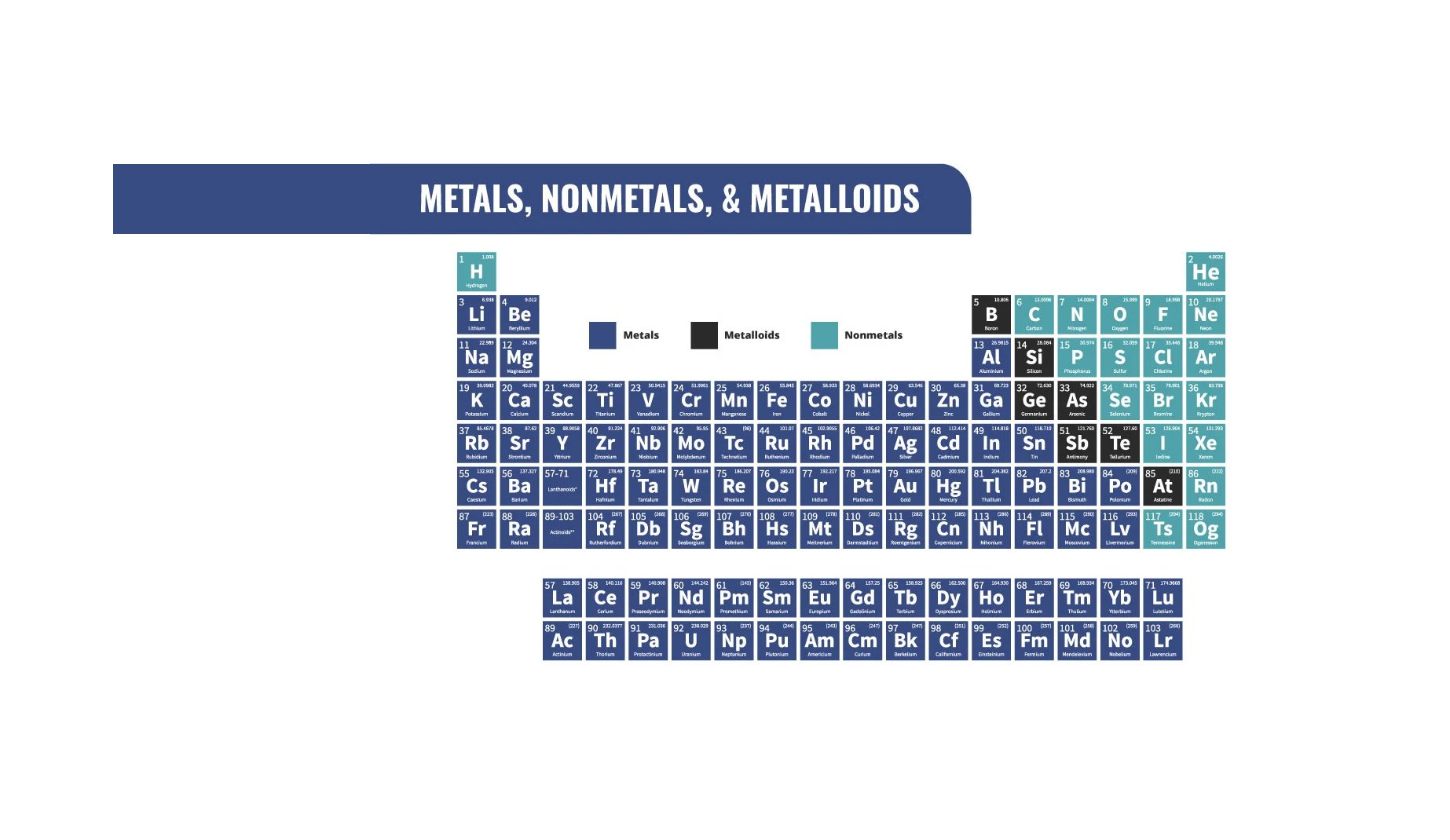
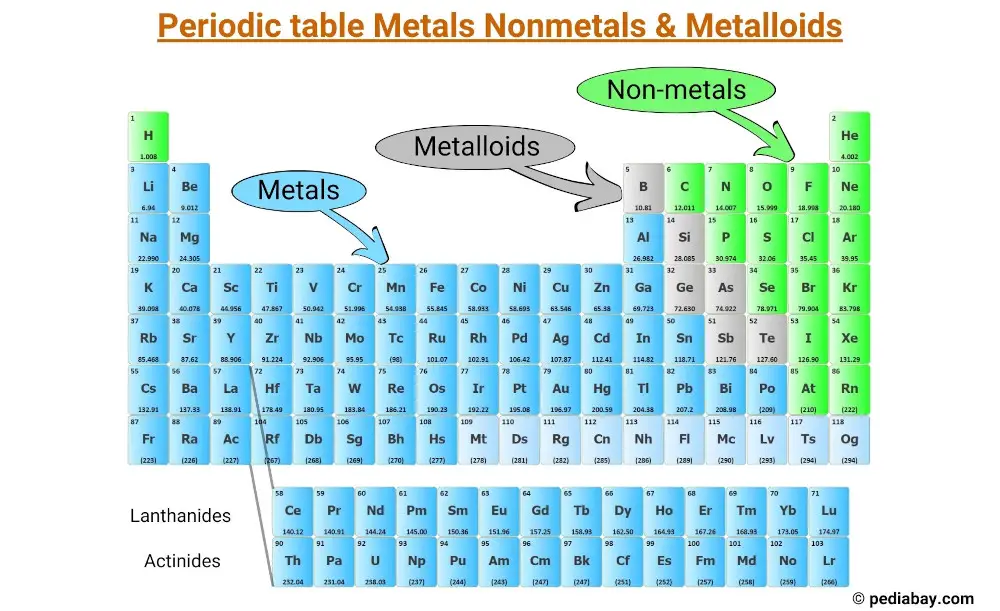
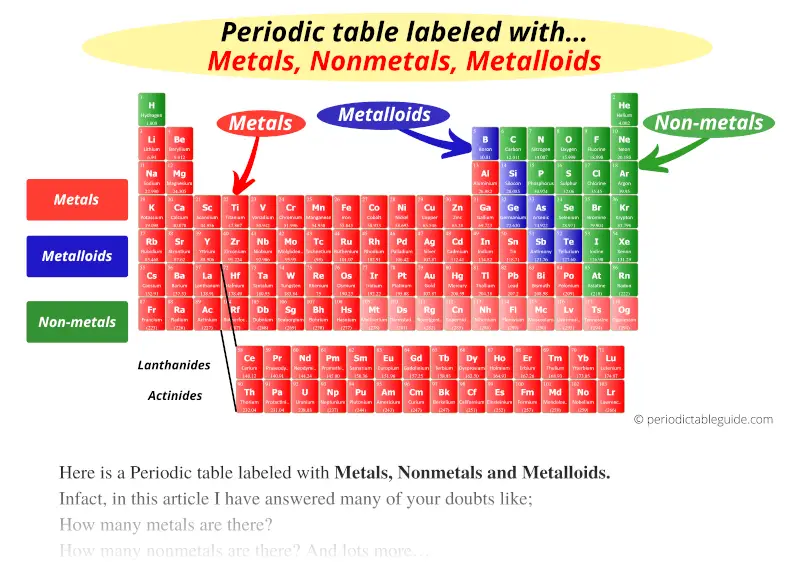
Alright, pull up a chair, grab your (hopefully not lead-based) coffee, and let's talk about the ultimate cheat sheet of the universe: the Periodic Table. But forget those dusty textbooks you crammed for in school. Today, we're diving into the really interesting bits – the Metals, the Metalloids, and the Nonmetals. Think of it as the celebrity lineup of elements, each with their own drama, quirks, and surprisingly useful talents.
So, what's the deal? Basically, scientists, bless their organized little hearts, looked at all the stuff that makes up everything – from your phone to that slightly questionable sandwich you had for lunch – and realized they all behave in certain ways. They decided to lump them together into three big, glorious groups. And thus, the Periodic Table, that iconic grid of boxes, was born. It's like the ultimate high school yearbook, but with way more explosions (sometimes).
The Rockstars: Metals!
First up, the undisputed champions, the headliners, the ones who hog all the glory: the Metals! These guys are the absolute workhorses of the element world. They're like the Beyoncé of the Periodic Table – powerful, versatile, and they just shine. Literally. Most metals have this awesome ability to reflect light, which is why you’ve got mirrors, shiny car bumpers, and probably that disco ball you've been meaning to hang up.
What makes a metal a metal, you ask? Well, for starters, they're usually pretty good conductors. This means they’re excellent at letting electricity and heat zip through them. Think of your trusty frying pan – without metals, your breakfast would be a lot colder (and sadder). Or your laptop charger – that's all thanks to metals acting as electrical highways.
And oh, the physical properties! Most metals are malleable, meaning you can hammer them into thin sheets. Think of gold leaf on fancy cakes, or the foil wrapping your chocolate. They’re also ductile, which means you can draw them out into wires. Ever wondered how we get those tiny copper wires into your internet cables? Yep, metals doing their thing.
Now, a fun fact that might blow your mind: Mercury! This liquid metal is the resident rebel of the metal group. While all its buddies are solid, stoic, and generally chill, Mercury is a sloshy, silvery enigma. It's like the metal equivalent of a moody teenager who refuses to follow the rules. Just don't lick it, okay? We're not entirely sure what happens, but it probably involves a trip to the emergency room and a very strange story.
And let's not forget gold and silver. These precious metals are so desirable they’ve literally caused wars. People have been trading, hoarding, and fighting over these shiny bits of matter for millennia. They're basically the element world's version of bling, and they're still holding strong. Talk about enduring popularity!
The Border Patrol: Metalloids
Next, we have the fascinating Metalloids. These are the fence-sitters, the indecisives, the elements that can't quite make up their minds. They're like the kids who are good at both art and math – they have a little bit of everything. Metalloids often share properties with both metals and nonmetals, making them incredibly useful for all sorts of techy wizardry.
Take Silicon, for example. This is the element that basically runs your entire digital life. Your phone, your computer, that smart toaster you just bought – they're all packed with silicon. It’s a semiconductor, which means it can conduct electricity, but not as freely as a metal. This "sometimes-yes, sometimes-no" conductivity is exactly what makes computer chips work their magic. It’s like having a tiny bouncer at the door of the electrical current, letting some through and blocking others, all at the speed of light.

Another cool kid in the metalloid club is Arsenic. Now, don't get scared by its evil reputation. While it can be a nasty poison in large doses (don't say I didn't warn you!), in smaller, controlled amounts, it's a vital ingredient in certain electronics. It’s proof that even the scariest-sounding elements have their place. It's like the element equivalent of that villain who’s actually kind of charming.
Metalloids are the unsung heroes, the behind-the-scenes MVPs. They might not be as flashy as gold or as essential for life as oxygen, but without them, we wouldn't be able to binge-watch our favorite shows or doomscroll endlessly.
The Quirky Crew: Nonmetals
Finally, we arrive at the Nonmetals. These guys are the rebels, the free spirits, the ones who march to the beat of their own drum. They’re often the polar opposites of metals, and frankly, they can be a bit more dramatic.
First off, forget about conductivity. Most nonmetals are terrible conductors of heat and electricity. They’re insulators, the silent guardians preventing us from being zapped or burned by our appliances. Think of the plastic coating on your electrical wires – that’s a nonmetal doing its protective duty.
And shape? Forget it. Nonmetals are usually brittle in their solid form. If you try to hammer them, they’ll likely just shatter into a million pieces. They’re the delicate china of the element world, but without the fancy floral patterns.
Now for some essential nonmetals. Oxygen! You know, that stuff we breathe? Yeah, that’s a nonmetal. Without it, we’d all be very, very gasping. It’s the lifeblood of our planet, and it’s just hanging out in the air, totally free. Talk about a bargain!
Then there’s Carbon. This element is the backbone of all life. Seriously. From the tiniest bacterium to the biggest blue whale, carbon is there, building our cells, our DNA, everything. It can form incredibly long chains and complex structures, making it the ultimate Lego brick of biology. It’s also what makes diamonds sparkly and graphite (pencil lead)… well, smeary. Talk about range!
And let’s not forget Helium. You know, the stuff that makes your voice sound funny when you inhale it from a balloon? It’s a noble gas, meaning it’s super unreactive. It just chills out, doing its own thing. It's the element equivalent of that friend who’s always calm, no matter how chaotic things get. It’s also used to cool down super powerful magnets in MRI machines, which is way cooler than just making your voice squeaky.
So there you have it! The Periodic Table: a dazzling display of metals, metalloids, and nonmetals, each with their own personality and purpose. They might seem like random letters in boxes, but these elements are the building blocks of everything we know and love. And next time you’re looking at your phone or eating a chocolate bar, give a little nod to the elements that made it all possible. Cheers!