
Root Cause Analysis Cause And Effect Diagram

Ever have one of those days? You know, the kind where everything seems to go sideways, and you're left scratching your head wondering, "Why, oh why, did that happen?" Maybe your toast landed butter-side down (a classic, right?), or perhaps your super-duper important presentation somehow ended up on a floppy disk instead of your USB drive.
Well, fret not, my friends! Because today, we're diving into a superhero tool that can help us conquer these everyday mysteries and banish those pesky "what ifs" to the land of lost socks. It’s called Root Cause Analysis, and it’s way more fun than it sounds, I promise!
Think of it like being a detective, but instead of chasing shadowy figures through foggy alleyways, you're chasing down the real reason behind a problem. And our trusty sidekick in this adventure is the super-cool, super-visual Cause and Effect Diagram!
So, what's the big deal with finding the "root cause"? Imagine you've got a leaky faucet. You could just keep mopping up the water, right? That’s like putting a band-aid on a much bigger issue!
But what if the leak is actually caused by a tiny crack in the pipe itself? Or maybe the faucet handle is just a little bit loose? If you don't fix the source, that drip, drip, drip will keep on tormenting you, and your floor will look like a mini-swimming pool. Root Cause Analysis is all about digging deeper to find that original problem, the one that’s like the sneaky gremlin hiding in the plumbing.
Now, let's talk about our star player: the Cause and Effect Diagram. People also call this the Fishbone Diagram because, well, it kind of looks like a fish skeleton! Isn't that neat? It's a fancy way of saying "let's brainstorm all the possible reasons why something happened."
Imagine you're having a picnic, and suddenly, a swarm of very determined ants decides your sandwiches are the ultimate buffet. Uh oh! Instead of just shooing them away with a twig, we can use our Fishbone Diagram to figure out why they’re so enthusiastic about our lunch.
First, we draw a big line, which is like the spine of our fish. This line represents the problem – in our case, "Ants invading the picnic!" Then, branching off from this spine, we draw smaller lines, like the ribs of the fish. These are our main categories of potential causes.
We’ll need some fun categories to get our brains buzzing. Think of the classic "Four Ms" in manufacturing: Manpower (people), Machine (equipment), Material (what things are made of), and Method (how things are done). For our picnic, we can adapt these!
So, for our ant-tastic problem, let's brainstorm under these headings. Under Manpower (which in our picnic case is more like "Picnic-goers"), we might ask: Did someone leave crumbs on the blanket? Was someone playing with food near the ant trail? Did we pack snacks that are extra-sticky and appealing?
Next, let's look at Machine, which for us could be "Picnic Gear." Did we use a cooler that’s not fully sealed? Is there a sticky spot on the picnic table where we set our drinks? Did our picnic basket have a tiny hole in it that’s an ant superhighway?
Then comes Material, or "Picnic Provisions" in our scenario. What did we bring? Was it a super sugary fruit salad? Did we forget to seal the jam jar properly? Is that chocolate cake just too irresistible, even for the ant elite?
And finally, Method, or "Picnic Practices." How did we set up? Did we accidentally unpack near an ant mound? Did we leave the food uncovered for too long? Was the blanket placed directly on a known ant path?
See how we’re breaking it down? It's like peeling an onion, but instead of crying, we're gaining brilliant insights! Each of these main branches can then have even smaller branches, representing more specific ideas.
For example, under "Picnic Provisions," we might have a sub-branch for "Jam Jar" and then another for "lid not sealed tight." Bingo! That’s a potential root cause. Or under "Picnic Practices," we might have "food left uncovered," leading to "for five minutes while everyone was admiring a butterfly."
The magic of the Fishbone Diagram is that it encourages us to think broadly and not jump to the first, most obvious conclusion. It prevents us from just blaming "the ants" and helps us understand why the ants are so keen on joining our party.
Once we have our magnificent fishbone diagram filled with all sorts of possibilities, the next step in Root Cause Analysis is to investigate. We become super sleuths, testing each of those potential causes. Did we actually find crumbs? Is the jam jar really unsealed? Was the picnic blanket right on top of an ant highway?

By systematically checking each branch of our fishbone, we can pinpoint the real culprit. It might be one thing, or it might be a combination of things. For instance, maybe it was a combination of a slightly loose jam jar lid and us forgetting to put the sugar bowl away properly.
And once we’ve found the root cause – say, the unsealed jam jar – then we can actually fix it! We can tighten that lid with the power of a thousand suns! Or we can implement a new "no uncovered food for longer than 30 seconds" rule at future picnics.
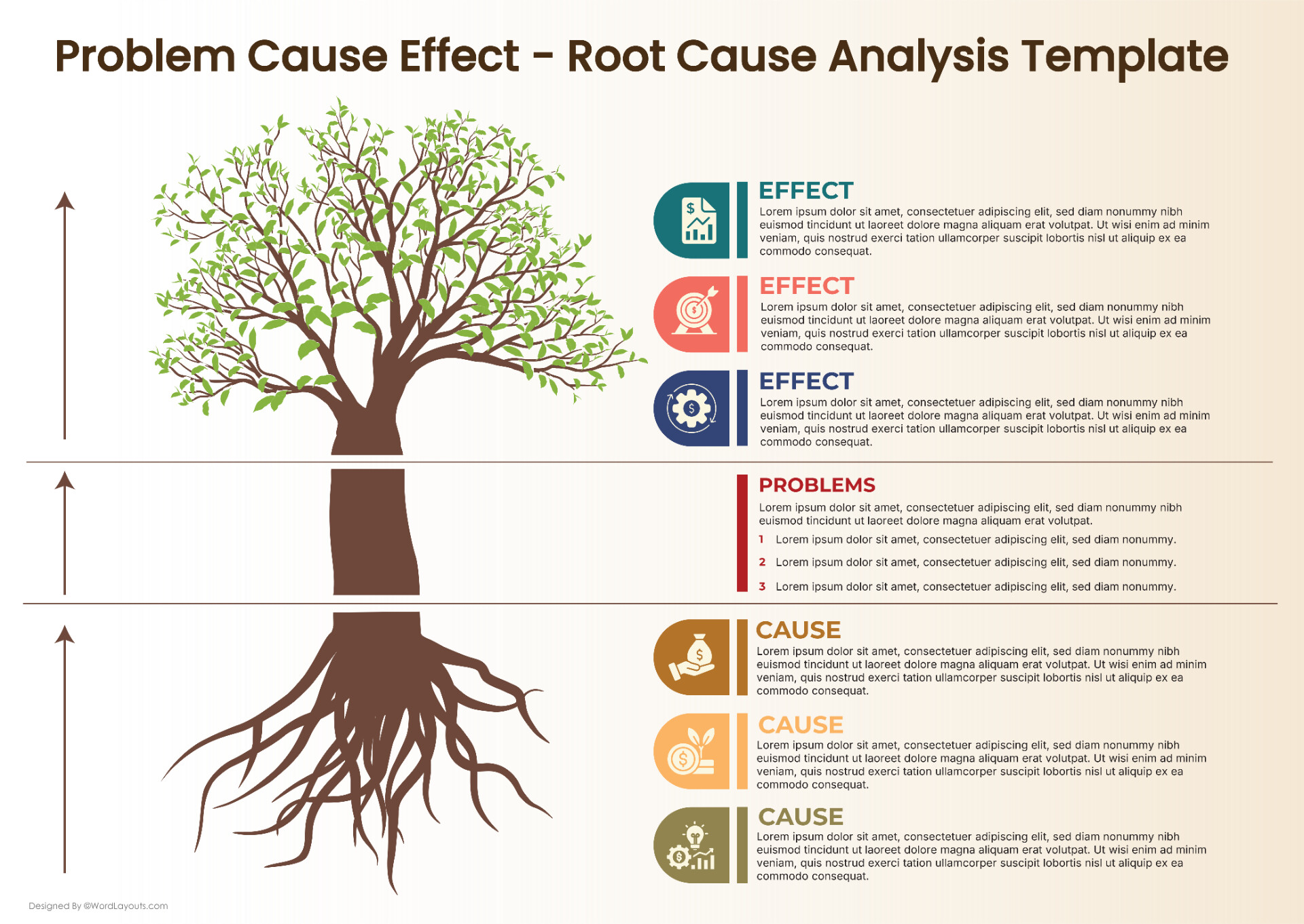
This is where the real win happens with Root Cause Analysis. We're not just fixing the symptom; we're eradicating the problem at its source. It’s like pulling a weed by the roots instead of just snipping off the top.
Think about another relatable example. Your car is making a funny clunking noise. If you only focus on the sound, you might just turn up the radio, right? But that clunking could be a loose bolt on your wheel!
Using a Fishbone Diagram, you’d brainstorm categories like:

- Driver (You! Are you braking too hard? Accelerating too quickly?)
- Vehicle Components (Engine, tires, brakes, suspension – the works!)
- Environmental Factors (Road conditions, weather, potholes)
- Maintenance History (When was the last service? Were there recent repairs?)
You’d then drill down. Under "Vehicle Components," you might have "Tires" and then "Wheel Bolts." Aha! A loose wheel bolt could definitely cause a clunk. Or under "Maintenance History," you might remember a recent tire rotation where maybe something wasn’t tightened back up perfectly.
The beauty of this process is its flexibility. It’s not just for big, complicated industrial problems. It’s for everyday life! Did your kid’s toy break? Did your favorite recipe turn out… less than fabulous? Did your Wi-Fi decide to take a vacation?
You can whip out your mental (or actual!) Fishbone Diagram and start digging. For a broken toy: Was it dropped? Was it made from flimsy plastic? Was it stepped on by a giant? (Okay, maybe not that last one, but you get the idea!).
The key is to be curious, to be thorough, and to avoid the temptation of quick fixes that don't address the underlying issue. Root Cause Analysis, with its trusty sidekick, the Cause and Effect Diagram, empowers you to be a problem-solving rockstar!
So, the next time you’re faced with a puzzling situation, don’t just sigh and shrug. Grab your metaphorical notebook, sketch out that fishbone, and start exploring. You'll be amazed at what you uncover and how much happier you’ll be when you’ve truly solved the problem, not just treated the symptoms. Happy problem-solving, everyone! You’ve got this!