
Silicon Is A Metal Or Nonmetal Or Metalloid
I remember back in middle school, trying to impress my crush, Sarah, with my newfound knowledge of the periodic table. I’d memorized the element symbols, which felt like a superpower back then. I remember pointing to a little squiggle on the chart and confidently declaring, “That’s silicon! It’s… uh… it’s kinda like a metal, but not really.” Sarah just blinked at me, and I’m pretty sure she was more impressed by the fact I could remember anything at all rather than the nuanced classification of silicon. So much for impressing anyone with chemistry back then, right?
But honestly, Sarah’s blank stare perfectly captures the confusion many of us have about silicon. Is it a metal? Is it a nonmetal? Or is it something else entirely? It’s that weird in-between kid on the periodic table, and frankly, it’s a lot more interesting than just another shiny, clangy metal or a floaty, airy nonmetal.
We live in a world powered by it. From the phone in your pocket (yep, that little chip) to the computer you might be reading this on, silicon is the unsung hero of our digital age. Without it, our modern lives would look drastically different. Think about it – no internet, no smartphones, no video games. It’s kind of wild how a seemingly ordinary element can be so fundamental.
So, let’s dive into the intriguing, and sometimes a bit murky, world of silicon. Get ready, because we’re about to demystify this essential element and figure out where it really belongs in the elemental kingdom.
Silicon: The Chameleon of the Periodic Table
The periodic table, bless its organized heart, tries to sort elements into neat little boxes. We’ve got our metals on the left, looking all shiny and conductive. Then we have our nonmetals on the right, often gases or brittle solids, good for breathing or making things brittle. But then, like a mischievous wink from nature, we have this band of elements that blur the lines. And smack dab in the middle of this ambiguity is our friend, silicon.
For a long time, I just thought of it as “that stuff in sand.” And sure, it’s abundant in sand (specifically as silicon dioxide, or silica), but to stop there is like saying a brick is just “dirt.” It’s like, “Woah there, slow down, there’s a lot more to the story!”
So, is silicon a metal? Well, it’s not exactly like iron or gold. It doesn’t readily conduct electricity and heat as well as a true metal. It’s also not as malleable or ductile – you can’t easily hammer it into thin sheets or draw it into wires. If you tried to do that with pure silicon, it would probably just shatter into a million pieces. Not exactly the ductile superhero we associate with metals.
Is it a nonmetal? Nope, not entirely. While it’s not as reactive as some nonmetals, it does have some metallic qualities. It can conduct electricity, albeit not as efficiently as a metal. And it has a certain… gravitas, a solidity that you don’t always associate with gases or very lightweight elements.
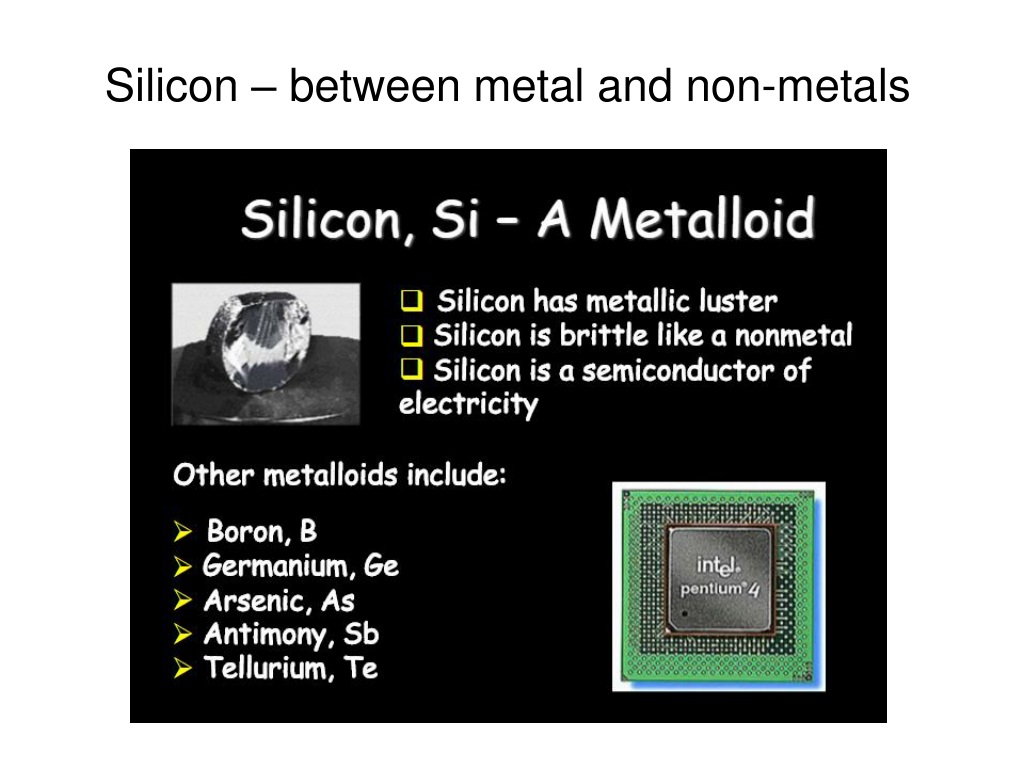
This is where the term metalloid comes in. And this, my friends, is where silicon truly shines. Think of metalloids as the rebels, the elements that don't fit neatly into the established categories. They have properties that are a bit of both metals and nonmetals. They’re the Switzerland of the periodic table, sort of.

The Metalloid Muddle: What Makes Silicon Special?
So, what are these “in-between” properties that earn silicon its metalloid status? It’s all about its electronic structure and how it interacts with energy. Let’s get a little science-y, but I promise to keep it light and fun. You’re still with me, right? Good.
Metals, for instance, have electrons that are pretty loosey-goosey. They can move around easily, which is why they’re great at conducting electricity. Nonmetals, on the other hand, hold onto their electrons pretty tightly. This makes them poor conductors.
Silicon, however, is in a fascinating middle ground. At room temperature, it’s a pretty decent insulator – not conducting electricity very well. But, and this is the kicker, its conductivity increases when you heat it up or introduce certain impurities (a process called doping, which we’ll get to!). This sensitivity to temperature and external factors is a hallmark of metalloids.
Imagine a dimmer switch for electricity. Metals are like a fully on switch, and nonmetals are like a fully off switch. Silicon, the metalloid, is like that dimmer switch, allowing you to fine-tune its conductivity. This is precisely why it’s the backbone of modern electronics. We can control how much electricity flows through it, making it perfect for transistors and integrated circuits.
It’s not quite the shiny, bendy metal, and it’s not the airy, reactive gas. It’s something… more. It’s the perfect blend of properties that allows us to build the intricate devices that define our modern world. It’s like the element that said, “Why choose? I’ll be both!”
A Quick Nod to the Neighbors: Other Metalloids
Silicon isn’t alone in its noble quest to defy categorization. The metalloid club includes some other pretty important players. You’ve got boron, which is used in things like laundry detergent (yes, really!) and the heat-resistant glass in your kitchenware. Then there’s germanium, another semiconductor that shares a lot of silicon’s traits and was actually used in early transistors before silicon took over.
We also have arsenic and antimony. Now, these guys have a bit of a reputation. Arsenic is famously poisonous, but in very small, controlled amounts, it can be used in semiconductor manufacturing. Antimony is used in flame retardants and alloys. They’re definitely on the more hazardous side of the metalloid spectrum, so maybe don’t try to hug them.
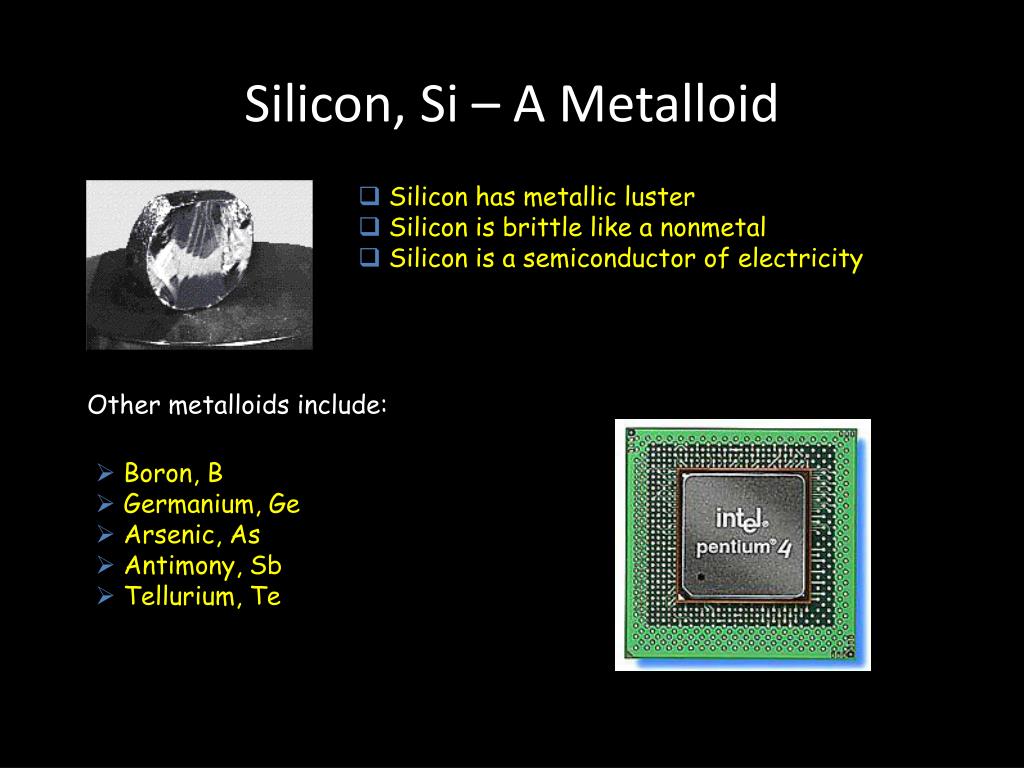
And let’s not forget tellurium and polonium. Tellurium is used in solar panels and in the production of certain alloys. Polonium is… well, let’s just say it’s highly radioactive and not something you’d want to find in your breakfast cereal. It was famously discovered by Marie Curie.
Seeing this list, you start to realize that metalloids aren’t just a curious anomaly; they are a crucial group of elements with diverse and often critical applications. They’re the specialists, the problem-solvers of the periodic table.
The Rise of Silicon: From Sand to Superchips
How did silicon go from being the main ingredient in sandcastles to the brain of our technology? It’s a story of scientific discovery and relentless innovation. For centuries, people knew about silica, the compound of silicon and oxygen, in quartz and sand. But pure silicon? That was a different story.
It wasn’t until the early 19th century that pure silicon was first isolated. And even then, it was just a scientific curiosity. It wasn’t until the mid-20th century, with the advent of the transistor, that silicon’s true potential began to be unlocked.
The transistor, invented in 1947 at Bell Labs, was a revolutionary device that could amplify and switch electronic signals. Initially, germanium was used, but scientists soon realized that silicon had superior properties, especially at higher temperatures. This led to the development of silicon-based transistors.
And then came the integrated circuit, or microchip. This was the game-changer. Instead of building circuits with individual components, engineers figured out how to etch thousands, then millions, then billions of transistors onto a single sliver of silicon. Think of it as building a tiny city on a postage stamp, but with electrical pathways instead of roads.

The development of the manufacturing processes for pure silicon – a process that involves extremely high temperatures and very precise purification steps – was a monumental achievement. The ability to create “semiconductor-grade” silicon, with purity levels of 99.9999999% or even higher, is what makes all our modern electronics possible.
It’s pretty mind-blowing when you consider that the sandy beaches and deserts of the world are the raw material for the most advanced technology we have. Talk about a humble beginning leading to an incredible future.
Silicon's Role in Our Lives (Beyond Your Smartphone)
You might be thinking, “Okay, I get it, it’s in my phone. What else?” Well, buckle up, because silicon’s influence extends far beyond our personal gadgets.
Solar Power: Those sleek solar panels you see on rooftops and in fields? They’re made of silicon. Silicon’s semiconductor properties allow it to convert sunlight directly into electricity, making it a key player in renewable energy. Without silicon, solar energy wouldn’t be nearly as efficient or cost-effective as it is today.
Construction: Remember that bit about silica being in sand? Well, that’s important for concrete and cement. And that glass you look through? That’s mostly made from silicon dioxide. Silicon is literally holding up our buildings and letting us see out of them!
Automotive Industry: Modern cars are packed with silicon-based electronics. Engine control units, anti-lock braking systems, airbags – they all rely on microchips made from silicon. So, that smooth ride and those safety features? Thank silicon.
Medical Devices: From pacemakers to advanced imaging equipment, silicon plays a role in many medical technologies. Its biocompatibility (it doesn't tend to react poorly with the body) makes it suitable for implants and diagnostic tools.
Aerospace: The demanding environments of space require robust and reliable components. Silicon semiconductors are essential for navigation systems, communication equipment, and power management in spacecraft.
It's almost hard to find an area of modern life that isn't touched by silicon in some way. It's like the quiet, indispensable helper in the background of pretty much everything.
The Future of Silicon: Still Shining Bright
So, is silicon going to be replaced anytime soon? While there’s always research into new materials, silicon is incredibly versatile and its manufacturing processes are incredibly well-established and cost-effective. It’s the king of semiconductors for a reason.
Scientists are constantly finding new ways to push the boundaries of silicon technology. We’re talking about smaller, faster, and more energy-efficient chips. There’s research into 3D silicon structures, and even exploring ways to integrate silicon with other materials for even greater capabilities.
There’s also a lot of work being done on how we use silicon, making our devices more energy-efficient to reduce our environmental footprint. Because, as essential as it is, the manufacturing of silicon can be energy-intensive.
The story of silicon is a testament to how understanding the fundamental properties of elements can lead to world-changing technologies. It’s a reminder that sometimes, the most important things in life are found in the most unexpected places – like in a pile of sand or a squiggle on the periodic table.
So, the next time you’re scrolling through your phone, marveling at a skyscraper, or enjoying the warmth of the sun on a solar-powered patio, take a moment to appreciate the humble, yet extraordinary, element that is silicon. It’s a metalloid, a semiconductor, and a cornerstone of our modern existence. And it all started with a bit of confusion about whether it was metal or not. Pretty cool, right?