
Stainless Steel Tubing Sizes And Dimensions

Alright folks, gather 'round! Today, we're diving headfirst into the wonderful, sparkly world of stainless steel tubing. Now, I know what you might be thinking, "Tubing? Isn't that… a bit dry?" But trust me, once you peek behind the curtain, you'll discover a universe of dimensions and sizes that are surprisingly fascinating, and dare I say, even a little bit exciting!
Think of stainless steel tubing like the unsung heroes of so many things we use every single day. They're the silent, shiny backbone, holding things together, carrying liquids, and generally being awesome. And just like you wouldn't use a garden hose to inflate a party balloon (that would be a disaster!), the right size of tubing is absolutely crucial for its job.
So, what exactly are we talking about when we say "sizes and dimensions"? It's not just one single number, oh no! It's a whole little family of measurements that tell us everything we need to know. We've got the Outside Diameter (OD), the Inside Diameter (ID), and the thickness of the wall, which we call the Wall Thickness. It's like a secret handshake for engineers and plumbers!
The Magical Trio: OD, ID, and Wall Thickness
Let's start with the Outside Diameter (OD). This is pretty straightforward, like measuring the width of a pizza. It's the total measurement from the very outside edge, across the middle, to the other very outside edge. It’s the first thing you usually notice, the grand presence of the tube!
Then we have the Inside Diameter (ID). Imagine the hollow space inside the tube, where all the magic happens – the water flows, the gas zips, or whatever its mission may be. The ID is the measurement of that empty space. Think of it as the pathway for the good stuff!
And finally, the Wall Thickness. This is the sturdy stuff, the muscle of our stainless steel tube. It's the distance between the outside edge and the inside edge. A thicker wall means a tougher tube, ready to handle more pressure or a more rugged environment. It’s the tube’s armor!
These three amigos, OD, ID, and Wall Thickness, work in perfect harmony. They're interconnected, like a well-oiled machine. If you know two of them, you can always figure out the third! It's like a little dimensional puzzle that makes the world of tubing so wonderfully logical.

Nominal vs. Actual: A Tiny Twist!
Now, here's where things get slightly more interesting, and for some, downright delightful! You’ll often hear about nominal sizes. This is like a general category or a nickname. For example, a "1-inch tube" might not have an OD of exactly 1 inch. It's more of a classification, a starting point.
The actual dimensions, on the other hand, are the precise measurements. These are the numbers you'll find in the technical specs, the ones that matter when you're fitting things together. It’s the real deal, the nitty-gritty!
Think of it like ordering a T-shirt. You might ask for a "Large," which is your nominal size. But the actual measurements of that Large shirt might vary slightly from brand to brand. Stainless steel tubing operates on a similar principle, with nominal sizes giving you a general idea and actual dimensions providing the exactness.
The difference between nominal and actual sizes is usually pretty small, but it’s vital for getting the perfect fit. It's the difference between a snug hug and a loose embrace for your plumbing or engineering projects. And we all want a good hug for our tubes, right?
The Humble Inch and the Mighty Millimeter
You'll encounter measurements in two main camps: inches and millimeters. Inches are our trusty old friends from the imperial system, familiar to many of us. Think of them as the familiar footsteps we take.
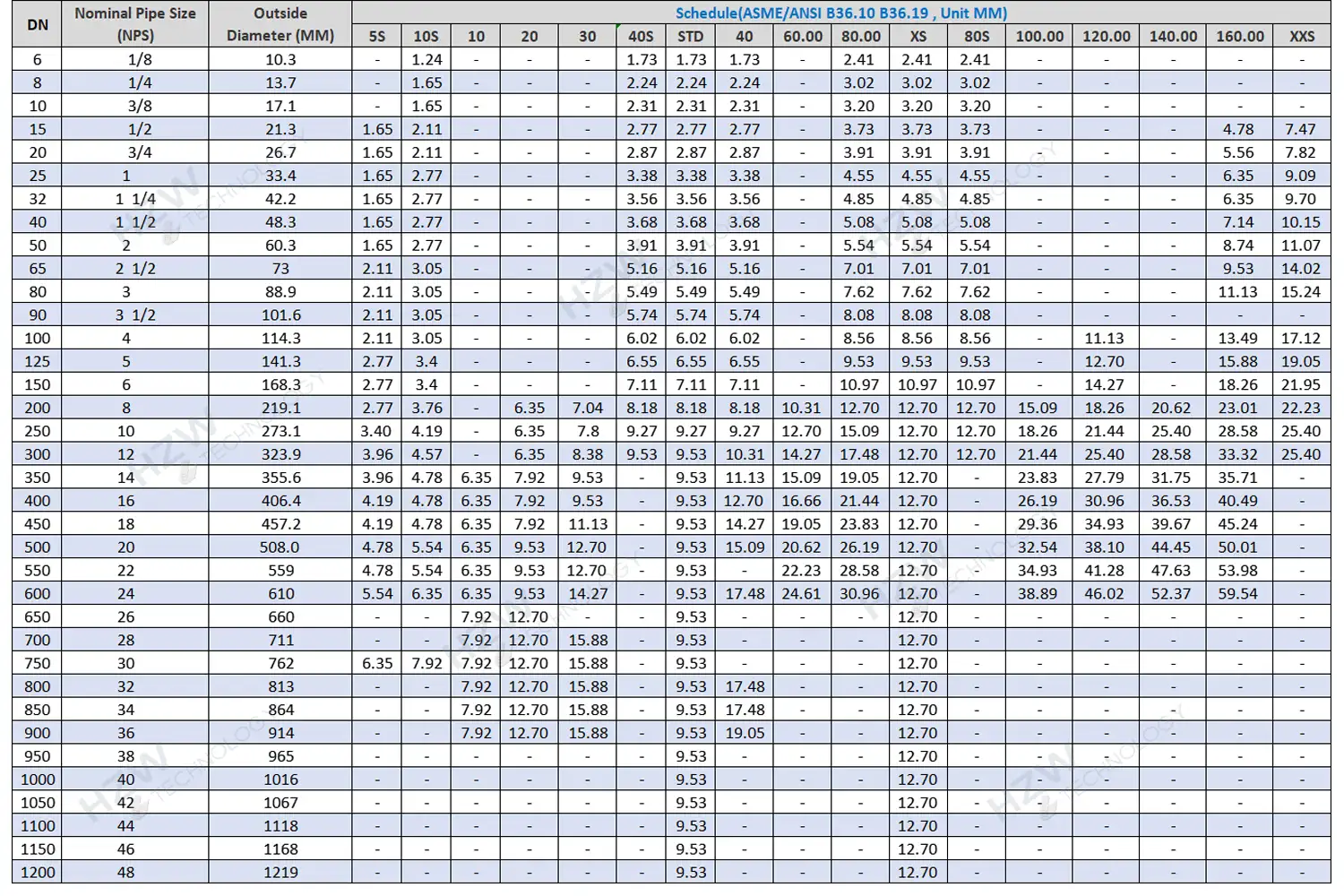
Then we have millimeters, which are part of the metric system. They’re super precise and often used in more technical or international applications. They're like the tiny, perfectly placed steps that ensure ultimate accuracy.
Most commonly, when you see tubing sizes, they'll be expressed as OD x Wall Thickness, often in inches or millimeters. For example, you might see a tube listed as 1" OD x 0.065" Wall. That means the outside diameter is 1 inch, and the wall is 0.065 inches thick. Simple, right?
Or in metric, it might be 25.4 mm OD x 1.65 mm Wall. See how these numbers, while different, are conveying the same fundamental idea? It’s all about the tube's physical form and its robustness!
Schedule Numbers: The Secret Codes!
Now for a little insider knowledge: Schedule numbers! Don't let this fancy term intimidate you. Schedule numbers are a way to simplify specifying tubing wall thickness, especially for pipes used in plumbing and fluid transport. It's like a secret decoder ring for tube walls!
The most common schedules you'll hear about are Sch 40 and Sch 80. Think of these as different levels of toughness. A higher schedule number means a thicker wall for a given OD.

So, for the same nominal pipe size, a Sch 80 pipe will have a thicker wall and a smaller ID than a Sch 40 pipe. It's like choosing between a regular backpack and a super-reinforced hiking pack – both carry your stuff, but one is built for more extreme adventures!
This is super important because if you need to transport high-pressure fluids or your tubing is going into a demanding environment, you'll want that extra wall thickness that a higher schedule provides. It’s peace of mind in metal form!
Let's Get Real: Examples Galore!
Imagine you're building a really cool, modern kitchen. You might want sleek, shiny stainless steel railings for your island. These might be 1.5" OD tubes with a relatively thin wall, perhaps 0.049" or 0.065". They look great and don't need to withstand immense pressure.
But then consider the plumbing under your sink! That’s a different ballgame. Those pipes need to handle water pressure without batting an eye. They’ll likely be thicker-walled, perhaps with a Schedule 40 designation.
And if you're working on a high-pressure industrial system, you might be looking at something much beefier, like a 4" Sch 80 pipe. This beast is built to take on serious challenges! It’s the superhero of the tubing world.

Even in the automotive world, stainless steel tubing is a superstar! Exhaust systems, fuel lines, you name it. The sizes and dimensions are carefully chosen to handle heat, vibration, and the flow of vital fluids. It’s an engineering marvel!
Think about those beautiful stainless steel bicycle frames. They often use thin-walled tubing, but the exact dimensions are crucial for strength, stiffness, and that smooth, responsive ride. It’s art in metal form, meticulously crafted.
And let's not forget the medical field! From surgical instruments to intricate fluid delivery systems, stainless steel tubing is indispensable. The precision in its dimensions is paramount for hygiene, safety, and effective treatment. It's life-saving precision!
The variety of stainless steel tubing sizes is almost as vast as the ocean! There are tubes for literally every conceivable application. It's a testament to human ingenuity and the incredible versatility of this amazing material.
So, the next time you see a gleaming stainless steel pipe or tube, give it a little nod of appreciation. Remember the careful thought and precise measurements that went into its creation. It’s a tiny, shiny piece of engineering wonder, and its dimensions are the key to its success. Isn't that just the coolest?