
Stress Strain Curve Of Steel
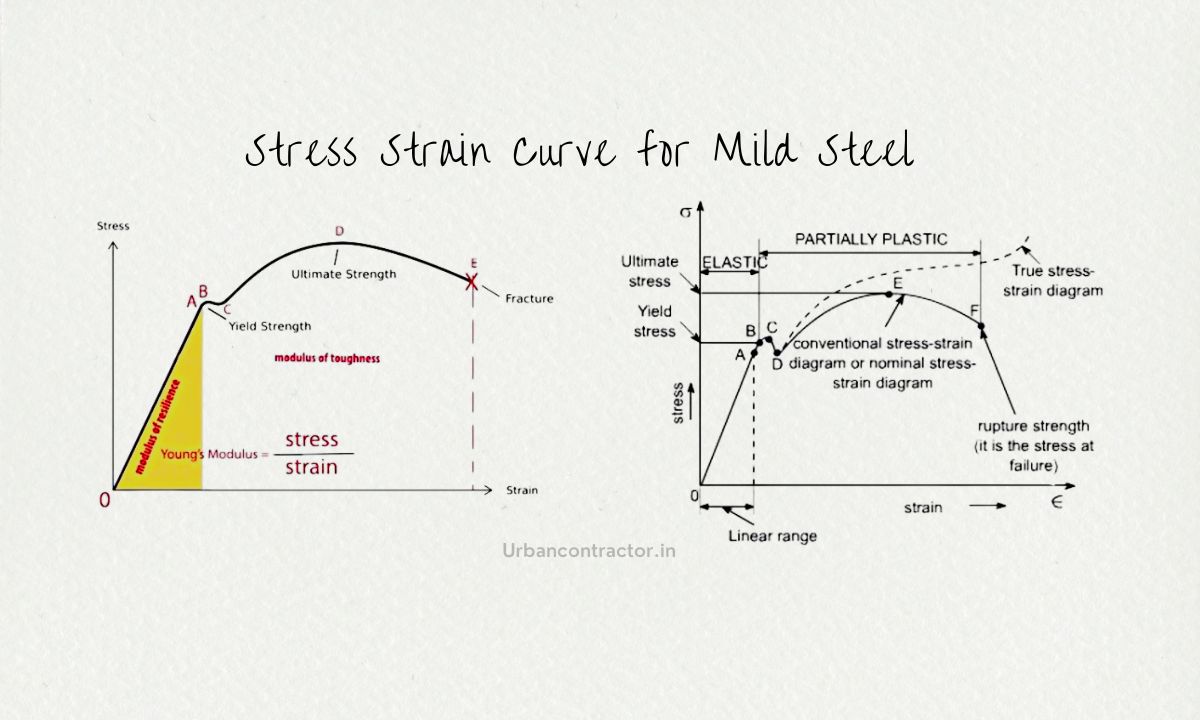
Ever wondered what makes that sturdy steel beam hold up a skyscraper, or why a paperclip bends but doesn't snap (at first)? It all comes down to how materials behave when you pull and push them. And for steel, one of the most fundamental ways we understand this is through its stress-strain curve. Now, before you picture a complex math equation, let's reframe this. Think of it as a sort of material's "autobiography" under pressure, revealing its strength, flexibility, and ultimate breaking point.
So, why should you care about a stress-strain curve? Well, it's the secret sauce behind engineering marvels. It's the blueprint that allows engineers to design everything from bridges and cars to your everyday kitchen utensils, ensuring they can withstand the forces they'll encounter. Without understanding this curve, we'd be building things that crumble or snap unexpectedly. It’s essentially a visual promise of reliability and safety.
Let’s break down what it actually shows. Imagine you're gently stretching a rubber band. At first, it’s easy. Then, it gets harder. Eventually, it might snap. The stress-strain curve captures this exact journey for steel. Stress is like the force you're applying per unit area (how much "pull" you're giving it). Strain is the resulting deformation or stretch (how much it gives in). The curve plots these two values, showing us how much stress is needed to cause a certain amount of strain. It reveals key points like the elastic limit (where it springs back to its original shape) and the ultimate tensile strength (the maximum stress it can handle before it starts to neck down and break).
You might not be explicitly drawing stress-strain curves in your daily life, but you're certainly experiencing their implications. Think about a well-built chair – it's designed to handle your weight (stress) without deforming permanently (strain). Or consider a car's bumper, engineered to absorb impact (stress) without catastrophic failure, thanks to materials chosen based on their stress-strain properties. In education, it's a cornerstone of mechanical engineering, materials science, and even physics, helping students grasp fundamental principles of material behavior.
Curious to explore this further? You don't need a lab coat! A simple way to get a feel for it is to observe everyday objects. Try gently bending a metal ruler – notice how it springs back at first (elastic region). Keep bending, and eventually, it might stay slightly bent (plastic deformation). This visual experiment mirrors the initial stages of the stress-strain curve. If you have access to a 3D printer, you can even experiment with printing different shapes and materials and observe their bending properties. Or, simply look up animated explanations online – many visually engaging resources can make the concept come alive without complex formulas. It's a fascinating peek into the hidden world of material resilience!