
Tensile Test On Mild Steel

So, you wanna talk about mild steel? Yeah, I know, not exactly the most thrilling topic you’ll stumble upon. Unless, of course, you’re like me and get a weird kick out of seeing how stuff breaks. Or maybe you’re just stuck doing a report for school. Either way, buckle up, buttercup, because we’re diving into the glorious, and occasionally gut-wrenching, world of a tensile test.
Think of it like this: you’ve got this piece of mild steel, right? It’s all… sturdy. You use it for everything from car parts to your garden gate. But how sturdy is it, really? That’s where our hero, the tensile test, swoops in. It’s basically asking the steel a really, really important question: “How much can you take before you cry uncle?”
And the steel, bless its metallic heart, answers. Oh boy, does it answer.
The Setup: Getting Cozy With Some Steel
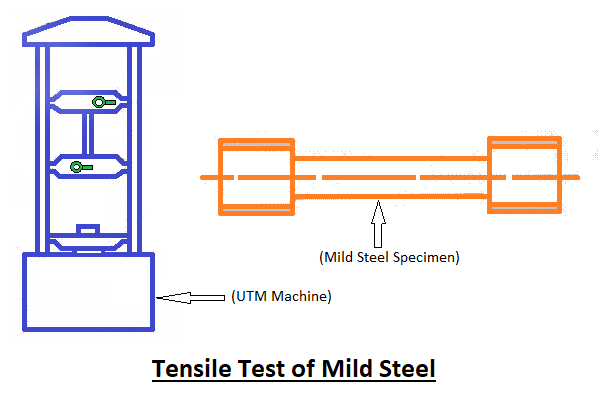
First things first, you need a sample. Now, this isn't just any old bent nail you found lying around. Nope. We’re talking about a properly prepared specimen. It’s usually a long, thin rod, kind of like a skinny metal spaghetti noodle, but way more important. It’s got these special little notches at each end, called grips. These are where the machine is going to grab it. Like a very firm handshake, but with a machine that doesn't care about your feelings.
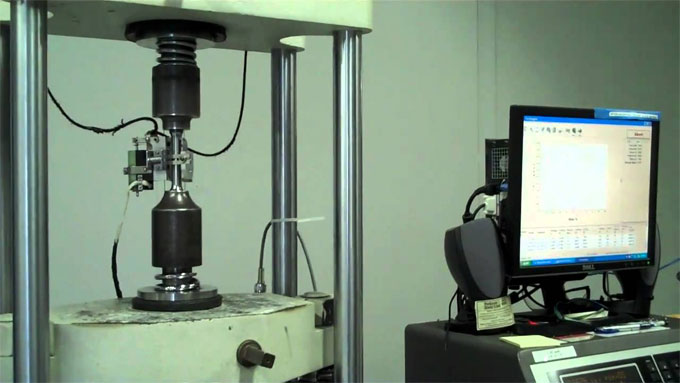
The machine itself? It’s a marvel of engineering. Think of it as a giant, really strong robot arm that’s been told to stretch things. It’s called a Universal Testing Machine, or UTM for short. Fancy name, right? It’s got all sorts of buttons and screens, and probably a little grumpy computer voice that tells you when things are going wrong. My kind of tech.
We’re going to clamp our little steel noodle into this machine. One end here, one end there. Nice and snug. No wiggling allowed, buddy. The machine is designed to pull both ends apart. Slowly at first, then… well, you’ll see. It’s like stretching a rubber band, but with a much, much less bouncy outcome.
The "Pulling" Part: Let the Games Begin!
Okay, the steel is secured. The machine is ready. The tension is… well, palpable. Literally. The machine starts to apply a force. It's a steady, consistent pull. Imagine you're trying to rip a phone book in half. That kind of sustained effort. The steel, being mild steel, is pretty good at this. It’s not going to snap instantly, thank goodness. That would be a very short and disappointing experiment.

As the force increases, something fascinating starts to happen to our steel sample. It actually starts to stretch. Yep, it gets longer. This is the elongation we’re talking about. It’s not just bending; it’s actually changing its shape permanently. Think of it as the steel saying, "Okay, I feel that. I'm groaning a little, but I'm still holding strong."
The machine is keeping a super close eye on this. It’s measuring both the force being applied and the amount the steel is stretching. These two pieces of data are the bread and butter of our tensile test. Without them, we’d just be watching a metal stick get longer for no reason. And that’s a sad, sad experiment.
The Stress-Strain Curve: The Steel's Life Story
Now, this is where it gets really interesting. The data collected by the UTM is often plotted onto a graph. This is the legendary stress-strain curve. Imagine this as the steel’s autobiography, laid out in lines and squiggles. It tells the whole story, from its humble beginnings to its ultimate demise.
On the bottom, we’ve got strain. Think of strain as the percentage of stretch. How much did it elongate compared to its original length? It's like saying, "This little guy stretched by 1%!" On the side, we have stress. Stress is the force applied over the area of the steel. It's how much pressure the steel is under. Think of it as the "ouch" factor for the steel.
The curve starts off pretty much as a straight line. This is the elastic region. In this phase, if you were to stop pulling, the steel would snap right back to its original shape. Like a perfectly good rubber band. It’s happy, it’s resilient, it’s living its best elastic life. No permanent damage done. Yet.

The Yield Point: Uh Oh, Things Are Getting Serious
Then, something shifts. The straight line starts to… curve. Or sometimes, it even dips a little. This is the yield point. This is a huge deal. It’s the point where the steel stops being a perfect elastic spring and starts to permanently deform. It’s saying, "Okay, I’ve had enough of just bouncing back. I'm going to bend now, and I'm not going to un-bend."
This is the point where the steel begins to plastic deformation. It’s like when you bend a paperclip. You can bend it back and forth a few times, but eventually, it stays bent. That’s plasticity for you. For mild steel, this yield point is super important. It tells us how much force it can withstand before it starts to permanently change its shape. This is crucial for engineers. They don’t want their bridges suddenly deciding to go all Dali-esque, do they?
Sometimes there’s a clear, dramatic “yield point.” Other times, it’s more of a gradual “yield strength.” It’s like a shy steel, not wanting to admit it’s yielding, but it is. The engineers have ways to figure this out, don’t you worry.
The Ultimate Tensile Strength: Reaching the Peak
After the yield point, the steel keeps getting pulled. And it keeps stretching. It gets longer and longer. But here's the kicker: the amount of force the machine needs to keep pulling actually starts to increase again after yielding. Huh? I know, it’s weird. It’s like the steel is saying, "I'm deformed, but I'm still tough! Watch this!"
This part of the curve usually goes up, up, up, until it reaches its highest point. This is the ultimate tensile strength. This is the absolute maximum stress the steel can handle before it starts to seriously give up the ghost. It’s the peak of its strength, the moment it’s at its absolute toughest. Think of it as the steel’s grand finale before things go south.
This is another super important number. It tells you the maximum load the material can withstand before it begins to fail. For many applications, knowing this ultimate strength is key to making sure things don’t, you know, spontaneously disassemble.
Fracture: The Sad, Sad End
After reaching its ultimate tensile strength, the steel starts to get weaker. It’s like it’s used up all its energy. It continues to stretch, but now it needs less and less force to keep pulling it apart. You might even see it getting thinner in the middle, a phenomenon called necking. It's like the steel is getting all worried and skinny in one spot, preparing for the inevitable.
And then, with a final, often dramatic, snap or tear, the steel sample breaks. This is fracture. The experiment is over. The steel has spoken its final word. It’s broken, it’s in pieces, and we have all the data we could ever want.
Looking at the broken ends can also tell us stuff. Did it break cleanly and with a bit of jaggedness? That’s typical of ductile materials like mild steel. Did it shatter like glass? That would be a brittle material, and a whole other story. But mild steel? It usually gives you a nice, fibrous break. Kind of a messy, but honest, ending.
What Do We Learn From All This Torture?
So, after all that pulling and stretching and eventual breaking, what have we actually learned? We've learned a bunch of crucial numbers! We’ve got the yield strength (when it starts to permanently bend), the ultimate tensile strength (its absolute strongest point), and the percentage elongation (how much it stretched before breaking). We can even calculate things like the modulus of elasticity from that initial straight line part, which tells us about its stiffness.
These aren't just random numbers on a page. These are the characteristics that define how mild steel behaves under stress. Engineers use these values to design everything from the supports in a skyscraper to the frame of your car. They need to know how much force their materials can take, where they'll start to deform, and when they might just… well, break. Safety first, people!
And for mild steel specifically, its ability to stretch a lot before breaking (its ductility) is a huge plus. It means it’s less likely to snap suddenly. It gives you a warning, a bit of a bend, before total structural failure. That's a good thing. You want your structures to tell you they're in trouble, not just suddenly collapse. Imagine the paperwork!
The Cool Factor: It's Not Just Boring Numbers
Seriously though, isn't it kinda cool? We take a humble piece of metal, put it through the wringer, and it tells us its life story in a graph. It’s like a metal superhero’s origin story, but with more machines and less spandex. And it’s all about understanding how things work, how they can be pushed to their limits, and how we can use that knowledge to build amazing things.
So next time you see a steel beam, or a metal railing, or even just a really sturdy paperclip, give it a little nod. It’s been through a tensile test, or at least, it was designed by someone who knows what happens during one. And that, my friend, is pretty darn neat.
And that’s the gist of it! A tensile test on mild steel. It’s not just about breaking stuff, it’s about understanding strength, limits, and the quiet resilience of a common, everyday material. Pretty fascinating, if you ask me. Now, who’s up for another coffee?