
The Combination Of All Forces Acting On An Object

Ever stopped to think about why that runaway grocery cart eventually slows down and stops, even if you nudge it down a gentle slope? Or why, when you're trying to push a stubborn door open, sometimes it gives way, and sometimes it feels like you're wrestling a bear? Well, my friends, you're already intuitively understanding one of the coolest concepts in physics: the combination of all forces acting on an object.
Don't let the fancy scientific name scare you! It's just a way of saying we're looking at all the pushes and pulls happening to something at the same time. Think of it like a tug-of-war, but instead of just two teams, you might have several teams, each with their own rope, all trying to yank an object in different directions.
Let's imagine a simple scenario: you're sitting on your favorite comfy couch. What's happening to you right now? You might think, "Nothing! I'm just chilling!" But physics tells us a different story. There's the force of gravity pulling you down, trying to send you right through the couch (and maybe even the floor!).
But wait! You're not plummeting to the Earth's core, are you? That's because the couch is pushing back! This is called the normal force, and it's basically the couch saying, "Nope, not today, gravity! You can pull, but I'm here to support you." These two forces, gravity pulling down and the normal force pushing up, are perfectly balanced. They're like two equally strong people playing a very gentle, perfectly still tug-of-war. Because they cancel each other out, you don't move. You're in a state of equilibrium, which is a fancy word for "things are balanced and not changing."
The Story of the Sideways Push
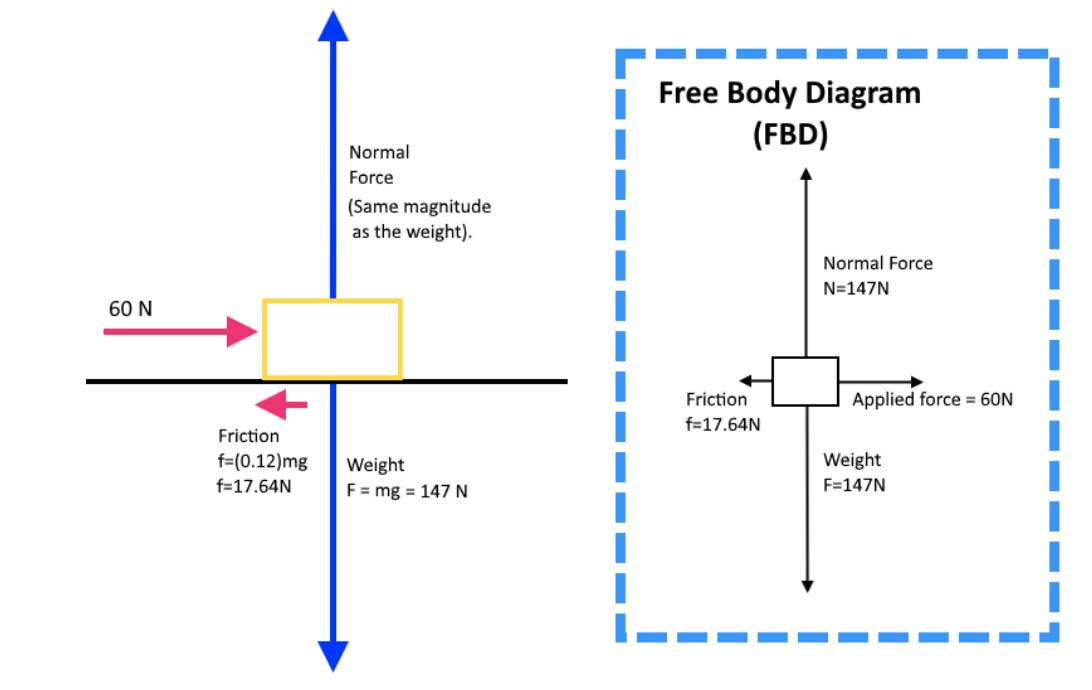
Now, let's spice things up a bit. Imagine you're trying to nudge that same couch across the room. You give it a gentle push from the side. Suddenly, there's another force in play! Your push is trying to move the couch to the right.
But, remember that old, grumpy rug under the couch? It's putting up a fight! This is friction, and it's working against your push, trying to keep the couch exactly where it is. So now, instead of just two forces (gravity and the normal force), we have at least three: your push, friction, and the ever-present gravity and normal force.
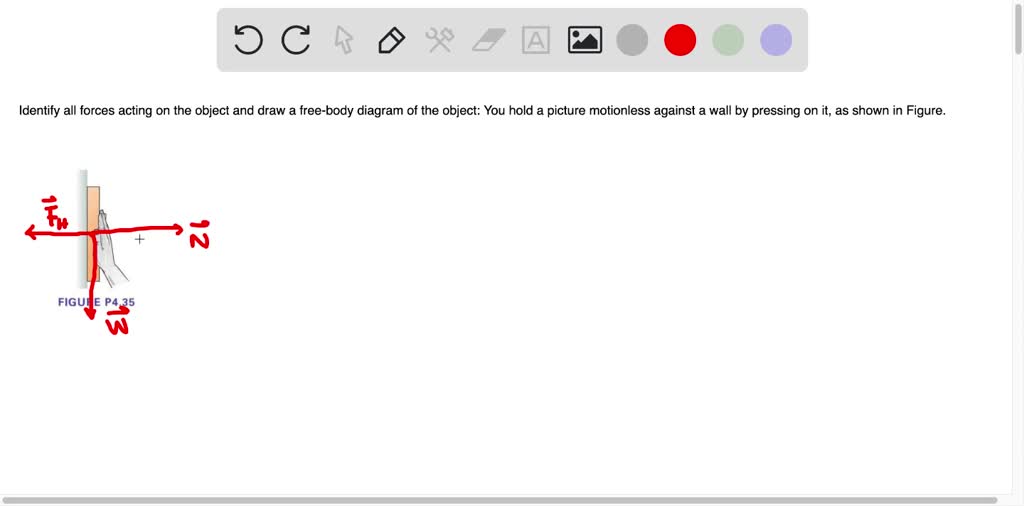
If your push is weak, and the friction is strong, the couch will stay put. The forces are still balanced, even with your push. It's like trying to push a massive boulder uphill; your effort is being completely overcome by the weight and the friction.
However, if you give that couch a really good shove, your push might become stronger than the friction. Now, the forces are unbalanced! This is where things get exciting. The combination of your push winning the tug-of-war against friction, while gravity and the normal force continue to cancel each other out, means the couch will start to slide across the floor. It will accelerate, which is just a science-y way of saying it will start moving and/or speed up.
Why Should You Care About This Sideways Tug-of-War?
You might be thinking, "Okay, this is neat, but why should I, a busy human with a million other things on my mind, care about forces combining?" Well, my friend, this concept is the invisible hand that shapes so much of your daily experience!

Think about driving a car. When you press the gas pedal, you're applying a force to make the engine work, which eventually pushes the car forward. But what's fighting that forward motion? Air resistance (that invisible wall of air you push through) and friction from the tires on the road. The car moves and speeds up because the engine's force is greater than these opposing forces.
When you brake, you're applying a new force (the braking force) that's usually much stronger than the forces trying to keep the car moving. That's why the car slows down and eventually stops. The combination of all these forces – the engine's push, air resistance, friction, and now the braking force – dictates the car's motion.
A Little Birdie Told Me (and Physics Agreed)
Let's take a more whimsical example. Imagine a little bird trying to fly. It flaps its wings, creating an upward thrust. But gravity is still pulling it down. And the air is creating drag (a type of friction) that slows it down. For the bird to fly, its upward thrust and the lift generated by its wings must be greater than the force of gravity pulling it down and the drag slowing it.
If the bird stops flapping, gravity will start to win the tug-of-war, and the bird will begin to descend. The moment it lands on a branch, gravity is still pulling it down, but the branch is now providing a strong upward normal force. These two are balanced, and the bird sits there, perfectly still, its forces in equilibrium once again.
Even when you're just walking, you're constantly applying forces to push yourself forward against the friction of your shoes on the ground. You're essentially winning a tiny, continuous battle against friction with every step you take.
The Grand Finale: Net Force
When all these individual pushes and pulls are added up (and remember, some forces might be in opposite directions, so they might subtract from each other), you get what scientists call the net force. This net force is the ultimate boss. It's the overall result of all the forces.

If the net force is zero, like when you're sitting on the couch or the bird is perched on the branch, nothing changes. The object stays put or keeps moving at the same speed in the same direction (this is Newton's First Law, the Law of Inertia, but we don't need to get bogged down in names!).
But if the net force is not zero, then the object will accelerate. It will start moving, speed up, slow down, or change direction. The bigger the net force, the more dramatic the change in motion.
So, the next time you see a leaf falling from a tree, a boat sailing on the water, or even yourself taking a sip of your favorite beverage, remember the invisible dance of forces happening. It's a constant, fascinating interplay of pushes and pulls that dictates everything around us. It's not just some abstract physics concept; it's the reason why the world works the way it does, from the grandest planets to the smallest crumb falling off your toast. Pretty cool, right?