
The Three Primary Colors Of The Solar Corona

I remember this one time, a few years back, I was out camping with some friends. We were way out in the middle of nowhere, no city lights, just us and the Milky Way doing its thing overhead. Utterly breathtaking, right? Anyway, my buddy Dave, bless his cotton socks, decides he’s going to impress us all with his astronomical knowledge. He points up and, with immense seriousness, declares, “Look at that! The Sun’s outer atmosphere is a magnificent shade of… blue.”
We all just kind of blinked at him. Blue? Dave, buddy, I think you might be confusing your celestial bodies. The Sun, to most of us, is… well, it’s yellow. Or sometimes orange, if it’s feeling particularly dramatic at sunset. But blue? We gently (or maybe not so gently) pointed out that the Sun itself, the big fiery ball, is definitely not blue. He mumbled something about filters and special cameras, but honestly, we all just figured he’d had one too many toasted marshmallows.
Fast forward a bit, and I’m diving down a science rabbit hole (as I’m wont to do). And guess what? Dave, the marshmallow-addled stargazer, was actually… sort of right. Not about the Sun itself, mind you, but about its outer atmosphere. The corona. Turns out, this super-hot, wispy veil surrounding our star isn’t just one bland, invisible blob. It actually has colors, and not just the ones we’re used to seeing. And it gets even cooler because it's not just one color, it's actually a trio of primary colors, if you will. Mind. Blown.
The Sun's Hairy Aura: Not Just White Light
So, why the confusion? Well, for starters, the Sun's corona is insanely hot. We’re talking millions of degrees Celsius. And because it’s so hot, the gases there are completely ionized. This means the electrons have been ripped right off the atoms. It’s a chaotic, energetic place. Think of it like a cosmic rave, but with plasma instead of glow sticks.
Now, when you look at the Sun directly (which, please, don't do without proper protection – seriously, my eyes are watering just thinking about it), the light we see is basically white light. It's a combination of all the colors in the rainbow. But that’s the surface of the Sun, the photosphere. The corona is different. It’s so thin and spread out that it’s usually drowned out by the brightness of the Sun’s disk. You can only really see it during a total solar eclipse, when the main disk is conveniently covered up.
And when you do see it during an eclipse, it often looks bright white or a pale yellowish-white. This is because our eyes are pretty good at blending colors, and the dominant emissions from the corona, when all mixed together, appear as white to us. It’s like mixing all the paint colors together – you tend to get a muddy brown or black, but with light, it’s a brilliant white. Clever, nature.
The Hidden Palette: Unveiling the Corona's True Hues
But here's where it gets interesting. Scientists, with their fancy instruments and tireless curiosity, have figured out that the corona isn’t just emitting white light. It’s emitting light in specific wavelengths, corresponding to different colors. And these aren't just random colors; they're dictated by the elements present in that superheated plasma.
Think of it like a neon sign. Each gas glows a different color when electricity zips through it. Helium glows pinkish-red, neon glows red, argon glows blue. The same principle applies to the Sun’s corona, just on a much, much grander and hotter scale. The elements in the corona are being super-excited, and as their electrons jump between energy levels, they release photons of specific energies, which our eyes (or our instruments) perceive as color.
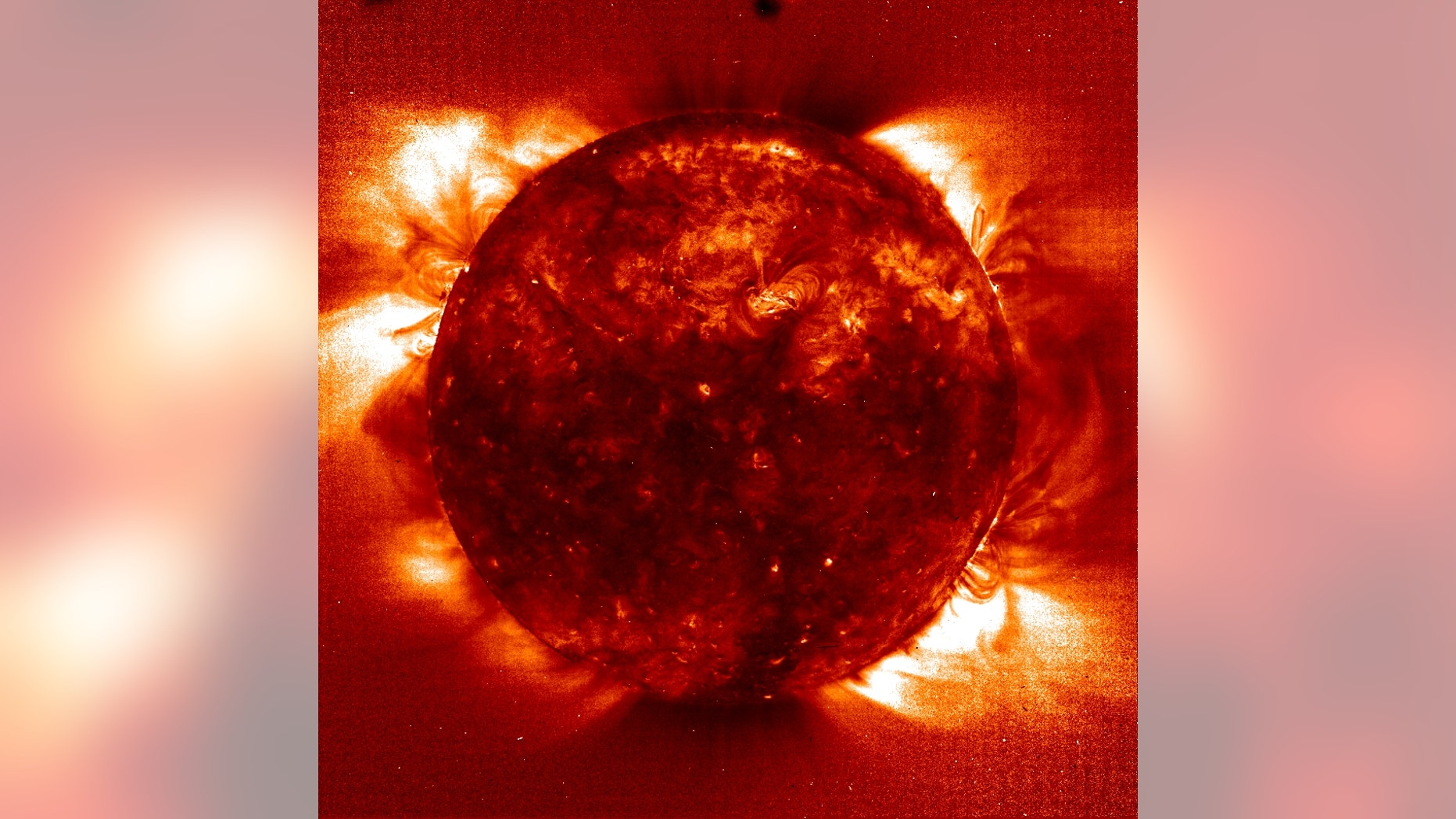
And it turns out, three elements are the main players in this celestial light show. Three elements that, when their emissions are considered individually, give us our primary colors of the corona. Pretty neat, huh? It’s like discovering the secret recipe for sunlight’s fancy hat.
The Red Giant: Iron's Fiery Contribution
Let’s start with the color you might least expect. The one Dave did mention, in his own roundabout way. Iron. Yep, good old iron, the stuff in your blood and your frying pans, is a big contributor to the corona’s color. Now, iron in the corona isn’t just… iron. It's highly ionized iron. We're talking about iron atoms that have lost a whopping 13 electrons. That’s a lot of electron shedding!
When this super-stripped iron atom gets excited, it emits light. And the specific energy levels that its remaining electrons can jump between produce a characteristic emission line at a wavelength of about 637.4 nanometers. What color is that? Brace yourself: it’s a deep, vibrant red. So, when you see those stunning, artist's impressions of the solar corona, the reddish hues you might notice are often thanks to the ionized iron.
It’s a bit ironic, isn’t it? We think of iron as strong and sturdy, maybe a bit rusty brown. But in the superheated plasma of the Sun’s corona, it’s performing a dazzling, red light act. It’s a reminder that conditions can dramatically change how familiar elements behave. Who knew your car might have a little bit of sun-like redness in its soul?
This red emission is particularly prominent in certain regions of the corona, often those that are slightly cooler but still incredibly hot by terrestrial standards. It’s like the corona has its own signature colors, telling us about the temperature and composition of different areas. The more you look, the more you realize it’s not just a uniform glow.

The Green Machine: Oxygen's Luminous Glow
Next up on our chromatic tour of the corona is oxygen. Now, oxygen is something we’re all pretty familiar with. It’s what we breathe, what fuels fires, and what makes rust happen. In the corona, however, it’s also putting on a spectacular light show. And this time, it's responsible for a color that’s perhaps more expected in a celestial context: green.
Similar to iron, it’s not just any old oxygen atom. We’re talking about oxygen that has been stripped of a considerable number of its electrons – usually around 9 or 10. This ionized oxygen, when excited, emits strongly at a wavelength of about 530.3 nanometers. You guessed it: that’s a beautiful, striking green. If you’ve ever seen images of the corona taken with specific filters to highlight certain emissions, you’ll often see these vibrant green structures.
This green light from oxygen is actually one of the most commonly observed and studied emissions from the corona. It’s a fantastic tracer of the coronal plasma, helping scientists map out the magnetic field lines and understand the dynamics of this ever-changing atmosphere. It’s like the corona’s way of drawing itself in pretty, luminous lines.
Think about it. The stuff that keeps us alive is also responsible for a significant part of the Sun's visible corona. It's a cosmic partnership of sorts. And that vibrant green is a constant reminder of the extreme conditions and the unique physics at play far beyond our little blue marble. It’s a color that screams "space!" doesn't it?
The Blue Streak: Helium's Electric Spark
Finally, we come to the color that Dave, bless him, tried to claim was the entire corona. While he was a bit off the mark, he was pointing in the general direction of one of our primary players. And that player is helium. Yes, the same stuff that makes balloons float and gives you that funny voice.

In the corona, helium is also ionized. It's lost one electron (this is known as singly ionized helium, or He II). When this singly ionized helium gets excited, it emits light at a wavelength of around 468.6 nanometers. And what color does that correspond to? You guessed it: a beautiful, clear blue.
This blue emission from helium is another key spectral line used by solar physicists. It's especially prevalent in hotter regions of the corona and can help us understand the temperature and density of the plasma. It’s a cooler color, relatively speaking, compared to the extreme heat of the corona itself, but it’s a vital part of the overall picture.
So, while Dave might not have been entirely accurate about the Sun’s corona being entirely blue, he was onto something with the color itself. It’s a part of the story, a crucial brushstroke on the canvas of our star’s atmosphere. It’s the electrifying spark that adds a cool tone to the fiery ensemble.
Why Does This Matter? (Besides Being Super Cool)
You might be thinking, "Okay, so the Sun's wispy bits are red, green, and blue. So what?" Well, it's not just about pretty colors, although that's a pretty good perk, let's be honest. Understanding these primary colors and the elements that produce them is absolutely fundamental to understanding the Sun itself.
These spectral lines – the specific wavelengths of red, green, and blue emitted by iron, oxygen, and helium – are like fingerprints. They tell us exactly what elements are present in the corona and in what quantities. By analyzing the intensity and characteristics of these emissions, scientists can deduce the temperature, density, and even the magnetic field strength of different regions within the corona.

Why is that important? Because the corona is where a lot of the action happens. It's the source of the solar wind, the stream of charged particles that constantly blows outward from the Sun. It's where solar flares and coronal mass ejections (CMEs) originate – those massive eruptions that can have a significant impact on Earth, messing with our satellites, power grids, and even astronauts in space.
So, by studying the "colors" of the corona, we're actually learning about the forces that drive space weather. We're getting a better handle on predicting these potentially disruptive events. It’s like being able to read the Sun’s mood swings before they happen. Pretty handy, wouldn't you say?
It’s also a window into the fundamental physics of plasmas under extreme conditions. The Sun’s corona is the ultimate laboratory for studying how magnetic fields and charged particles interact. And the colors we see are direct evidence of these complex interactions playing out on a cosmic scale.
The Blended Masterpiece: A Universe of Information
So, next time you see a picture of the Sun's corona, whether it’s from an eclipse or a satellite image, remember that it’s not just a blank canvas. It’s a vibrant tapestry woven from the emissions of different elements. The reds, greens, and blues are clues, revealing the secrets of this incredible celestial phenomenon.
And while our eyes might blend these colors into a dazzling white, the science behind them tells a much richer, more detailed story. It’s a story of extreme temperatures, powerful magnetic fields, and the fundamental building blocks of the universe putting on a breathtaking display. So, Dave wasn't entirely wrong. There is blue, and red, and green. They just all come together to create something even more magnificent.
It’s a constant reminder that even the most familiar things, like our Sun, hold hidden depths and incredible complexities. All you have to do is look a little closer, and sometimes, you need a good filter or a total eclipse to really see the magic. And maybe a friend who occasionally says something surprisingly insightful, even if it’s a little off the mark at first. Makes for a good story, at least!