
Transition Metals Vs Inner Transition Metals

Have you ever peeked at a Periodic Table and wondered about those weird blocks stuck in the middle and at the very bottom? We're talking about the stars of our show today: the Transition Metals and the Inner Transition Metals. Think of them as the cool cousins in the big, scientific family.
These metals aren't like your everyday table salt or the aluminum foil in your kitchen. They've got some seriously unique personalities. They're the ones that give our world color, strength, and a whole lot of sparkle.
So, let's dive into what makes these two groups so fascinating. It's like a friendly debate between two awesome rock bands. Each has its own stage presence and signature sound.
The "Regular" Cool Kids: Transition Metals
First up, we have the Transition Metals. You can find them right there in the middle of the Periodic Table. They're like the popular kids who are good at pretty much everything.
They’re famous for being super strong and often a bit colorful. Think of your everyday objects that feel sturdy and look shiny. Many of those probably involve a transition metal.
For instance, iron is a transition metal. It builds our skyscrapers and cars. Without iron, our cities would look very different.
Then there's copper, the star of electrical wires. It’s also that lovely reddish-brown color you see in pipes and old pennies. It’s incredibly useful and quite pretty!
And let’s not forget gold and silver. These are the ultimate bling. They're not just for jewelry; they have important jobs in electronics too.
What makes them so special is their ability to form lots of different kinds of bonds. This means they can link up with other elements in many ways. This versatility is key to their many uses.
Transition metals also love to show off with vibrant colors. Think of the blues of lapis lazuli or the greens of malachite. These stunning hues often come from transition metal compounds. It's like they've got a built-in paint box!
They're also great at being catalysts. Catalysts speed up chemical reactions without getting used up themselves. It’s like having a super-efficient coach for chemical processes. This makes them invaluable in industry.
So, the transition metals are the workhorses of the Periodic Table. They’re strong, colorful, and incredibly versatile. They’re the reliable friends who always get the job done, and look good doing it.
The "Super-Deeper" Stars: Inner Transition Metals
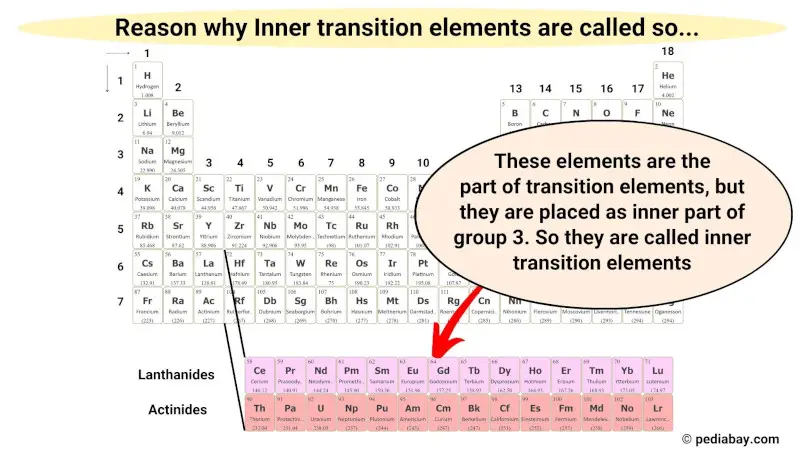
Now, let’s talk about the group that’s a little more… exclusive. These are the Inner Transition Metals. They’re tucked away at the bottom of the Periodic Table, almost like a VIP section.
This group is usually split into two rows. They’re called the lanthanides and the actinides. They’ve got their own special story to tell.

What makes them so "inner" is where their electrons are busy. While transition metals fill their "d" orbitals, these guys are filling their "f" orbitals. It’s a slightly deeper level of electron action.
Think of it like this: if transition metals are the main stage, inner transition metals are the backstage crew doing some incredibly intricate work. Their electrons are organized a bit differently, giving them unique properties.
The lanthanides are the first row. They’re known for their magnetic properties and their use in high-tech stuff. You might find them in magnets in your speakers or the phosphors that make your TV screen glow.
They are also crucial for things like lasers and strong lighting. These metals are like the secret ingredients that make modern gadgets work. Without them, your phone might not be so smart!
Then there are the actinides. This row is particularly interesting because many of them are radioactive. This means they give off energy and change over time.

Uranium is probably the most famous actinide. It’s known for its role in nuclear power and, unfortunately, in nuclear weapons. It’s a powerful element with significant implications.
But not all actinides are scary. Some, like thorium, are being explored for future energy sources. They have a hidden potential that scientists are still uncovering.
The inner transition metals often behave very similarly to each other. This can make them tricky to separate. Imagine having a box of very similar-looking but distinct Lego bricks. It takes patience to sort them out!
Their unique electron configurations mean they have very specific chemical behaviors. These behaviors, though sometimes complex, are essential for specialized applications. They're the specialists of the elemental world.
The Fun Contrast
So, what’s the big difference that makes them fun to compare? It’s all about their location and their electron configurations.
Transition metals are in the middle, filling those "d" orbitals. They are generally more common and have a wider range of everyday uses. They’re the versatile all-rounders.

Inner transition metals are at the bottom, filling those "f" orbitals. They are often less common and their uses tend to be more specialized, often in high-tech or scientific fields. They are the specialized experts.
Think of transition metals as the blockbuster movies. They're widely popular, easily recognizable, and used in tons of things. You interact with them all the time.
The inner transition metals are more like the critically acclaimed indie films. They might not be in every household, but they are essential for certain powerful effects and advanced storytelling. They push the boundaries of what’s possible.
Both groups are absolutely vital to our world. They contribute to everything from the colors we see to the technology we use. They’re the hidden heroes of chemistry.
Next time you see a colorful gem, a sturdy bridge, or a complex electronic device, remember these amazing metals. They’re not just elements; they’re the building blocks of wonder. Isn't science just full of exciting surprises?
The Periodic Table is like a treasure map, and the transition and inner transition metals are definitely among its most glittering jewels!