
Truck Inner Tube Sizes Explained

So, you're staring at a pile of what looks like giant, deflated donuts. These aren't just any donuts, mind you. These are truck inner tubes. And if you're anything like me, the whole "size thing" can feel a tad overwhelming, maybe even a little bit, dare I say it, secretive.
It's like they have their own special language. A language I'm pretty sure I'm not fluent in, and I bet you're not either. Let's be honest, who wakes up dreaming about the precise diameter of a 22.5 inch rim? Not me, that's for sure.
But here's the funny thing. You actually need to know this stuff if you've got a truck. Or a big tractor. Or maybe even a really, really massive bicycle you're planning on riding to the moon. Suddenly, those numbers aren't just random digits anymore.
Think of it like this: trying to put a tiny donut into a giant hole. Or a giant donut into a tiny hole. Neither scenario ends well. It's a recipe for squished, sad, and utterly useless rubber. And nobody wants that. Especially not your trusty truck.
The Mystery of the "Size"
When you hear "truck inner tube size," what actually pops into your head? Is it like shoe sizes? "Oh, this one's a 9, this one's a 10E"? Not quite. It's a bit more… technical. And yet, somehow, still surprisingly simple once you peel back the layers.
The most common way these rubbery behemoths are described is by referring to the wheel diameter they're designed to fit. So, if your truck has 20-inch wheels, you're probably looking for a tube that fits a 20-inch wheel. Revolutionary, I know. Stay with me.
But wait, there's more! Because, of course, there always is. They also talk about the tire profile. This is where things get a little wiggly. It's like the height or the girth of the tire, if you will.

You'll see numbers like "11R22.5" or "315/80R22.5". These might look like alien spacecraft coordinates. But they're actually giving you crucial information. And surprisingly, it's not that hard to decipher.
Decoding the Numbers: A (Slightly) Humorous Guide
"Okay," you might be thinking, "where do the inner tubes themselves fit into this grand cosmic equation?" Good question! And the answer is, they're designed to be the perfect snuggly fit for a specific tire and wheel combination.
Let's break down that alien code. The "R" almost always means "Radial," which is just a fancy way of saying how the tire's cords are arranged. Don't worry about it too much. Think of it as the tire's secret handshake.
The numbers before the "R" usually refer to the tire width in millimeters. So, "315" means the tire is 315 millimeters wide. Imagine that! That's wider than my coffee mug. Definitely not a snack-sized tube needed here.
The numbers after the "R" and before the wheel diameter (like the "80" in "315/80R22.5")? That's the aspect ratio, or the tire's sidewall height as a percentage of its width. So, 80% of 315mm. It's basically saying how "chunky" or "slim" the tire looks.
And finally, the big one: the number at the very end. That's your wheel diameter. So, in our example, "22.5" means the wheel itself is 22.5 inches across. This is where the inner tube gets its primary instruction manual.
The "Not-So-Unpopular" Opinion
Now, here's my mildly controversial, yet entirely honest, opinion. Does every single truck owner need to be a tire-size guru? Probably not. Unless you're a mechanic by trade, or you're constantly swapping out wheels for, I don't know, different terrain expeditions.
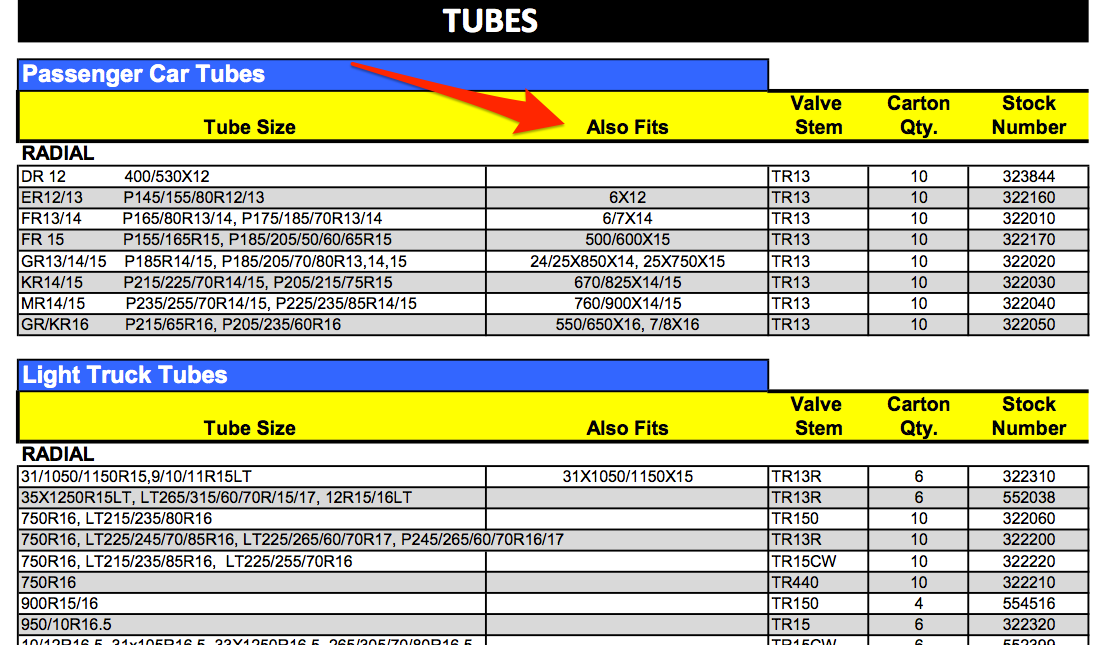
For most of us, it's about finding the correct replacement. It's about grabbing that old tube, squinting at the faded numbers, and trying to find its identical twin. Or, heaven forbid, admitting you don't know and having to ask someone who actually does.
And there's a certain charm in that, isn't there? The shared helplessness of the average driver facing a wall of rubber. We nod knowingly, point vaguely, and hope for the best.
But here's the thing: understanding the basics makes you feel a little less like a clueless passenger in your own vehicle. It's a tiny victory. A small step for truck owners, a giant leap for your tire maintenance confidence.
What About Different Tube Types?
Beyond the size, you might also encounter terms like "heavy-duty" or "standard." This is where the plot thickens, or rather, the rubber thickens. Heavy-duty tubes are built for, you guessed it, heavier loads and tougher conditions.
Think of it as going from your everyday sneakers to steel-toed boots. Both protect your feet, but one offers a bit more… resilience. Your truck probably appreciates that kind of resilience, especially when it's hauling something substantial.
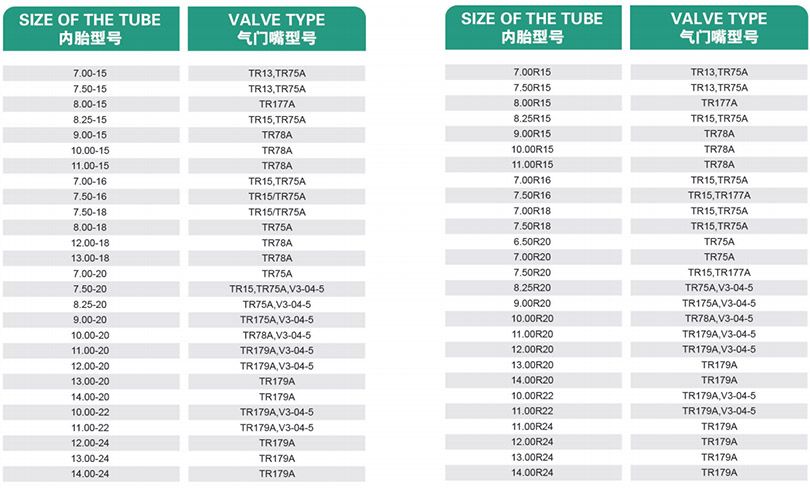
Then there are the valve stems. These are the little nubs you inflate. They come in different lengths and angles. It's like choosing the right spout for your watering can. Too short, and you're struggling. Too long, and you might be tripping over it. You want that perfect fit for easy air access.

Sometimes, you'll see tubes described by the tire size they fit directly, like "for 11R22.5 tires." This is often the easiest way to go. They've done the decoding for you! It's like getting a pre-assembled IKEA furniture piece. Glorious!
The "It Fits!" Moment
The ultimate goal, of course, is the satisfying "thwump" as a properly sized inner tube slides into its designated home. The smooth, even inflation. The happy sigh of a tire that's finally found its perfect rubbery embrace.
It's not about memorizing a dictionary of tire dimensions. It's about knowing enough to get the job done. To avoid the flat tire frustration that can derail your entire day. Or your entire hauling operation.
So, next time you're faced with a fleet of inner tubes, don't panic. Remember the wheel diameter is your best friend. The tire size is your trusty sidekick. And the goal is simply a happy, inflated union between rubber and wheel.
And if all else fails? Well, there's always the option of finding a friendly face at the tire shop who speaks fluent "rubber lingo." We've all been there, and there's no shame in seeking a little expert guidance. After all, life's too short to wrestle with a poorly fitting inner tube.